


 34
34 
Incoterms is the short form for International Commercial terms. These terms relates to the sales contract and are used worldwide. INCOTERMS were first introduced in 1936 by International chamber of Commerce (ICC). These Incoterms were revised several times, latest being Incoterms 2010.
Why do we need INCOTERMS ?
A cargo may move several days before it arrives at its destination. Even though shipping is safer these days, many cargoes still do not reach their destination or reach in bad shape. And when that happens, one should know who had the title of the goods lost. For that reason, It is important for buyer and seller to pre-define the responsibilities and obligations for transport of the goods. INCOTERMS are all the possible ways of distributing responsibilities and obligations between two parties.
These responsibilities and obligations include
- Point of delivery: Incoterms defines the point of delivery of the goods by seller to buyer. The meaning of delivery here is”transfer of risk and responsibility”. So the INCOTERMS defines the point of change of hands (passing of risk) from seller to buyer.
- Transportation Costs: Incoterms defines which party pays for the transportation cost. There may be more than one means of transportation and INCOTERMS defines who pays for which leg of the transportation. In case of sea transport, it also means which party will act as shipper of the cargo.
- Export and import formalities: Incoterms outlines which party arranges for export and import formalities.
- Insurance costs: Incoterms outlines who bears the insurance costs.
There are few important points that requires highlighting before we move any further.
- Arranging for the main transport does not mean the risk is with the arranging party. Seller may arrange for the main transportation even when the consignment is already delivered (that is risk has passed to buyer). In this case the risk has passed to the buyer and seller is just acting as the shipper without any risk to him.
- Arranging for the insurance does not mean that risk is with the party arranging the insurance. In few of the INCOTERMS, seller arranges for insurance to cover buyer’s risk. In these cases, seller is only required to cover minimum risk as defined in the minimum risk clause in respective incoterm. Buyer must take more insurance to cover any extra risk that he wishes to insure against.
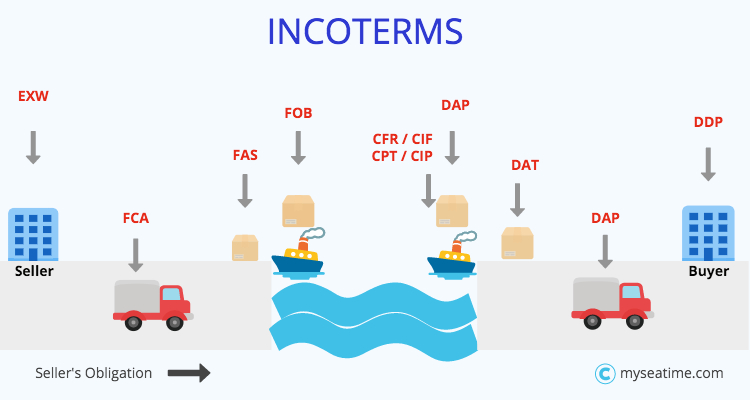
There are total 11 INCOTERMS defined by the ICC . The 11 INCOTERMS are based upon the consideration of least responsibility of the seller to least responsibility of the buyer. For example INCOTERM EXW (ex-work) considers least responsibilty for the seller. Same way INCOTERM DDP (Delievered duty paid) considers least responsibility for the buyer. We can say that all other nine INCOTERMS lies between these two extremes.
Join now to access this article and much more.
Admin has placed this article behind a paywall, making it accessible only with a paid membership, which offers numerous perks:
- Contribute to creating a platform for reading and writing without ads.
- Enjoy all content here, including exclusive articles for members.
- Gain access to all exclusive articles for members.

About Capt Rajeev Jassal


Capt. Rajeev Jassal has sailed for over 24 years mainly on crude oil, product and chemical tankers. He holds MBA in shipping & Logistics degree from London. He has done extensive research on quantitatively measuring Safety culture onboard and safety climate ashore which he believes is the most important element for safer shipping.



Comments (34)