
The Most Comprehensive Yet Simple Guide of Static Electricity
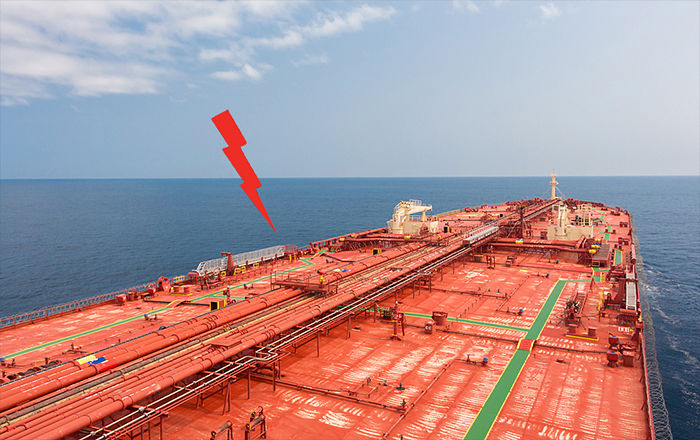
Static electricity is kind of big deal on tankers. If you think it is just a hypothetical term, you would be wrong.
Shipping history has witnessed many incidents related to static electricity.
For example, a cargo tank of the vessel Fiona exploded when surveyor was manually measuring the temperature of the cargo. In the NTSB investigation, the reason for the explosion was found to be static electricity.
There are many other such incidents.
So what exactly is static electricity and why this is so big deal ?
Let us discuss. But before we do that we need to refresh some basic science.
Some basic science
To understand static electricity, we need to refresh some basic science. Knowledge of the basic science would help when we talk about relatively bigger terms.
But don’t worry, this will be just basic science and I won’t bore you with high dose of science.
What are atoms ?
All the matters in this world are made of atoms. Atoms consists of three things. Negatively charged electron, positively charged protons and neutral neutrons.

An atom has equal number of protons and electrons and thus is electrically neutral in nature. Neutrons and protons together makes the nucleus of an atom and electrons are present in the outer shells of an atom. Electrons are very very light (1:1800) as compared to the proton and neutron.
An atom never looses its protons and neutron and so the composition of its nucleus never changes.
But an atom may loose or gain electrons to or from other materials.
Since electrons are so light, these are easily released with small amount of energy. Friction is the most common way in which electrons are released from an atom.

What makes an object a conductor or insulator
I just said that electrons can be easily released from an atom. But this isn’t the case with atoms of all the elements.
Some atoms have the tendency to release electrons easily while others have tendency to accept electrons easily.
A conductor of electricity has loosely bound electrons in the outer shell of its atom. These electrons are looking to escape from the atom. So conductors have the affinity to release the electrons easily.
Non-conductors (Insulators) like plastic have tightly bound electron which do not release easily. Insulators can however accept the electrons.
Do you want to know why some materials have tendency to give up their electrons and other to receive the electrons ? Then you should know terms like electronic configuration of an atom and valency.
If you are interested in these terms you can read about that in detail but for the time being let us stick to our topic.
So if we rub a conductor and inductor together, some of the electrons would move from conductor to the inductor.
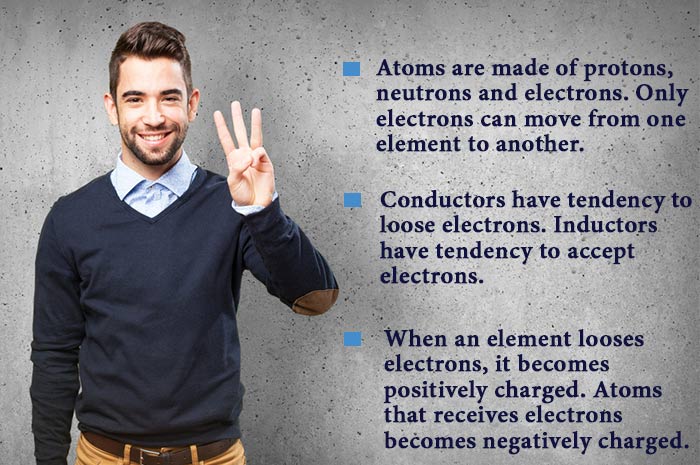
So let us summarise what I have said so far in these three points.
What is electricity
Electricity is flow of charge. Electron is the carrier of the charge because it carries a negative charge. If we can free an electron from an atom and force it to move, we have created the electricity.
What is static electricity
When two dissimilar materials are rubbed together, one may give up its electrons and other may receive these electrons.
The material that gives up electrons becomes positively charged. And the one that receives electrons becomes negatively charged.
So what would happen when two objects, one positively and other negatively charged come together ? The extra electrons from negatively charged particle would move to the positively charged material. This is because of nature of equilibrium. This flow of electrons (charge) is called static electricity.
This is a form of electricity because as I said the electricity is flow of charge.
Still not clear what static electricity is, watch this wonderful video.
Three stages of static electricity
Let us now simplify the process of generation of static electricity
- Charge separation
- Charge accumulation
- Electrostatic discharge

Charge separation
When two different materials come in contact, electron may move from one material to another.
This process is called charge separation and is the first step for static electricity generation.
But for one material to give its electron and other to be able to receive electron, one material need to be conductor while other need to be insulator.

On board tankers charge separation can happen because of
- Friction between the cargo and the pipeline during flow of cargo. In this case the pipeline loose the electron and cargo gains the electron and becomes negatively charged.
- Friction between the cargo and tank top because of splashing during initial stage of loading. Again during splashing, the tank top gives electrons and cargo gains the electrons.
- Steaming: Steam is an insulator. When steam flows through the steam pipe, it attains a negative charge (I hope by this time you would know why ?)
- mixing of two immiscible liquids: When two immiscible liquids are mixed together, charge separation can take place.
You will note that in all these situations of charge separation, one material is a conductor and other is insulator.
Charge accumulation
I said that charge separation requires one insulator and one conductor. It isn’t that charge separation cannot take place in two conductors.
But in two conductors the separated charges recombine and neutralize almost immediately.
When an insulator has attained a negative charge, it takes time for it to release it because of the properties of the insulator. This time is called the relaxation time.
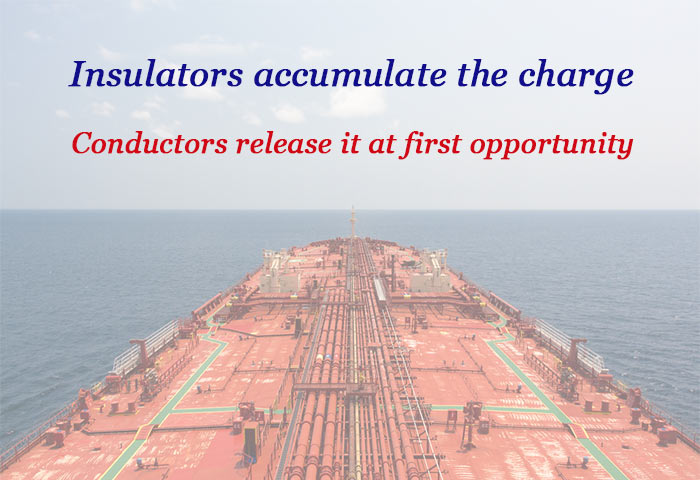
If a material (or cargo) cannot retain a charge for longer period, it will be of no concern to us. This is because, for spark generation there need to be sufficient charge accumulated.
So Charge can only be accumulated on inductors. Any charge accumulated on conductors is released at the first opportunity.
Electrostatic discharge
When two material with opposite charge come in contact, electrons shift from one material to another. This process is called electrostatic discharge.
For this electrostatic discharge to take place, the two charges need to have a minimum distance between them. If two charges are separated by a large distance, these will not meet.
This distance depends upon how strongly the materials are charged. Or in more technical words, how much the voltage difference between two objects is. More the voltage difference, lesser distance is required for electrostatic discharge.
Electrostatic discharge is one thing. Electrostatic discharge to produce a spark is another thing.
For electrostatic discharge to produce a spark, there need to be certain amount of voltage difference between two charges.
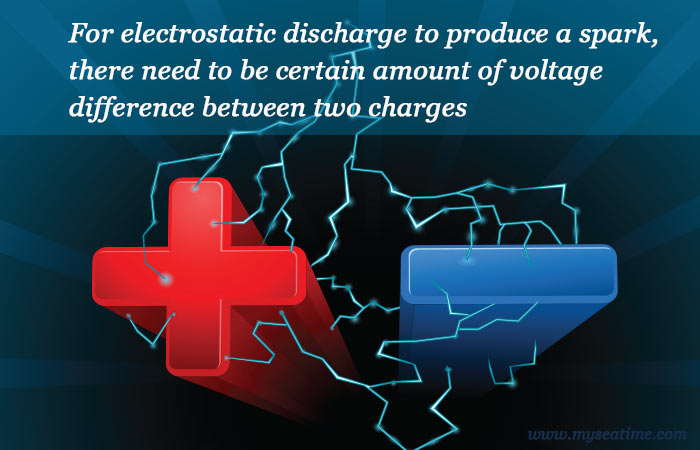
This again highlights the importance of presence of an inductor in this process. Inductors are able to retain a charge and thus will be able to create that voltage difference.
Sources of static electricity on board
While static electricity is present everywhere, it is of concern where flammable vapours may be present. Tankers will have the flammable vapours in the cargo tanks and so static electricity present a major hazard on tankers.
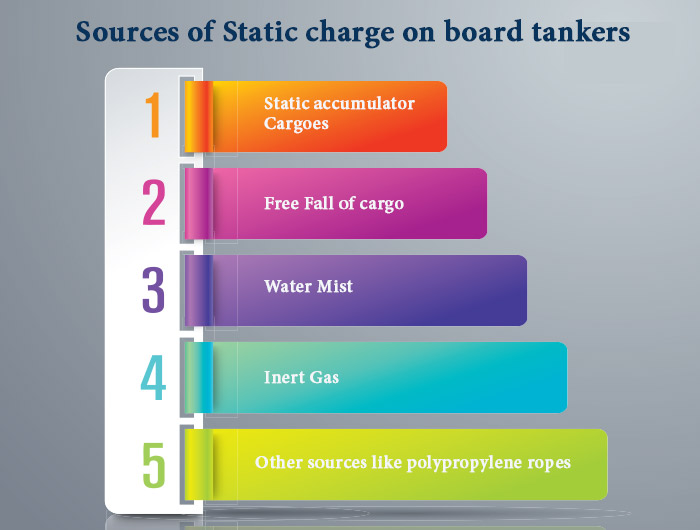
Let us discuss what are the sources of static electricity on tankers.
i) Static accumulator cargoes
Now if I was clear on what I said so far, you would know two things.
First, that only insulators can accumulate the electric charge.
Second, there has to be charge build up for the spark to take place during electrostatic discharge. Conductors cannot retain the charge and hence will not be the main reason to produce spark.
Insulator has the tendency to hold the charge and are the reason for the spark during electrostatic discharge.
Now the cargoes that are not good conductor of electricity would be able to hold the charge for longer period of time. These cargoes possess the hazard of static electricity.
These cargoes are called static accumulators.
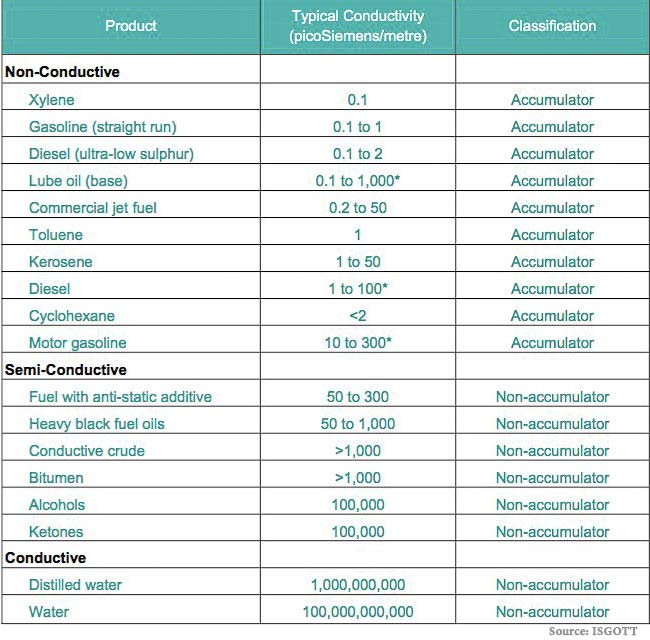
ISGOTT has assigned a number to define static accumulator cargoes. As per ISGOTT, these are the cargoes that have conductivity of less than 50 picoSiemens/metre (pS/m).
ii) Free fall in the tank
If a cargo or ballast is loaded from the top in such a way of free fall into the tank, the cargo (or ballast) will splash. This produces a mist of electrically charged droplets in the ullage space of the tank.
To avoid the explosion, ISGOTT does not allow loading on top for static accumulator cargoes.
iii) Water Mist
Like free fall in the tank, water jet from the tank cleaning machines during tank cleaning also generate mist of electrically charged droplets.
iv) Inert gas
Inert gas can carry the electrically charged small particle with it. These particles can be carried into the tank along with the inert gas in to the tank.
v) Other sources
There can be number of other sources on board for static charges generation. And it is not possible to check if static charge exists or not. The best possible way is that whenever in doubt, assume static charge exists.
Precaution against static electricity
Whatever the reason of static electricity generation is, the more important thing is not to allow the explosion.
Even if the electrostatic discharge results in a spark generation, two more things need to be present for the explosion to occur
- Flammable mixture which can be ignited
- air to support the combustion
If the tanks are in inert condition, there are no specific precautions required for static electricity. This is because there is no oxygen inside the tank to support combustion.
Let us say tanks are not in inert condition and vessel is loading the static accumulator cargo. The flammable mixture and oxygen would be present inside the tank.
To avoid explosion due to static electricity, we need to take steps to
- minimise the charge separation and charge accumulation
- Avoid the electrostatic discharge
Let us see how we can achieve that
Minimising the charge separation and charge accumulation
I have already described how charge separation take place. By friction between two dissimilar material or by mixing of two immiscible liquids among many. If we understand the reason for static charge generation, we would understand the steps required to minimise these.
Linear velocity restriction
When a static accumulator cargo flows through the pipeline, the pipeline loose some of its electrons. The cargo gains these electrons and becomes negatively charged.
This cargo when enters the empty tank, it splashes. This again increases the static charge generation.
To avoid this static charge generation, we need to reduce the friction between the cargo and the pipeline. Also we need to reduce the splashing of the cargo in the tank. This can only be achieved by reducing the rate of flow.
ISGOTT requires that for loading static accumulator cargoes, we must restrict the linear velocity to
- 1 m/s until the cargo is loaded to a level where there is no splashing during loading. This is generally possible when filling pipes and all other structures at the tank bottom has been submerged to twice the filling pipe diameter.
- After all the splashing has stopped, linear velocity can be increased to maximum 7 m/s.
Calculating the maximum loading rate as per these linear velocities is not that difficult. Here is the calculation for loading rate through 10 inch pipe with linear velocity of 1 m/s.
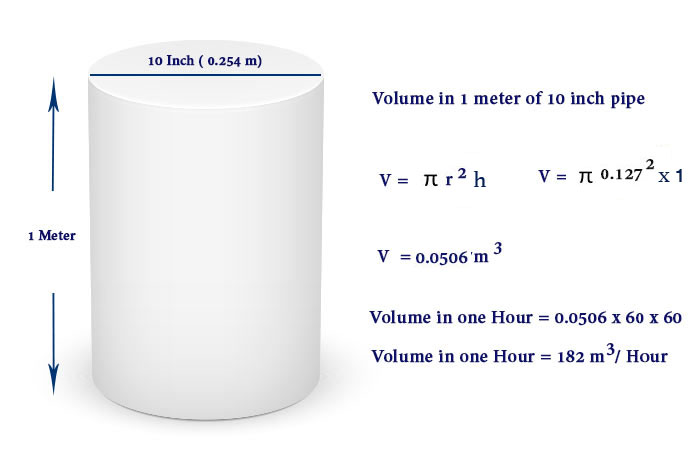
The maximum loading rate for other size of pipeline diameter can be calculated in similar way
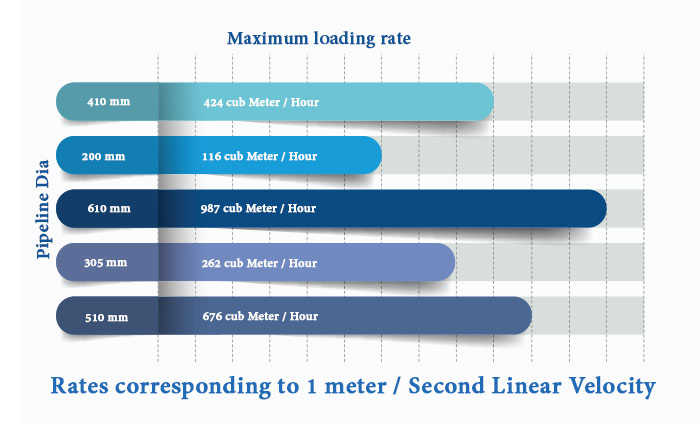
When loading static accumulator cargoes, we must not increase the loading rate as per these linear velocities.
Avoiding free fall of the cargo in the tank
Free fall of the cargo from top of the tank causes splashing and thus static charge generation. So far as possible, we should not allow the free fall of the cargo into the tank.
In case of static accumulator cargoes, it is a must to load only through the bottom line unless the tanks are in inert condition.
Controlling the inert gas or air in the tank
The inert gas can carry some of the charged particles along with it. Introducing the inert gas in a tank that is already inert is of no danger.
But inerting the tank that is not inert and has flammable vapours can be dangerous because of static charge accumulation.
In this case controlling the rate of inert gas entering in the tank will be the best solution.
Bonding
Bonding of all equipments ensures that there is no charge separation.
Antistatic additives
Adding some chemicals can increase the conductivity of the cargo. If these chemicals are added to the static accumulator cargoes, these would no longer be static accumulators.
Irrespective of whether the antistatic additives are added or not, sip staff should treat these cargoes as static accumulator.
Avoiding the electrostatic discharge
We have done our best to reduce the static charge generation in the tank. But can we measure the charge in the tank ? No.
Even if we have minimised static charge generation in the tank, we can never be sure that spark will not generate if we introduce a metal object in the tank.
So taking the precautions for preventing electrostatic discharge is as important as controlling the static charge generation.
If we have loaded a conductive cargo, the charge accumulated will automatically be discharged through the tank sides. This is because
- Tank sides are earthed as these are directly in touch with the seawater.
- Conductive Materials (and cargoes) have the tendency to discharge the accumulated charge immediately.
This means that even if the charge is accumulated while loading these cargoes, it immediately gets discharged.
But this is not the case with cargoes that are poor conductor of electricity (Static accumulator cargoes). It takes some time for these cargoes to discharge the static charge accumulated.
Now what will happen if we
- introduce a non-conductor material in the tank
- introduce a conductor (Metal) in the tank
Non-conductor material will either be negatively charged same as the cargo or will be neutral.
If the this material and the cargo have same polarity of charge, there will not be any exchange of charge and thus no spark.
This is the reason that ISGOTT allows the tapes made of non-conductors for static accumulator cargoes without waiting for relaxation time.
Now if we introduce a metal in the tank, this metal will most likely be positively charged or neutral. When this metal is introduced in the tank containing the static accumulator cargo, electrons will move from the cargo surface to the metal.
This transfer of electrons can result in a spark. So to avoid this spark we need to take few precautions
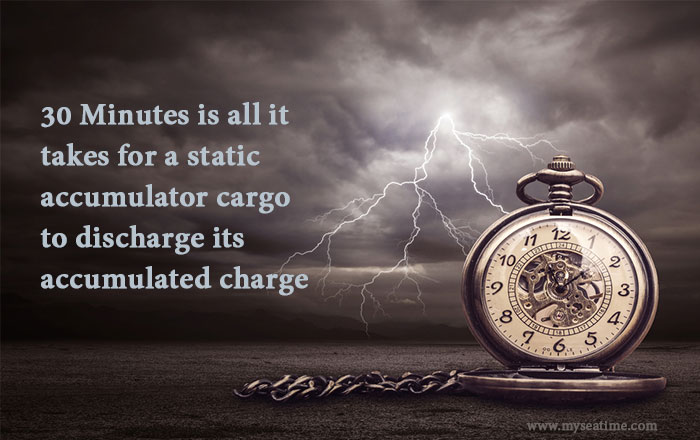
Allow 30 minutes of relaxation time
The charge accumulated on the cargo surface gets discharged through the tank sides which are earthed through the sea water.
But this process take time in case of static accumulator cargoes.
Before introducing any metal object in the tank, we need to allow this relaxation time. As per ISGOTT, we need to allow at least 30 minutes of relaxation time after all the movement of cargo in the tank is complete.
Only after 30 minutes of relaxation time, we can introduce any metal tapes inside the tank.
If you have loaded a static accumulator cargoes, some vetting inspectors would ask for the time sheet at load port to check if 30 minutes of relaxation time was allowed before start of ullaging.
This relaxation time is not required if the sounding pipe extends to full height of the tank and is bonded at the bottom of the tank.
Conclusion
Static electricity is so real. Everyone have felt it at least once in their lifetime. We have touch the door know to get a shock.
We have played a trick to pick piece of paper with a plastic scale. We have seen it and we have felt it.
But after all this if we refuse to accept it as a risk on tankers, we are fooling ourself. Static electricity is a real risk on tankers and all the places where a spark can cause an explosion.
Knowledge of how static electricity is generated can help in taking steps to mitigate the risk of explosion due to static electricity.
A Basic and Simple Guide of Civil Liability Convention 92
Let me tell you a story.
A ship loaded a cargo of crude oil from Mina-Al-Ahmadi and was bound for Wales. On the way, it got aground outside territorial waters of any country.
119000 T of crude oil spilled and found its way on the coastal waters of two countries, UK and France. Millions of Dollars were spent for clean up operation.
Apart from the money required for clean up operation, there were number of people who lost their source of income.
For example, fishermen could no more go for fishing. People who earn their living from tourism, were also hit by this incident.
Apart from all this there is damage to the ecology which no one can measure in monetary values.
Now who would pay for all these damages ?
Ship owners ? The incident did not take place in the territorial waters of any country. Even if it did take place, the local laws for these cases are never so detailed to easily recover the money from ship owners.
Now even if ship owner had to pay the money, the money may be so big that a ship owner could loose entire business because of one incident.
What is the solution then ? CLC convention aims to bring a solution to this situation.
In fact the story I told you above is the real story of the vessel “Torrey Canyon”.
CLC convention was the result of the incident of grounding and oil pollution of the vessel “Torrey Canyon“.
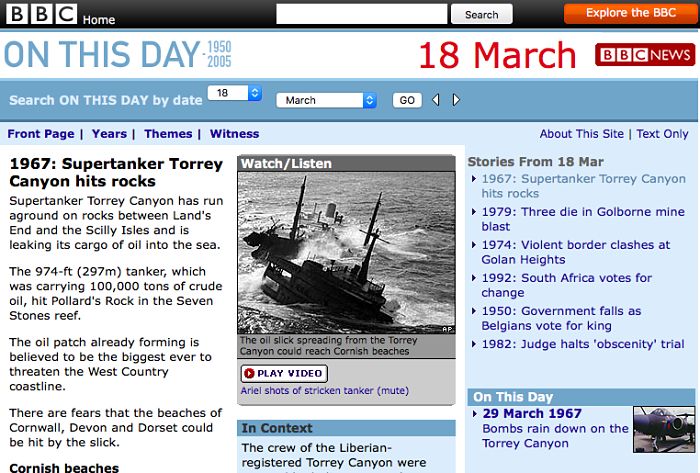
And there have been many incidents of oil pollution before and after Torrey Canyon.
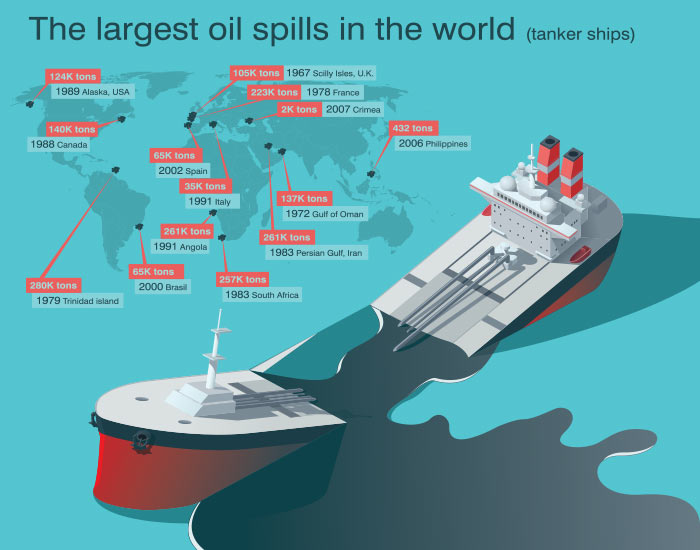
Let us see how CLC convention is helping to solve the problem of paying for the damages and at the same time not burdening the ship owners.
CLC convention
CLC convention first came into existence in 1969 and was called CLC 69. This convention was later amended in 1992. CLC 92 was amended in the year 2000 to increase the amount of compensation. We will discuss the latest amended convention i.e. amended CLC 1992.
CLC is the short form for “International Convention on Civil Liability for Oil Pollution Damage”.
As the name suggests, it is the convention that determines the liability of the parties in case of oil pollution damages.
CLC convention can be summarised in four points
- Ship owner is liable for the oil spills originating from his ship
- There are very few exceptions to this liability to the ship owners in case of oil spills from their ships
- There is a maximum limit of liability set out in CLC according to the tonnage of the ship. This limit will not be applicable if owner is at fault
- It is compulsory for the ship owners to take insurance to cover his liability in case of oil pollution from his ships
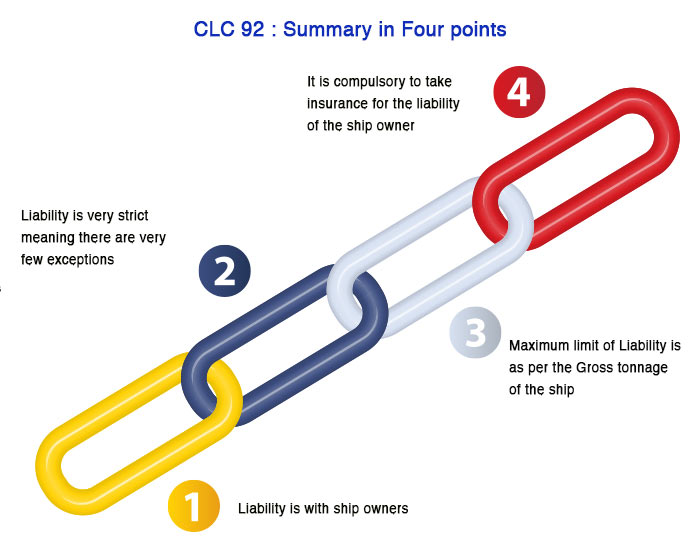
These four points summarises the whole CLC 92 convention in brief. Let us now discuss this convention in little detail.
1. When would CLC convention apply ?
The applicability of any convention is the most important thing. After all if a convention is not applicable in some situation then all other articles of the convention would not apply.
This is the reason that the article detailing the application of a convention is one of the initial article of any convention.
So let us see when and how CLC convention apply.
Type of oil
First thing we should know that CLC deals with oil pollution only. Which kind of oils ? It deals with pollutions from persistant oil only.
Persistent oils, as the name suggest are the one that persists longer in the environment. Whereas Non-persistent oils either evaporate easily or disperse easily.
The pollution from persistant oil is more serious when compared to non-persistant oils. Persistant oils require more resources and money for clean up operation.
So the CLC convention applies to the pollution of persistent oils.
For example in July 2011, an abandoned oil tanker was found an aground in Mumbai’s Juhu beach. The vessel was abandoned near to Oman. The ship had drifted and got aground in Mumbai’s Juhu beach.
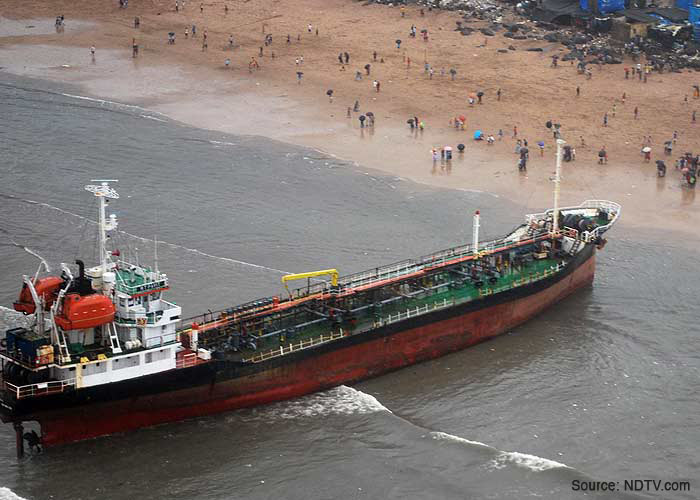
Indian authorities filed a claim of 1.8 Millions US dollars for the various works like towage and removal of oil.
The claim was rejected because the oil carried by the ship during previous voyage was MGO which is non-persistant oil.
Area of application
The area to which CLC convention would apply is covered under annex II of the convention. The CLC convention applies to any pollution incident that occurred either in the
- Territory and Territorial waters of a contracting state. In simple words territorials waters is the area of 12 NM rasius from the baseline of the contracting state.
- Exclusive economic zone (EEZ) of the contracting state. In simple words EEZ is the area of 200NM radius from the baseline of the contracting state.
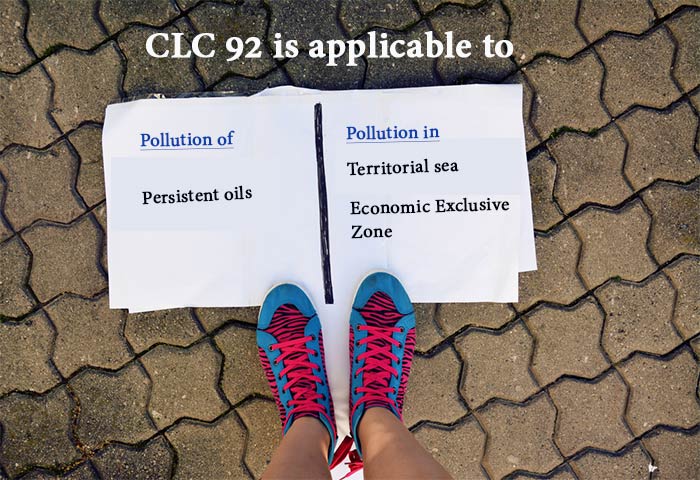
The CLC 92 does not cover the pollution incidents in the high seas. High seas pollutions were not included in the CLC convention because the pollution in high seas were considered to cause lesser damages.
Damages because of pollution incident
Even though the CLC convention deals with the pollution incidents, damage can be much more than the pollution itself.
The compensation and liability of the owner of the polluting ship does not limit to the pollution alone.
Damages include physical injury, psychological conditions and loss of income resulting from the pollution. CLC convention covers the expenses for all of these damages.
2. Who need to pay in case of pollution incident
Oil pollution incidents are costly affairs. It requires great amount of money to clean oil spills and somebody need to pay for it.
As I said, one of the principle of the CLC convention is that ship owner is liable for pollutions from their ships. And as such, in most of the cases it would be ship owner who need to pay for it.
In any case, as per article III, para 4, no claim can be made against
- the servants or agents of the owners or crew members. If you read the footer of the emails sent by the ship management employees, it would read “as agents to the owners only”. This is to stress upon the point that they are acting on behalf of owners as agents.
- pilot, charterers, a person performing salvage or a person taking preventive actions
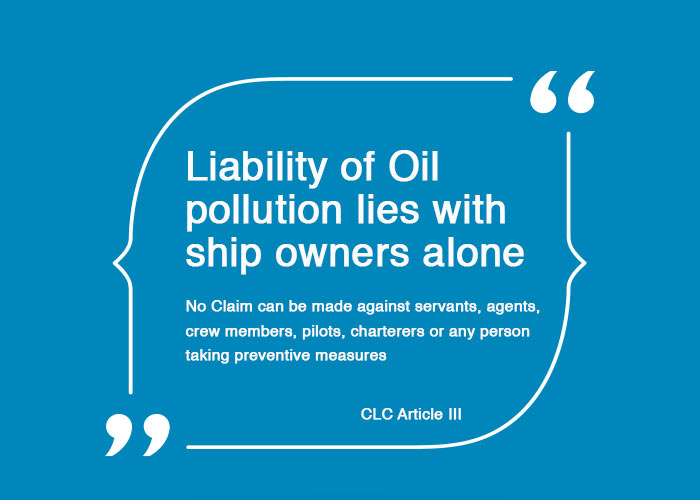
So it does not matter if the ship is on bareboat charter or is being handled by a ship management company, the claim can only be made against the owner of the ship.
3. How much ship owner need to pay in case of a pollution incident
Let us talk about the money part of the CLC convention. We can talk about the money part by talking about how much ship owner would pay in case of a pollution incident.
This can be covered in 3 situations
1. Ship owners need not pay anything if he proves that
- Pollution resulted from the act of war or natural phenomenon of exceptional, inevitable or irresistible nature. One example of natural phenomenon could include the pollution if a tanker gets aground because of tsunami.
- Pollution resulted because a third party delibrately wanted to cause the damage to the ship
- Pollution resulted because of negligence of government or other authority who failed to maintain the lights or other navigational aid.
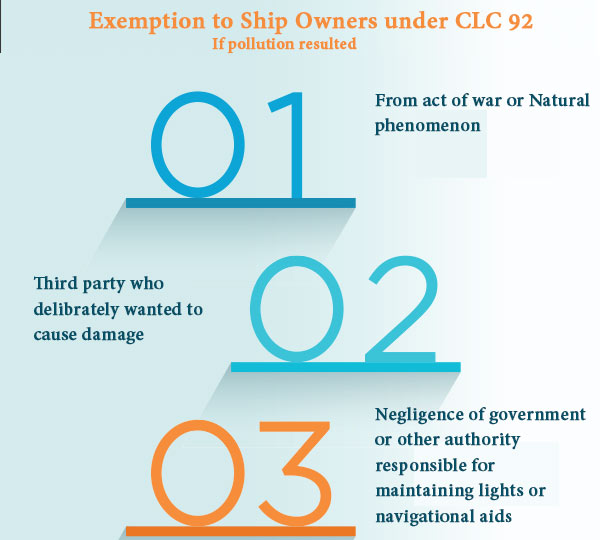
While the first point may not be difficult to prove, other two points are more difficult to prove. This means that ship owners have hardly any exception to the liability. In almost all the cases of oil pollution, ship owners need to pay the money.
2. Ship owner need to pay the full amount whatever damages are claimed by various claimants if it is proved that
- damages were the result of acts of ship owner committed with the intent to cause this damage
- damages were because of the acts of ship owners who knew that his acts would result in these damages
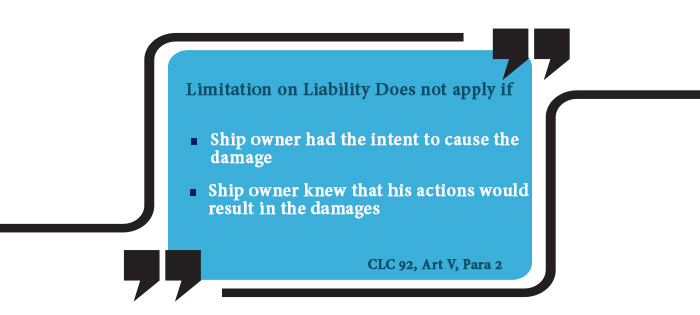
For example if the ship was trading with an expired trading certificate, ship owner would need to pay for the all the damages.
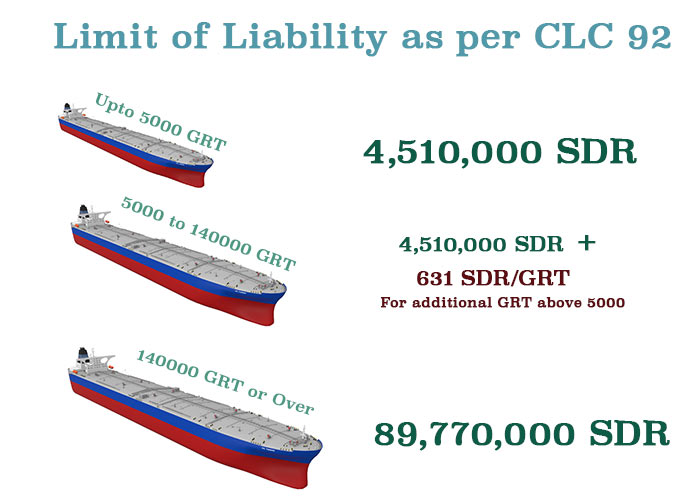
3. If a ship owner do not fall in above two categories, his liability in any one pollution incident would be limited to
- 4,510,000 SDR for vessels up to 5000 GRT
- For vessels over 5000 GRT, the maximum liability will be 4,510,000 SDR + 631 SDR per additional GRT above 5000 GRT. So for a vessel with 10000 GRT, maximum liability would be SDR 7,665,000 (4,510,000 + 631 x 5000)
- Maximum liability in any case will not be more than SDR 89,770,000
Question is why limit the liability of the ship owners ? For example if the vessel got aground because ship’s crew did not keep a good watch and damages are in billions, why owners is required to pay only fraction of it ?
The answer lies in the principle of shipping business. If there is no limit of liability on ship owner, they need to pay for more insurance. Because of this, they would charge more freight and thus oil price would be higher.
Limit on ship owner’s liability brings a balance between paying for the damages and not over-burdening the ship owners.
4. What a ship owner need to do to ensure that his ships are not arrested by the claimant
In the case of Torrey canyon incident, the claimant arrested a sister ship of the owners in Singapore. The ship could only be released upon payment of USD 3 millions to the claimants.
This was the times before the CLC convention.
But to take the advantage of CLC convention and to ensure that his ships are not arrested after a pollution incident, a ship owner need to constitute a fund equal to his liability as per CLC convention.
The idea here is that, after the investigation if ship owner is liable to pay the amount equal to his limit of liability, the claimant need not be chasing the ship owners for money.
The money should already be in the possession of the court.
The fund can be constituted by
- depositing the sum or
- producing the bank gauranttee or
- any other way acceptable to the contracting state where fund need to be constituted.
5. Where the action for compensation can be brought
Again in the case of Torrey Canyon, the pollution resulted in the territorial waters of UK and France. This could be very common situation in the present scenario too.
So where the action for compensation can be brought against the ship owner ?
As per article IX of CLC 92, action can be brought in any of the country that was affected by the pollution.
Article X also states that the judgment given by the court in which action is brought will have to be recognised by other states.
6. Insurance required as per CLC 92
As per article VII of CLC 92, all ships that carry more than 2000 T of oil as cargo need to maintain insurance equal to the ship owner’s liability as per CLC 92.
This certificate is issued by the flag of the ship after the ship owner provides proof of the insurance to the flag.
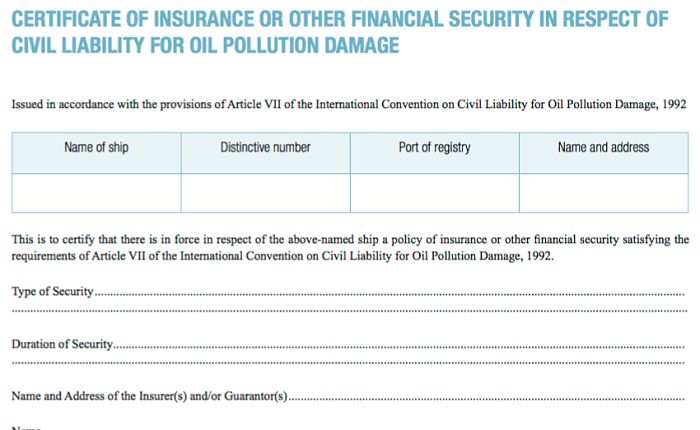
The insurance cover (proof of insurance) is called the blue card. This blue card need to be provided to the flag along with the application for issuance of this certificate.
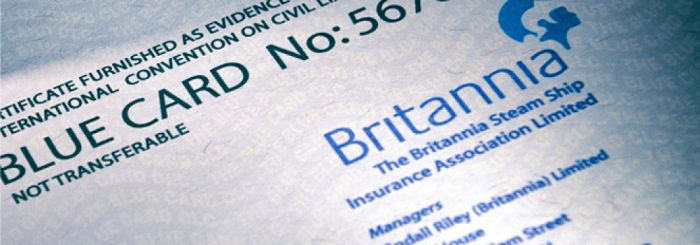
The certificate is usually valid for the period of one year from 20th of February of each year.
The CLC certificate also plays one important benefit both for ship owners and the claimant. The claim for the pollution damage can be brought directly against the insurer or person providing the financial security.
Conclusion
Each year close to 11000 Billion ton-mile of oil is transported through sea. Even though oil spill incidents have reduced drastically in recent year, shipping industry need to be ready for all th eventualities.
CLC convention is one such step. It not only defines the liability in case of oil pollution incident but also limits this liability to encourage the oil trade.
The question you may ask is who would pay for the amount spent over and above the ship owner’s liability. This amount is paid under the Fund convention which I will cover in future post.
4 Ship Handling Tricks To Handle Ships in Better Way
The mark of a great ship handler is never getting into situations that require great ship handling.
I am so much in love with this quote by Ernest King.
Ship handling is both a science and an art. Science because it requires knowledge of various forces acting on the ship. Art because it requires the skills of an experienced navigator to use these forces in his favour.
We may learn the science part from the various ship handling courses. But the art can only be learned from experience.
Art has many forms. Art of ship handling also has many forms. Each navigator handles the ship in his own way and so far it does not go against the general good practices, each one of it is correct.
So how can someone become a good ship handler. Or if I may say so, how can someone not be in a situation that would require great ship handling ?
It can only be achieved by knowledge. It can only be achieved by learning both, the science and art of ship handling.
I value the importance of all the terms related to ship handling. But when it comes to understanding these terms, I always prefer it to be in layman’s words.
Today, let us talk ship handling in layman’s language.
Talking in the same breath, let me ask a question. Why exactly one need to learn ship handling ? What are the things one would wish to use the ship handling for ?
I always asked these questions to myself while learning ship handling. I found that after learning ship handling, I would like to be able to
- move the ship in any direction I want (Like moving the ship sideways without changing the heading)
- Stop the ship wherever and whenever I want (something like applying a brake)
- Reduce the speed in an instant (Like what I can do with my car)
- Turn the ship at its position (like how an experienced bikers do)
In this post, I will share few of the tricks (art and science) of ship handling so that you are able to do all of this.
Let us dive in.
1. How to move a ship in the direction you want
Whenever I studied ship handling, I always asked this question to myself.
Can I move a ship in any direction while keeping the same heading ? If I can, what else do I need to know about ship handling ?
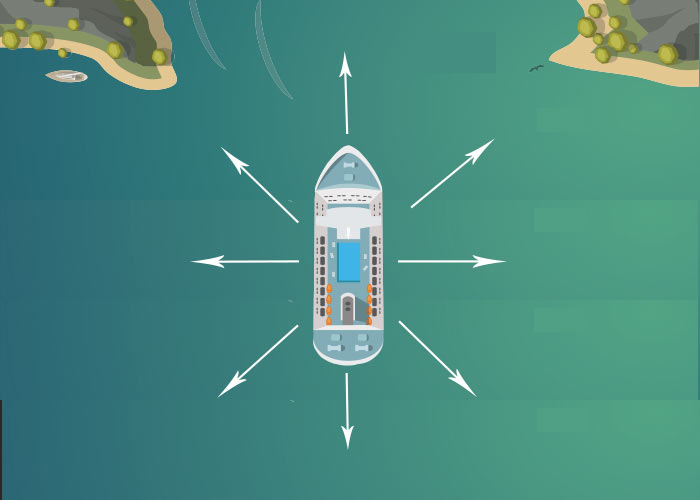
After all Ship handling means making the ship move in the direction we want and when we want.
So do you want to know how we can move the ship in any of these direction.
Before we proceed, I assume you know how the resultant of two or more forces acting in different direction works.
If you want to know more on it, you can read it here or here.
Or else you can watch this video.
In short you should know about parallelogram of forces. It states that
If two forces whose lines of action meet at a point are represented in magnitude and direction by the sides of a parallelogram drawn from one of its angular points, their resultant is represented in magnitude and direction by the diagonal drawn from that angular point.
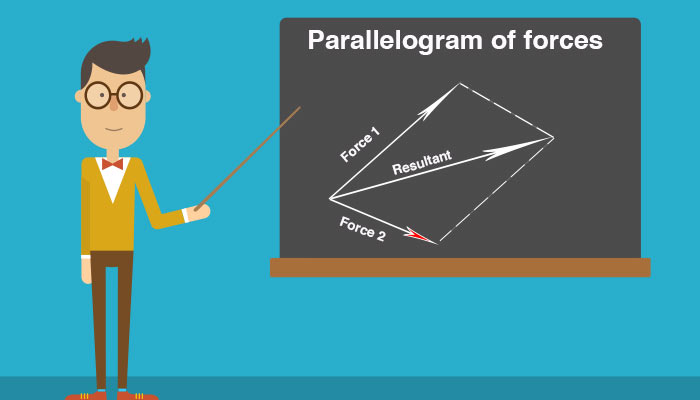
So what all forces a ship can experience while she is at sea ?
Current and Wind are two of the most common forces. We should take these to our advantage. But there is one force that we can use to our advantage. That is the force of resistance from the water itself.
Say the ship is moving at dead slow ahead. And I turn the rudder on the port side. Will the ship start turning right away ? No it won’t. Because depending upon the under water area of the hull, there is huge resistance offered from the water.
The water acts as something like a wall to the underwater hull.
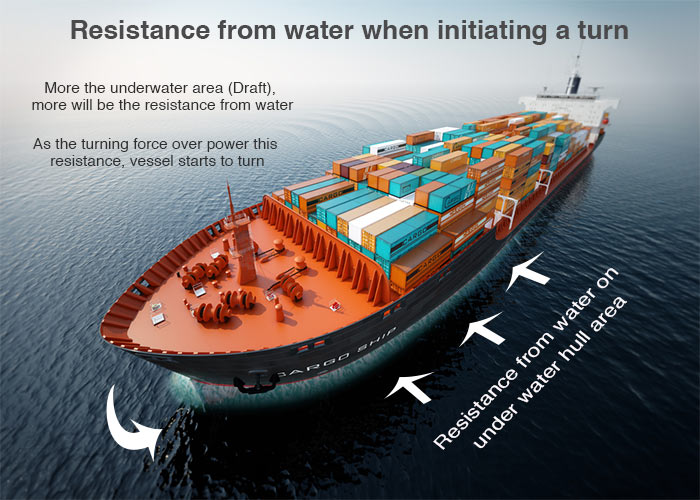
The hull need to over power this resistance for it to start turning. This is also the reason why loaded ship start turning late when we give rudder order.
But how can we use this resistance to our advantage ? Using this water resistance, we can actually move the vessel in any direction we want.
Let us see it with an example.
Let us say we want to move the ship towards the berth while keeping the heading of the vessel parallel to the berth.
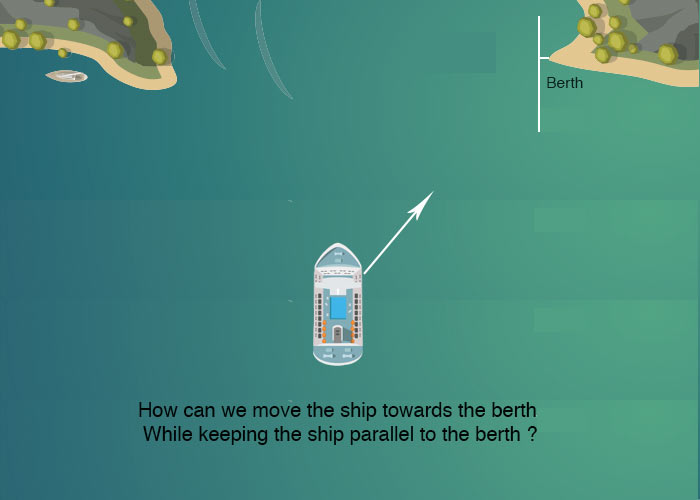
For berthing in this situation, one school of thought teaches us to berth in this way.
For berthing to port side alongside, head to the berth with an angle of around 20 deg with the berth. Few meters from the berth, go astern. For right hand, fixed pitch propeller, this will turn the ship slightly to starboard because of transverse thrust. This will make the ship parallel to the berth.
This method have some dangers associated with it. For example transverse thrust may not be as much as you expected.
What if We use the forward headway vector and resistance force of water to have a resultant vector that will take the ship towards the berth. This is how it is done.
Maintain a low forward speed (say around 3 knots). Now put the rudder on 10 Deg port. While the rudder is on 10 Deg port, vessel would experience the resistance on the underwater hull area.
This resistance will try to push the vessel on the other side. Keep an eye on the rate of turn indicator as we will not allow the ship to turn.
Before vessel starts to turn, put the rudder to midship. The resultant of vessel’s headway and the resistance we created will make the ship move towards the berth.
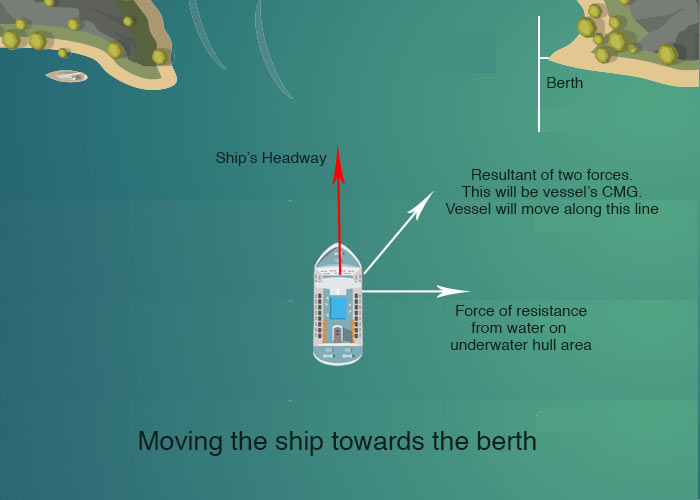
We can adjust these two vectors to move the ship in a direction we want. For example we can reduce the speed if we want to have the resultant more toward abeam. Or we can increase the speed a bit to have the resultant vector more forward of beam.
Or we can also increase or decrease the resistance force by varying the rudder order (say between 5 deg-15 Deg).
Still do not believe that the we can use the water resistance to our advantage ? Then see this image taken during actual berthing of the vessel.
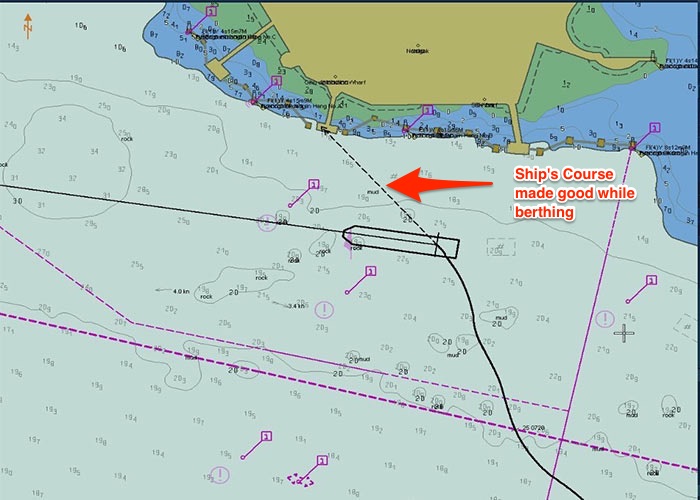
By varying the strength of these two forces, we can move the ship in any direction we want.
Apart from this, there are number of ways we can use this resistance in our favour.
For example, let us say we are waiting for the pilot to board in a busy traffic area with engine stopped. If the vessel is drifting towards fishing vessels or other anchored vessels, what can we do to reduce this drift.
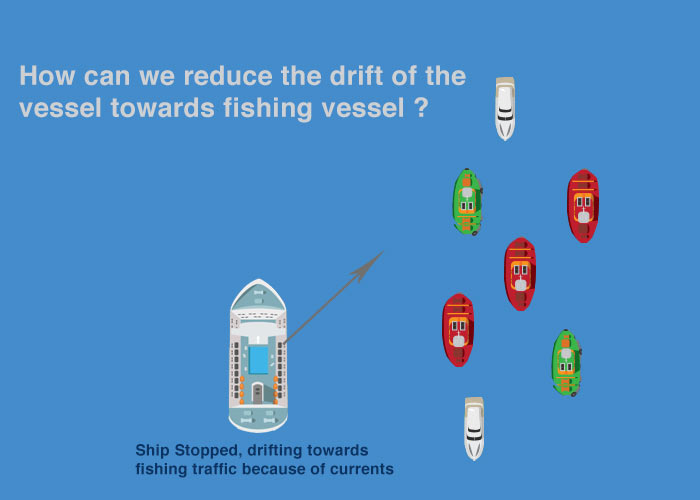
Again we can use the engine to dead slow ahead and put the rudder on hard to starboard. Before the vessel start to turn, stop the engine and rudder amidship. The Direction of vessel’s drift will change towards the vessel’s heading.
We can use this resistance in many ways, only limitation being your imagination.
2. Using anchor to stop the ship in emergency
Do you think we should keep anchor party standby forward when the vessel is moving at full manoeuvring ahead in a river ?
I mean, what if they are stand by in the accommodation area with walkie talkie ? In emergency, by the time we reduce the speed to the level where we can drop anchor, the crew would definitely reach forward.
This thought is based upon the assumption that even in emergency we cannot drop anchor when the ship moving at full ahead. Do you agree ?
If you agree, you would be wrong. We can drop the anchor in emergency even when ship is moving at full ahead. Only thing is we need to follow the right steps in doing so.
Want to know how we can achieve that ?
Imagine that vessel is moving at 12 knots in a river with engine full ahead. For some reason we need to stop the vessel immediately.
Here is how we can do it.
- Put the rudder hard over to the side you can turn the ship.
- Drop the anchor to the side of the turn. So if you are turning to starboard, drop starboard anchor. Before we drop anchor we must ensure that we are dropping the anchor in an area of suitable anchoring depths.
Turning would reduce the vessel’s speed. As the speed of the ship reduces, keep on going down on the engine movement too.
For example, let us say half ahead speed is 10 Knots and slow ahead speed is 7 knots.
- When we have dropped the anchor and start turning, bring the engine to half ahead.
- When the speed is just over 10 knots (say 11 knots), bring the engine to slow ahead.
- When the speed is just over 7 knots (say 8 knots), bring the engine to dead slow ahead.
- Whenever you can, stop the engine.
We need to be careful with stopping the engine as when we stop the engine, vessel’s rate of turn would reduce and anchor chain might get stressed.
While we have initiated this procedure, the instructions to the anchor party would be to keep pay out the cable as the weight comes. Their goal would be to not to stress the cable too much and hold the anchor until weight comes on the cable.
This procedure allows the vessel to stop with the help of three things
- Turning reduces the speed
- Gradual reduction of Engine movement from full ahead to stopping the engine reduces the speed
- Controlled weight on the anchor reduces the vessel’s speed
But the question is, won’t the anchor damage in this case ? The answer would be No.
When the vessel starts to turn, it will cover distance equal to head reach in forward direction and side reach in athwartship direction.
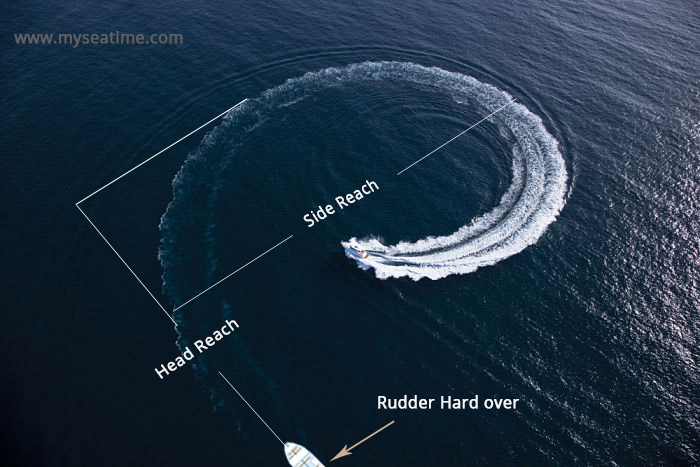
In fact because of controlled load on the anchor, its maximum head reach and side reach will reduce.
The length of the anchor chain would be sufficient to stretch to this distance. In fact you may not need to pay the entire length of the anchor chain.
If you get a chance, try this exercise on the simulator to believe it.
3. Rudder Cycling to reduce the ship speed
Imagine we are moving at some speed to approach a port and suddenly we are asked to wait for the pilot. This is a common situation Masters are subjected to at many ports.
We wish we had some kind of brakes on the ship, which we could just press to stop the ship or reduce the speed. But we do not have brakes on ship, right ?
But wait, who said ship does not have brakes to stop the ship ? Rudder cycling is most effective way to stop a ship without changing the heading.
It uses the resistance of water on underwater hull area to reduce the speed of the ship.
Want to know how it is done ? Considering port side is safer than starboard side
- Put the rudder on hard to port side
- When the ship has turned to 20 deg from the original course, put the telegraph to half ahead
- When the ship’s heading is 40 degrees from the original course, put the rudder on hard to starboard
- When the ship’s heading just starts to turn to starboard side, make the engines on slow ahead
- When the ship’s heading has returned to original course, put the rudder to hard to port
- When the ship just starts to turn to port, put the engine to dead slow ahead
- When the ship’s heading returned to original course, put the rudder on hard to starboard to check some of the port swing.
- When the ship still has some rate of turn to port, put the rudder midship and go full astern on the engines to stop the ship
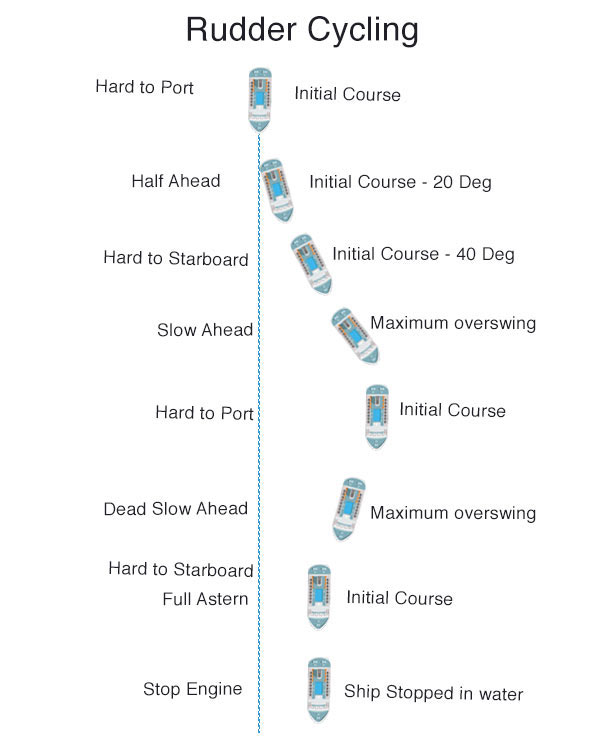
This will stop the ship at considerable lesser distance. But we do not need to use rudder cycling only to stop the ship. We can also use the rudder cycling when we need to reduce the speed of the ship.
4. Turning the ship at its position
Can you think of a situation when we need to turn the ship at its position ?
We may need to turn the ship near to the berth when we arrive at the berth from down river direction and we need to berth facing upriver direction.
But turning in this situation may not be that tricky as we can use the tugs to turn the vessel.
Now consider a situation where you have anchored in a very congested anchorage and you need to pick up the anchor and turn the vessel.
In this situation if you have bow thruster fitted, it is easier to turn the vessel. But how to turn the vessel at its position if you do not have bow thruster.
For right hand fixed pitch propellers, it is always easier to turn the ship on starboard side.
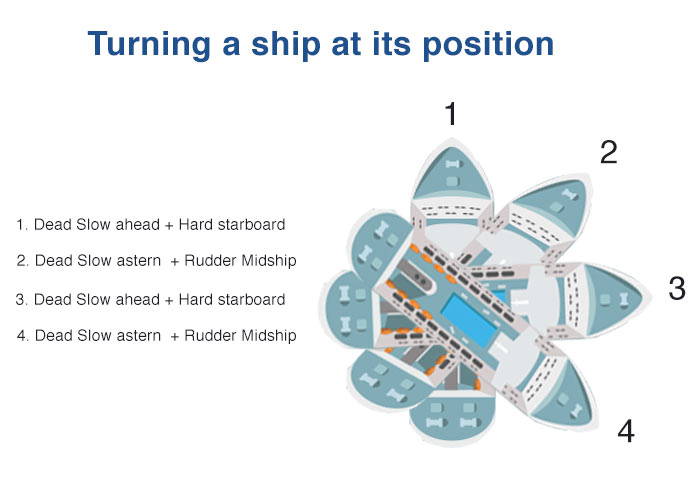
So to turn the ship
- Wheel hard to starboard and give a quick burst ahead on the engines. Ship will start to turn to starboard. Do not gather too much ahead speed. Just about when speed is around 0.5 Knots, stop the engine.
- Wheel amidship, give a quick burst astern on the engine. As the engine goes to stern, the bow will start to move to starboard. This will help the starboard turn as well as reduce the forward speed of the ship.
- As the ship gains some sternway (around 0.5 knots), stop the engine.
- Repeat the above steps and keep the vessel turning to starboard.
Conclusion
Ship handling cannot be learned in few days or few months. Apart from learning the theory of Ship handling, we also need to practice it on board to be master of it.
Ship handling need to be learned right from the time on junior ranks. We need to observe how Masters and pilots handles the ship.
If they ordered the rudder to port 10 deg, why did they do so ? If they used the engine in astern direction, why did they do it now ?
Asking these question and then finding the answers right from the junior ranks can make us a better ship handler.
7 Medicines to Save Lives During Medical Emergencies on Ships
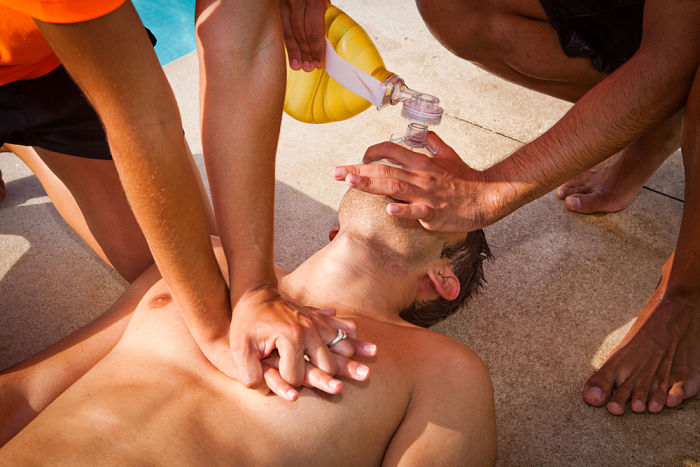
Have you faced any medical emergency on board during your career on board ?
Medical emergencies at sea is the most dreadful thing to imagine. We ain’t no doctors. But we are put into these situations where we need to act like a doctor.
But when we are in these situations, one thing is clear. Seconds save life. Everything need to be early. We need to act fast to save a life.
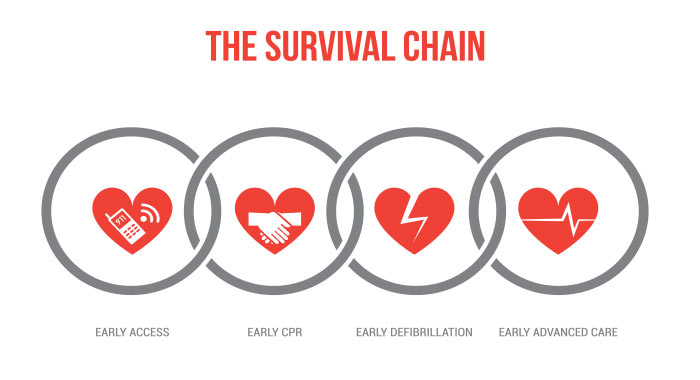
Ease of communication these days have made the radio medical advise easily accessible. But ship’s crew still need knowledge to quickly act on the instructions of radio medical advise.
In this post, I will discuss about 7 life saving medicines on board. It would include some of my personal experiences where in I faced some of the medical emergencies on board as Master of the ship.
I thought it will be worth sharing these experiences.
1. Sorbitrate
It was 1035 Hrs SMT and we were to reach Suape, a port in Brazil at around 1700 Hrs SMT.
I (Master) was in my cabin when I got a call from 2nd engineer that ETO was found unconscious on the poop deck. He also informed that they have already brought ETO to the hospital.
I rushed to the ship’s hospital. Once I reached there, We removed his shoes, socks and rubbed his feet. He was unconscious but breathing normally.
Ideally when a person is breathing but is unconscious, we should put him in “recovery position”. Recovery position helps in keeping the airway of the casualty open which otherwise can choke even because of his own saliva. Recovery position help the casualty to continue breathing normally.
If you do not know how to put a casualty to recovery position, watch this video.
https://www.youtube.com/watch?v=uCDa-AhrjHo
As we were about to put him to recovery position, he regained his conscious. He was not able to speak but his signs and gestures suggested that he was complaining of chest pain.
I rushed to the satellite phone and called CIRM Rome for Radio medical advise. I narrated the entire incident quickly and doctor on the phone suggested to place one Sorbitrate tablet under his tongue.

I came back, asked 2nd officer to get Sorbitrate tablet. I put the tablet under the tongue of ETO who was still complaining of the chest pain by signs alone.
After around 10 minutes, he was talking like nothing happened to him. And finally he narrated the incident.
He was alone working on the boiler panel and he got an electric shock of 440V. He felt dizziness and went to poop deck for fresh air where he collapsed. A crew member spotted him few minutes later.
While we sent him to doctor on arrival port same evening but it was amazing to see what can one tablet do to avert a medical emergency.
Sorbitrate did it in this case. So what exactly Sorbitrate does ?
Sorbitrate relaxes and widens the blood vessels so that blood can flow easily. The condition where something blocks the arteries and thus restricts the flow of blood to heart is called Angina.
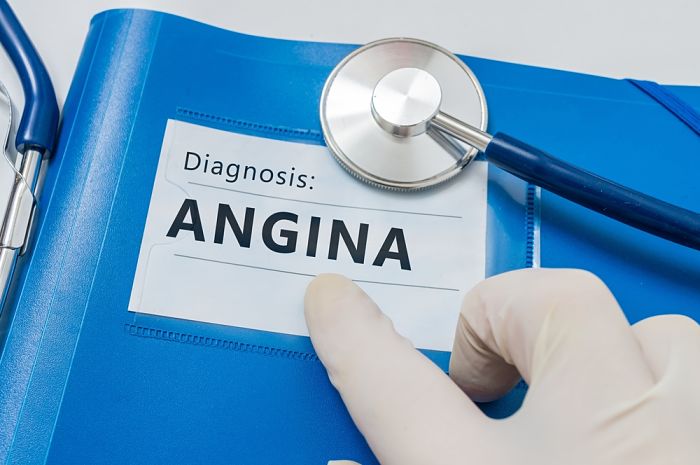
While the ETO in this case may not have Angina but the symptoms were similar to that. Sorbitrate helped to relieve the chest pain.
Needless to say, if you arrive in similar situation, do not (I repeat, Do not) give sorbitrate right away. Seek radio medical advise first.
2. Activated Charcoal
It was a nice Friday evening at around 1730 Hrs ship’s time. I (Master) was on the wheel house when I got a call from chief officer. He informed me that something has happened to Able Seaman.
Without enquiring about the details, I rushed to his cabin. I found he was kind of suffocating. He was holding his stomach and neck alternatively and was trying to speak something but was not able to speak.
It did not look like he was short of breath.
I quickly asked chief officer about work assigned to him in the day time. Chief officer told that he was transferring chemicals (Metal bright) to the new drums.
I suspected that he might have consumed some amount to chemical unintentionally.
I rushed to seek radio medical advise. Along with other details, I told the doctor on the other side that I suspect the crew member has consumed some amount of metal bright chemical (phosphoric acid).
Doctor gave very specific instructions.
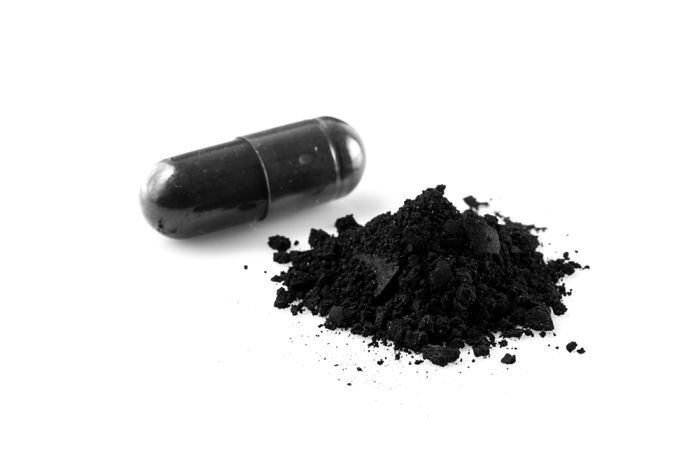
- Dissolve one packet of activated charcoal in cold milk and give it to crew member.
- Report to the doctor exactly after 15 minutes for further instructions
I did exactly that. We made crew member drink activated charcoal mixed in cold milk. I went to quickly send an email to the office and returned back after 2-3 minutes.
To my surprise, the crew member was smiling and narrating what he was feeling earlier.
I called CIRM Rome again to advise the improvement in the health condition of AB.
Activated charcoal is useful in many ways which includes treating poisoning. Even though some believe activated charcoal is not useful for acid poisoning, but it worked in our case.

Activated charcoal works through the chemical process of adsorption. Adsorption is the chemical reaction by which elements binds to a surface.
Activated charcoal is quite safe drug with lesser side effects if used in small quantity. Even then it should only be used when recommended by the radio medical advise.
3. Omeprazole
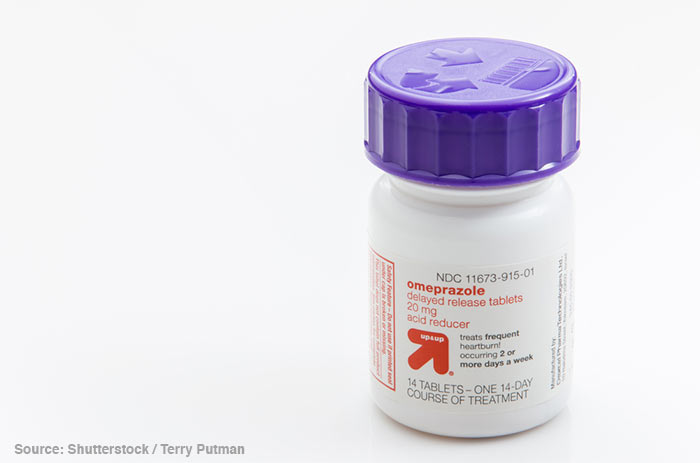
I had just joined a ship. Fitter on board came with the complain of weakness. He said he was not able to even stand for very long.
He was put on bed rest. He later informed that the stool is black in color.
We called C.I.R.M. Rome for radio medical advise. Doctor asked us to treat this as a medical emergency and send him to visit doctor first thing on arrival port to which we were arriving in few hours.
Doctor also advised to give him Omeprazole tab, 2 tablets immediately.
I declared medical emergency to office as well as to the agent of arrival port (Fujairah).
On dropping anchor at Fujairah, Fitter was sent to visit the doctor.
Doctor did some blood tests on him and he was diogenised with severe anemia. His Haemoglobin level was found to be 6.7 g/Dl.
Few units of blood was transfused into the fitter at shore hospital.
Doctor declared him medically unfit and was signed off from the vessel.
While we on board ship did not come to know the root cause of severe anemia but the direct cause was internal stomach bleeding.
Why did doctor giving radio medical advise recommend Omeprazole. Or why this is considered as one of the life saving drug and why did it find its place in ship’s medical locker ?
Omeprazole is on the world health organisation’s list of essential medicines. It is considered to be one of the most important medication needed in a basic health system.
Omeprazole is mostly used for stomach ulcers and stomach bleeding.
Off course there is more to Omeprazole but we do not need to go in details of what all omeprazole is used for. But all we should be aware that when dealing with stomach related emergencies, doctor may advise this medication.
We should be ready for that.
4. Metoprolol
I came across this medicine when I was third officer. One of the crew member complained of severe headache. The pain killers worked but the effect was not lasting for too long.
Next day his blood pressure was checked and was found to be very high (I do not remember exactly how much).
Captain and radio officer were trying to seek radio medical advise.
And suddenly we saw blood coming out of his nose while he continue to hold his head.
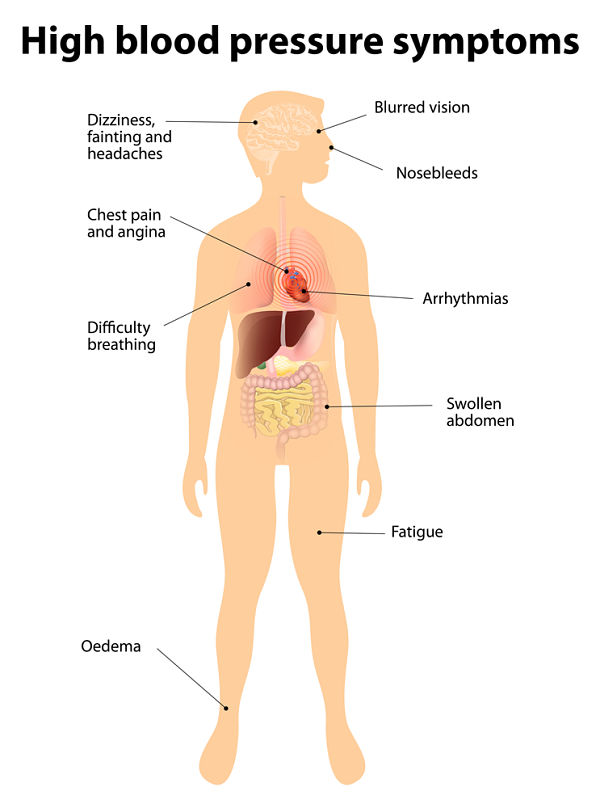
Captain came with the radio medical advise and gave Metoprolol to this aged crew member. He felt better. He was signed off from the ship on arrival port.
Strict medical standards nowadays may not allow us to witness such cases. But we must be aware of this medicine which is mainly for high blood pressure.
I keep on repeating myself but it is important. Do not give these medicines without seeking radio medical advise.
5. Diazepam
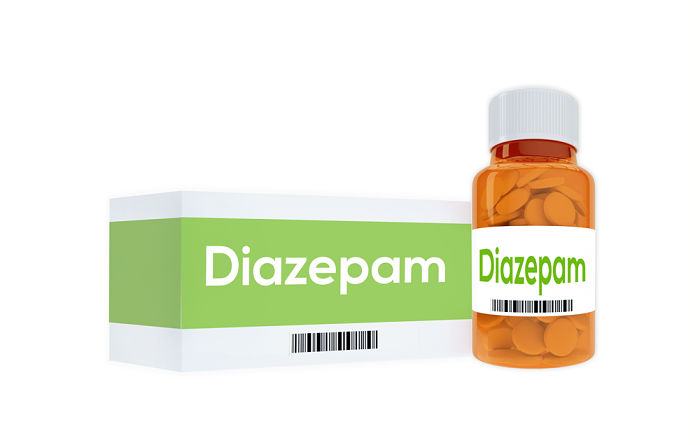
Though I never witnessed any case on board that required the use of Diazepam but it is an important medicine that seafarers must know about.
Diazepam help in increasing the effect of a chemical in the brain called GABA. GABA is the chemical that blocks the transmission from the brain to the various nurves and it thus brings calming effect.
So in simple words Diazepam is used for calming a person. If I say it in medical term, Diazepam is used for treating anxiety.

So on board ships, when can you expect a person to suffer from anxiety or when do you need to calm a person ?
One instance is post accident trauma where the person may be in shock following a serious accident.
Diazepam is also used to treat insomnia or severe sleep disorder.
While this is a life saving medicine on board, it again need to be given strictly on advise of doctor through radio medical advise. Diazepam is also a controlled drug and must be kept in custody of master.
If you find this medicine with any crew member, we must investigate the reason for him having this medicine in his possession.
6. Morphine injection (or other similar analgesics)
Ship’s crew work in a dangerous environment. Even though shipping has become safer in last decade, accidents still happens.
Imagine treating someone with a broken limb. The first thing that we need to do as first aid is to relieve the pain.
Morphine or similar analgesics help to relieve moderate to severe pains.
Morphine can be injected intramuscularly (into a muscle) or intravenously (into a vein). Injecting it intravenously (into a vein) may relieve the pain faster. But if someone is not comfortable with that, injecting intramuscularly (into a muscle) should be just fine too.
Needless to say, this injection also need to be used after radio medical advise.
7. Cardiopulmonary resuscitation (CPR)

Yes, I understand that this is not a name of the medicine but it is sure a way to save a life on board ships. This has to be in any life saving medical list.
What is CPR and when to perform it.
Let us say you find a casuality lying on deck (May be you can consider the case of ETO which we discussed above).
First thing we need to check is if he is breathing. If he is breathing and has a pulse, he is just unconscious. We shall put him in Recovery position.
Now take the another case, where he is not breathing. This will be a more serious case. Why ? Because if he is not breathing or his heart is stopped, his brain isn’t getting oxygen as there is no circulation of blood.
What can you do if you pneumatic (or electric) transfer pump (for example for transferring lube oil) is not working ? We can use manual pump.
When heart has stopped, we can use the manual compressions to make the oxygenated blood flow to the brain.
In most cases it will not revive the casualty but it will keep him alive till the time professional help arrives.
You can watch this video to know what exactly CPR does.
Knowing how to give CPR to someone is as important as all the life saving medicines we discussed here. This video demonstrates how to perform CPR.
Apart from knowledge of CPR, there is one more thing that is required to save a life in these situations. That is willingness to save the life, no matter what.
For example, if the nearest port of refuse or medical help is 24 hours away, are we willing to continue CPR for 24 hours ?
Conclusion
Apart from passenger ships and ship that continuously remain in Brazil, usually there is no doctor on board.
Any medical emergency on board is sometime is an emergency we are not ready to handle.
With better ship shore communication equipments these day, professional doctor help is just a phone call away. But knowing what all medicines we have on board can help save a life.
For example, when we call for radio medical advise and doctor recommends a medicine, we need to be sure if we have that on board.
If we are not sure, considerable time can be lost in communicating.
If we are not acquainted with the medicine names, we can loose precious time in asking the doctor to spell out the name of the medicine.
We must keep ourself acquainted with the medicines and keep the medicine inventory up to date. You never know when we might need it.
Collision off Singapore strait and other main maritime stories of August 2016
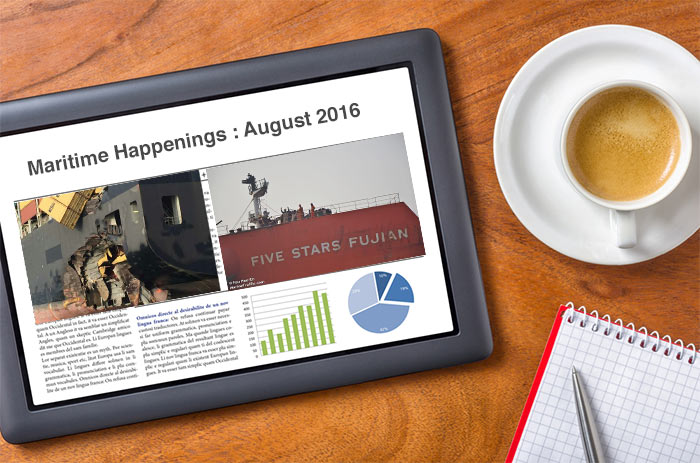
Shipping is a big industry. It is most international among all the industries of the world. And it is moving at some pace now. For the seafarers it is important to keep abreast with all the happenings of the industry.
But due to the amount of the information, the shipping news is so scattered that it can be hard to keep the pace. We thought to solve that by presenting the essence of a month’s main shipping activities across the globe.
Here is what happened in the month of August 2016.
Drug Trafficking
If you thought drug trafficking has hardly anything to do with shipping, you would be wrong.
This month saw the sentencing of captain and chief mate of a tug boat to 22 and 20 years in jail respectively by the Glassgow high court. Drugs worth 664 Million US Dollars (3.2 tonnes of cocaine) were recovered from the tug boat which amounts to the biggest in Britain.
The arrest was made in the high seas beyond the territorial waters of Britain with the help and permission of Tanzania where the boat was registered.
This also authenticate a report that said drug smugglers are taking to high seas to avoid increasing boarder patrol.
As per the United nation, Columbia has been the main source of cocaine into Europe. The cocaine is mostly trafficked in Europe through sea.
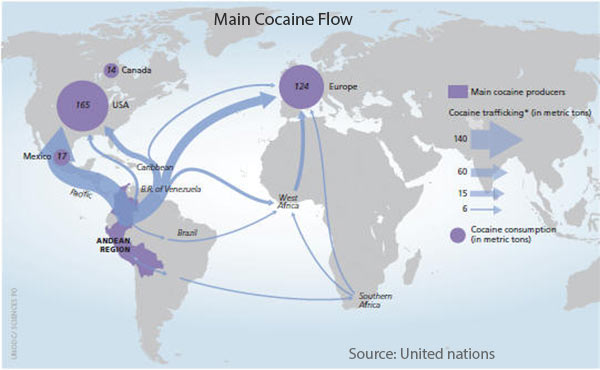
Around 700 tons of cocaine is siezed every year by the authorities around the word.
If you think drug trafficking is rare in main shipping fleet, you are wrong as there are many reported incidents of drug smuggling in the recent times.
How can seafarers protect themselves from the risks of drug trafficking ? The answer is by being vigilant.
For example seafarers should know the possible sources by which drugs can be placed on board ships. Containers are most prone for drug trafficking as it is virtually impossible for anyone to physically check each container.
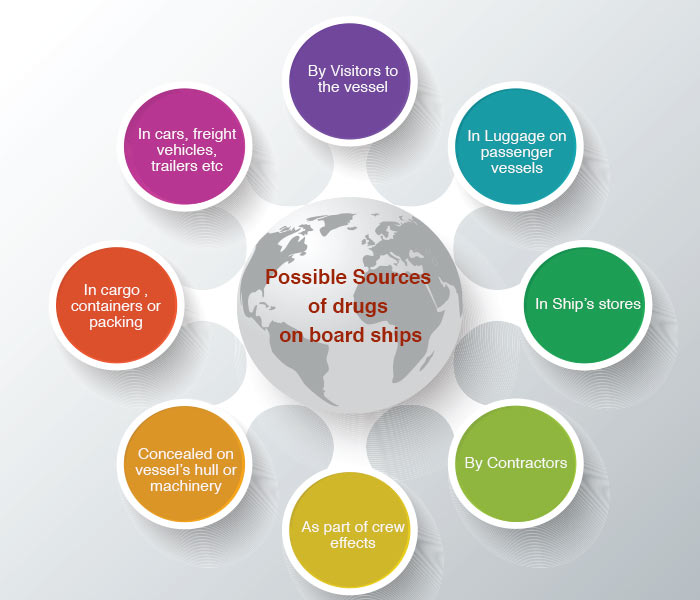
There are lot of resources to help seafarers train themselves about the risks of drug trafficking and to avoid the use of ships for that.
Some of these resources are
- ICS publication titled “Drug trafficking and drug abuse” 4th edition
- IMO Resolution FAL.9(34)
Seafarer should read these specially when their ship is bound to a port with high risk of drug trafficking.
Case of MLC Violation
As the shipping continue to suffer from over capacity, we see more and more cases of MLC violation.
In August there was this case when 20 crew members found themselves stranded on board Hong Kong flagged coal carrier “Five star Fujian”.
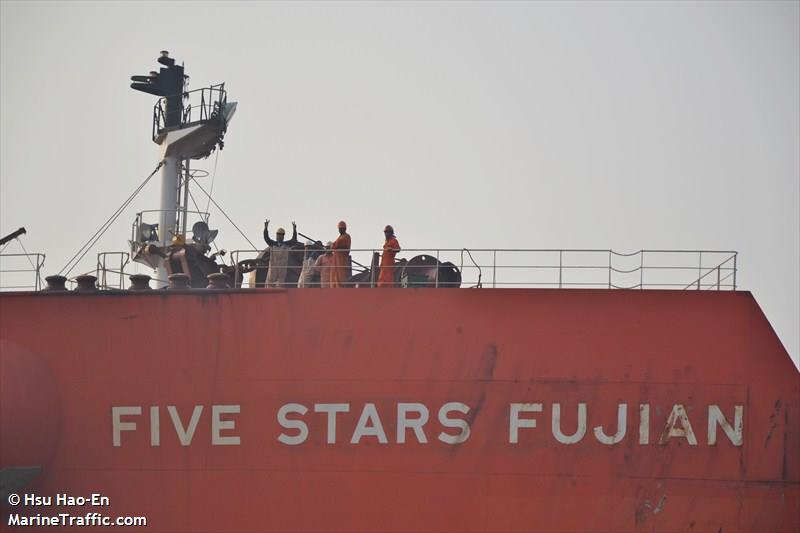
Crew had not received their wages and the ship was short of provisions and they could not contact the owners. The ship was carrying coal worth US $40 millions.
The case of a tanker Amba Bhakti was no different. The crew had not received their wages, were short of provisions and the ship was in urgent need to repairs.
On the positive side, these two cases in this month is a good sign that master and crew are not taking thing lying down. They are responding by bringing these MLC violations to light.
But these incidents will see the light of the day if the ITF and other agencies are able to get the dues of the crew on board.
On the negative side, the agencies are sometimes not able to even locate the registered owners of the ship.
Navigation Incidents
This month witnessed two major navigation incidents.
In first incident, a VLCC Dream II collided with the container vessel MSC Alexendra in Singapore strait.
The bow of the VLCC hit the port quarter of the over 13000 TEU container vessel. The photos of the damage looked horrible.
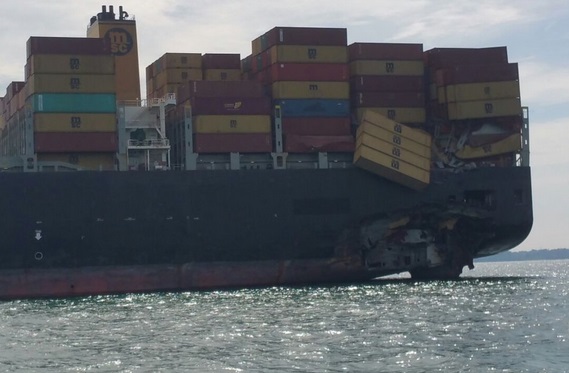
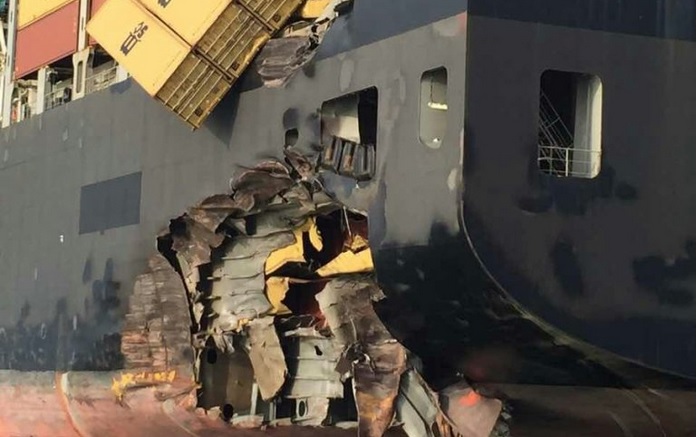
The AIS recreation of the incident shows that the container vessel was crossing the TSS. With respect to VLCC, the container vessel was crossing from her starboard to port.
The situation demanded VLCC to alter the course to starboard as she was the give way vessel as per crossing situation.
In another navigation incident, three Turkish coast gaurds were killed in ship collision in Bosporus strait.
The coast gaurd vessel capesized after collision with bulk carried Tolunay.
Both these incidents shows the importance of good navigation in the high traffic density areas.
More often than not, the incidents in high traffic density areas are the results of complacency of the bridge team when the members of the bridge team has been around the areas for a long time.
If we are alert each time we navigate in these areas in same way we were during our first time in these areas, accidents can be avoided to certain extent.
Fire on board Caribbean Fantasy
This month saw a major fire incident on board passenger ferry Caribbean Fantasy near San Juan, Puerto Rico. The location of the fire was in engine room.
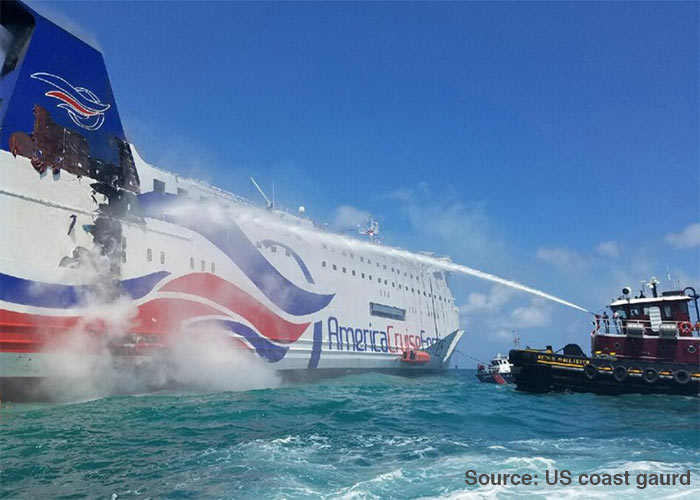
Following the fire, more than 500 passengers and crew were evacuated by US coast gaurd.
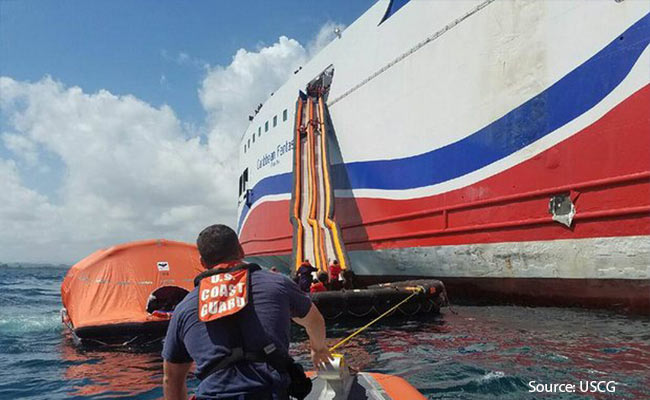
While the fire broke out on 17th August 2016, reports suggest the foundation for the fire was laid out months back.
In various inspection on board this vessel since last 5 years, close to 100 deficiencies were noted. These deficiencies included
- Missing exhaust lagging
- Fuel oil weep on auxilary engine
- Fuel oil leak on FO line
- Fire doors not operating correctly
A perfect example of “if you think safety is expensive, try an accident”.
Case studies by NTSB
National transportation safety board (NTSB) released a safety seas digest this month. This digest is published yearly and it aims to learn lessons from the majors incidents of the year.
Christopher A. Hart, Chairman of NTSB said,
Safer Seas Digest 2015 represents our continuing commitment to sharing the lessons that we learn through our investigations.
Many marine accidents can be prevented when crews know and respond to safety issues early and when crews work together effectively in the event of a crisis.
This safety digest discussed some of the interesting cases of 2015. Few of these being
- Allision of bulk carrier Anna Smile with grain elevator in Houston.
- Collision between bulk carrier “Flag Gangeos” and oil tanker “Pamisos”
The 29 case studies in this issue identified eight areas of failure. These identified areas were
- Voyage planning
- Communication
- Fatigue
- Alerting and Navigational alarms
- Written procedures and training
- Stability
- watertight integrity
- Abandoning ship
You can download the safety seas digest by clicking here.
Kolkata income tax tribunal judgment
A judgment of Kolkata income tax tribunal created havoc among Indian seafarers. This has been the talk of the town in the month of August too.
As per the tribunal judgment, the defendent seafarers should pay the tax as the amount (salary) was received in India. If the logic of tribunal judgment is to be considered, Indian seafarers may have to pay taxes in future.
Apart from future taxation, seafarers may be asked to pay taxes for up to last 6 years.
Maritime union of India has appointed its lawyer to look into this case. MUI has asked all the indian seafarers to show their support by signing the petition against the tribunal jusgement.
If you have not yet done that, you can do so by clicking here.
What to do if you receive a notice from the income tax ?
If you receive any such notice, you should put forth your points (about your NRI status) either directly or through a CA. If same is not accepted, you should contact MUI or NUSI to take your case.
We hope that the MUI and NUSI will be able to get the case turn in favour of seafarers soon.
Video of the month
Every month we will bring one amazing video of the month. This month the video that we have chosen for the video of the month is time lapse video of a ship moving in Hong kong waters.
Watch the video
Conclusion
This is the first issue of our monthly news digest and we hope that you found it useful. We are sure the monthly news digest will keep on improving with each passing month.
Stay safe.
Risks Involved in Enclosed Spaces and How These Can Be Mitigated
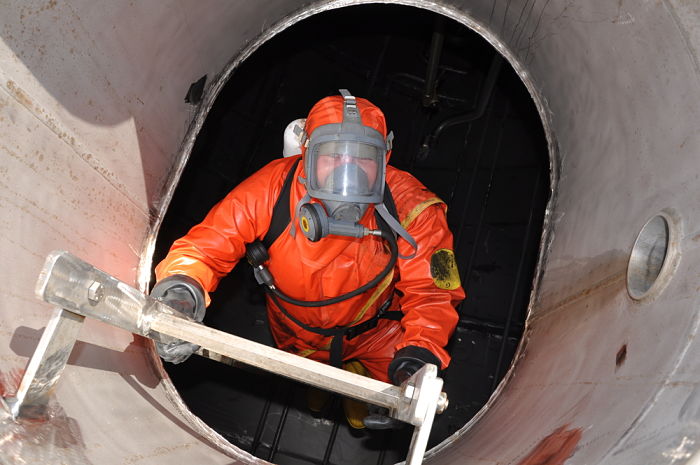
When you see a casualty in a tank, do not rush and enter the tank to save him. Instead sound the alarm and muster the emergency team.
Memories of this important lesson to cadets like me during a basic course in the 90s are still afresh. And we were told that enclose space is the talk of the town.
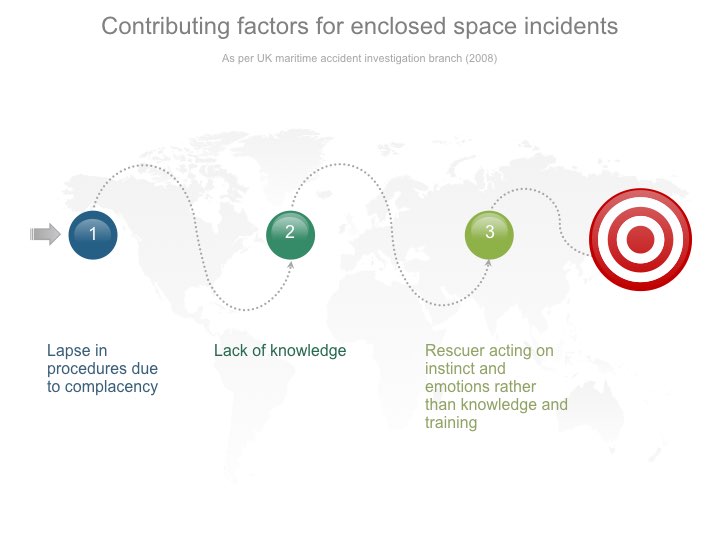
Irony is that 18 years later, concerns about enclosed space casualties is still the talk of the town. As per IMO, on average two seafarers in a month still die because of enclosed space incidents.
There are extreme efficient procedures in place but enclosed space incidents did not decrease in last 2 decades. There can be many contributory factors for that.
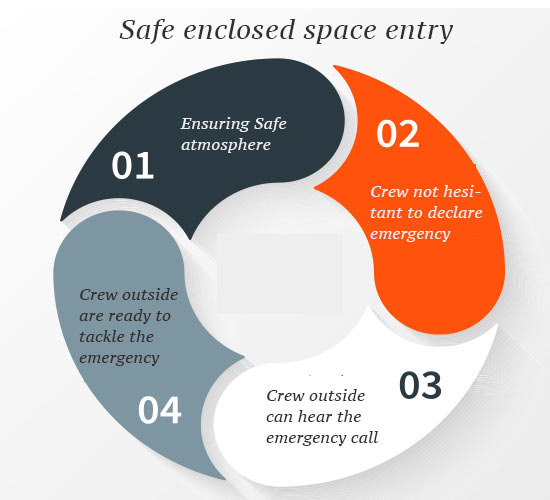
We may go overboard in addressing the problem but the fact remains that there are four elements that we need to address for safe enclosed space entry.
- Ensuring the atmosphere is safe inside the enclosed space
- crew not hesitant to declare emergency
- Crew outside will be able to hear the emergency call
- Crew outside are ready to tackle the emergency
 Before we proceed to discuss these, we need to know what exactly is an enclosed space ?
What is an enclosed space
Before we discuss anything about enclosed space, we must define “enclosed space”. Is a deck store on midship of the ship an enclosed space ?
No, I never heard someone filling up permit for entering inside a deck store. Then how do we decide what is an enclose space ?
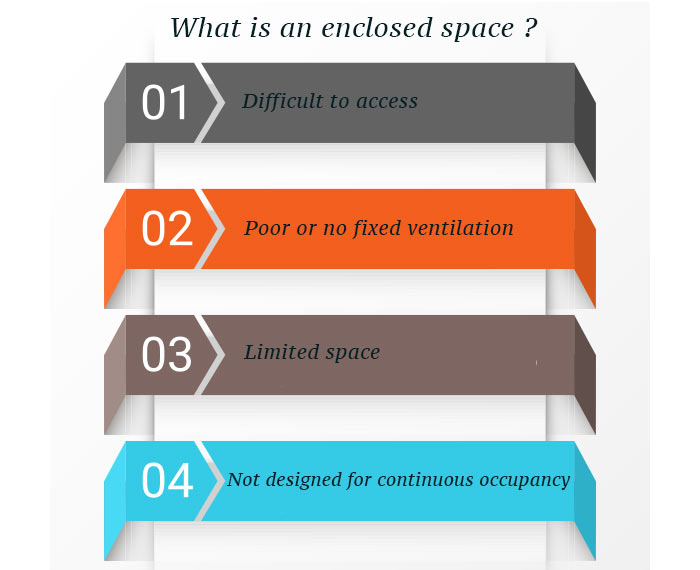
There are four elements, presence of any one will make the space an “enclosed space”
- Difficult to access
- Poor or no fixed ventilation
- Limited space
- Not designed for continuous occupancy
Difficult to access: A space can have a danger of exposure to lack of oxygen or presence of other deadly gases. In case of this exposure, climbing up aggravate the situation.
While climbing a person would need more oxygen which in this case will not be enough. Also with climbing as the breathing becomes more rapid, the intake of other deadly gases will increase.
This makes the spaces with difficult access more dangerous.
Except the common work place of crew, any other space that require climbing will be an example of such space. Pump rooms are for example one of such space.
Poor or No fixed ventilation: Poor or no fixed ventilation of a space means that there are high chances of absence of oxygen in the space. Apart from oxygen, there could also be high chances of presence of other deadly gases like H2S.
Ballast tanks, cargo tanks and void spaces with no fixed ventilation system are few of the examples that fall in this category.
Limited space: If there is limited space in a compartment, the rescue from these compartments could be very difficult. It may be difficult to remove the casualty to a safer place.
Chain lockers, engine scavenge space are few of the examples that fall under this category.
Not designed for continuous occupancy: The conditions inside these spaces could have changed drastically since it was visited last time.
Now that we know what an enclosed space is, let us discuss the elements of safer enclosed space entry.
Ensuring the atmosphere is safe inside the enclosed space
To ensure the atmosphere is safe we need to know what are the dangers we can expect inside the enclosed space and how we can mitigate these dangers.
Let us first talk about the dangers
Lack of oxygen
Apart from slip, trip and fall, the main danger with enclosed spaces is the lack of oxygen. Want to know how dangerous the lack of oxygen can be ?
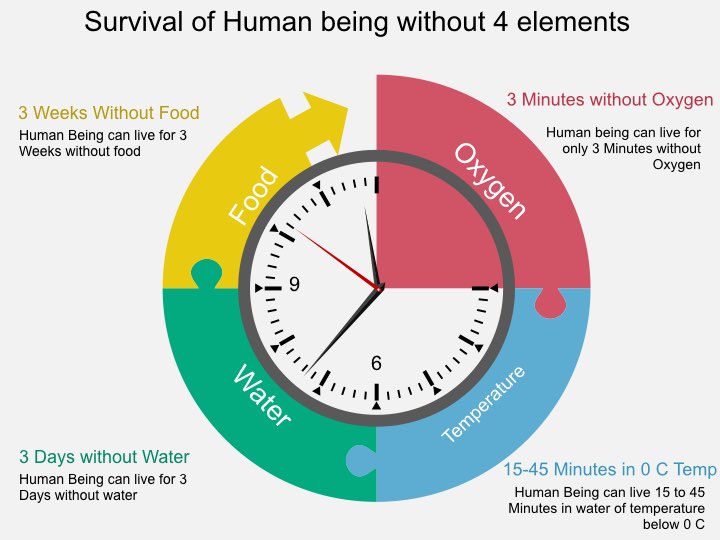
A person can survive 3 weeks without food, 3 days without water and 10-45 minutes in ice cold water. But a person can only survive for 3 minutes without oxygen. Yes, it is that serious.
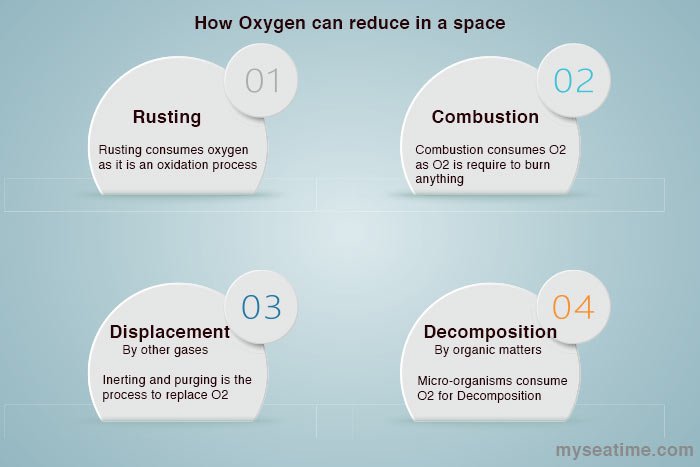
But how can oxygen in a space be reduced ? Where does this oxygen go.
Well there are many ways oxygen can be consumed in a compartment. The most common among these is the the rusting of the metal. The process of rusting is an oxidation process that consumes oxygen.
Presence of toxic gases
Even if there is sufficient oxygen in a compartment does not mean that it is safe for entry. The presence of toxic vapors in a space can be deadly too.
For example exposure to H2S can cause immediate loss of consciousness and death.
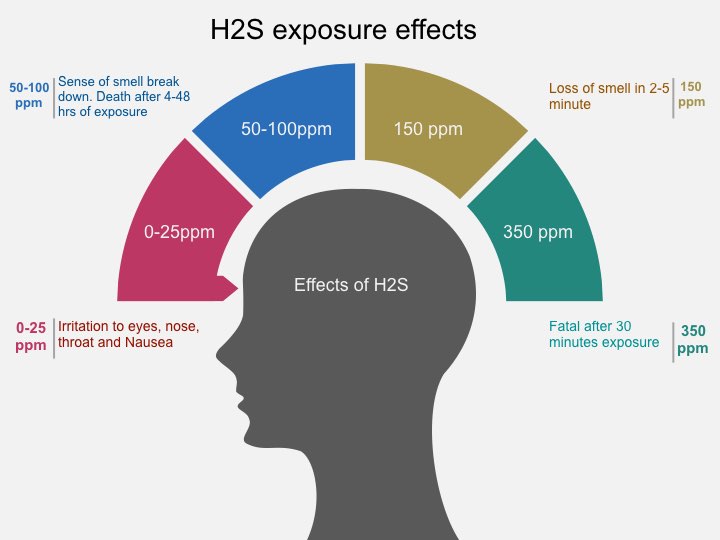
Apart from H2S, gases like Benzene could also be present on all tankers. On chemical tankers that load different kind of chemical can have different type of toxic gases around them.
Trapped inside
If you thought a person cannot be trapped inside an enclosed space, let me let you a real story.
Two cadets went into the ballast tank to clear the choked sounding pipe just before departure of ship. A ship’s crew saw the ballast tank access cover open and closed it and secured it. The chief officer ballasted the tank to reduce the trim. Two cadets died of drowning.
On departure when crew were searching for the cadets, they realised cadets might have been in the ballast tank. The bodies were recovered.
This was in the year 1998 but things have not changed. In 2005, crew died because they were trapped in the ballast tank of a cruise ship.
In short there have been many casualties because of being trapped inside an enclosed space. This poses another hazard in the enclosed spaces.
Slip, trip and falls
As per UK P&I, one in every third personal injury claim results from slip, trips and falls. This is not uncommon in personal injuries cases in enclosed spaces too.
People can slip because of muddy surface in the ballast tanks. People can trip because of so many pipelines and obstruction in an enclosed space. And people can fall while climbing up or down an enclosed space.
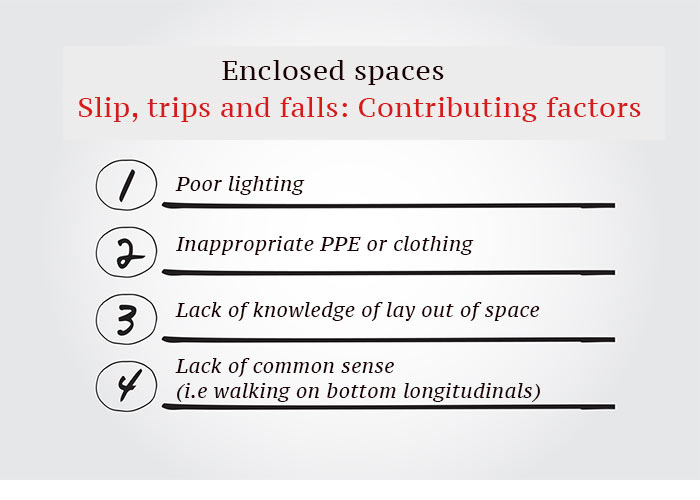
Most of the enclosed space will have all the elements that have the dangers of slip trip and fall.
Mitigating the dangers of enclosed space
Now that we have identified the dangers associated with enclosed space. Let us see how each of these dangers need to be dealt with.
i) Ventilation
I have stressed so far about the presence of toxic gases and the absence of oxygen in a space. This can be reversed by ventilation.
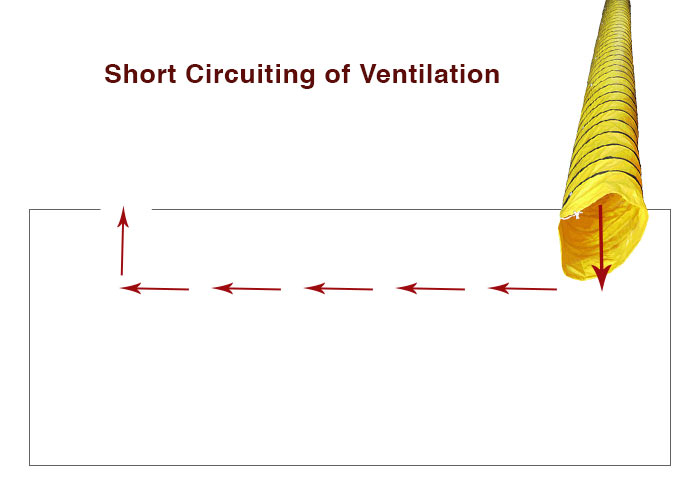
But it is important that ventilation of the space is effective. For the ventilation to be effective, the ventilation equipment should be placed adequetly in a way that short circuiting of the air do not take place.
ii) Measuring atmosphere inside the space
We identified lack of oxygen and presence of toxic gases as the main factors for enclosed space casualties. To avoid these casualties, we need to ensure that atmosphere inside the enclosed space is ideal for man entry.
We can only achieve this by measuring the atmosphere. For example if the oxygen inside the enclosed space is less than 20.9%, we would not make an entry into this space.
But how can we ensure that if we do not know what when and how of measuring the atmosphere ? We need to know the answers to questions like what to measure, when to measure and how to measure the atmosphere.
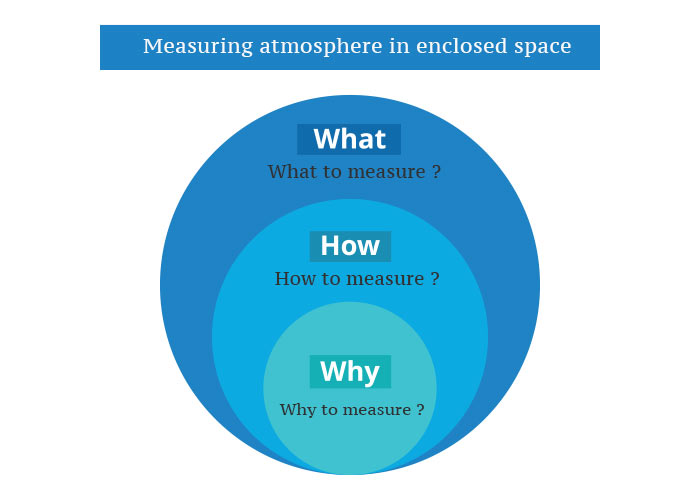
What to measure
Apart from oxygen we also need to measure presence of toxic gases inside the enclosed space. Knowing what to measure important.
For example will you measure anything apart from oxygen in a space containing wooden pallet cargo ? If we do not know that there are high chances of presence of carbon mono oxide in a space containing wooden pallets, how can we measure it ?
Crew members have died of Carbon mono-oxide exposure by entering cargo holds containing wooden pallets.
So first thing to know is what all toxic gases we can expect in an enclosed space. For example on tankers, H2S, CO, Hydrocarbons and Benzene are the most common toxic gases.
Knowing the properties of the cargo on board and all other materials in and around the enclosed space will tell us what to measure.
Moreover company’s SMS manuals need to address the toxic gases ship staff can expect on the ship.
How to measure
The second important thing to know is how to measure these gases.
For example will you measure the gases at the top level, middle level or bottom level of the enclosed space ?
If you measure H2S at the top level, you will most likely get zero or incorrect reading. This is because H2S is heavier than air and will always settle at the bottom of the space.
If you measure Carbon mono-oxide at the bottom of the space you will get zero or incorrect reading. Again this is beacuse CO is of same weight as air and may settle in middle of the space.
Now instead of knowing the weights of each gas and then deciding where to measure, it is a good practice to check the concentration of a gas at multiple levels.
Why to measure
The concentration of a toxic gas below which it is safe for exposure of the a human being is called “Threshhold limit value“.
By measuring we can decide if it is safe to enter the space or not. If the measured concentration is lesser than the TLV value of that gas, it would be safer to enter.
When to measure
Will a compartment that was safe to enter 20 hours back be safe now too ? Off course the answer will be No.
We must know when we should measure the atmosphere of a space. The two most important timings are
- Just before the entry and
- Just before the re-entry after any break
Apart from that we should check the atmosphere after a pre-determined time (say after every 2 hours).
Who should measure
The repetitive checks can be done by a responsible person outside the space. But revised IMO guidelines require that each person entering the space should check the atmosphere themselves.
iii) Mitigating the risk of being trapped
How can we ensure that someone does not close the opening of the enclosed space while a person is still inside ?
Off course the best way is having a link man stationed at the entrance all the time. But we cannot rely only on this one control. Apart from the link man, the use of entry tags is considered to be the best way to mitigate this risk.
For example look at this tag.
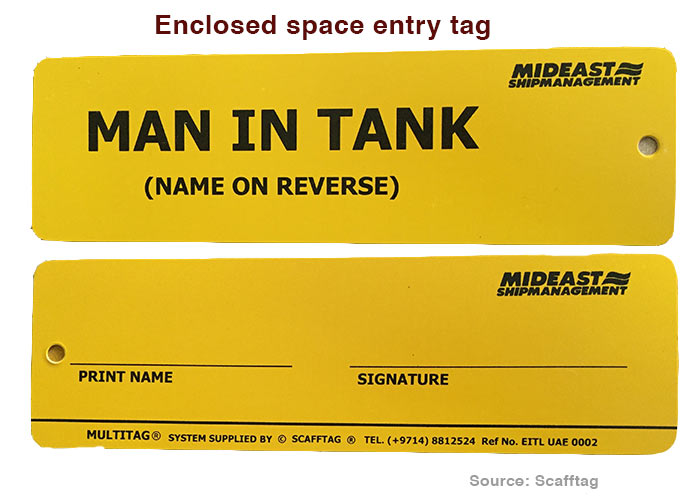
This one tag is attached at the entrance of the space for each person that enters that space. When a person is out, his tag will be removed from the entrance of the space.
The number of tags shows how many people are inside the space.
Now any person willing to secure the space can check from the tags if any person is inside the space or not.
iv) Mitigating the risk of slip, trips and fall
Inside an enclosed space, there can be various reasons for the slips, trips and falls. For example, a person may not be able to avoid hitting with ship structure because of poor lighting.
Or crew may slip because they are not wearing anti-skid safety shoes.
Ship staff must ensure that these contributing factors are eliminated to avoid dangers of slip, trips and falls.
Crew not hesitant to declare emergency
Different people can have different reaction to atmospheric conditions. Some people can work comfortably in an atmosphere with oxygen level of around 20% while other may not.
When a group of crew are working in an enclosed space, when one feels uncomfortable, he may not declare that he has an emergency.
The reason could be confirmation bias where in the person thinks that everything is OK because other person has not complained.
The other reason for not declaring the emergency is the tendency of the crew to finish the job before they exit the enclosed space. This is specially the case when the job would take just another couple of minutes to finish.
It is important that the crew entering the space are appraised of the importance of even couple of seconds that can save the life.
Crew should be willing to leave the work and declare emergency in case they do not feel comfortable.
Crew outside able to hear the emergency call
When an emergency is raised by the crew inside a compartment, crew outside the space should be able to respond to that immediately.
This require the link man to be stand by near the entrance of the space. They also need to check that communication link is not broken at a specified interval.
Sometimes it may not be possible to communicate from the entrance of the space. In this case employing two link men, (one outside the entrance and other inside) may be necessary.
Readiness of the emergency party
I earlier said that a person can die within 3 minutes without oxygen. That shows that in an emergency, the rescue party or people outside have less than 3 minutes to bring the person out.
In this situation, if the rescue and first aid equipments are not ready at the entrance of the space, it is impossible to save the person inside.
These equipments include but not be limited to
- Self contained breathing apparatus
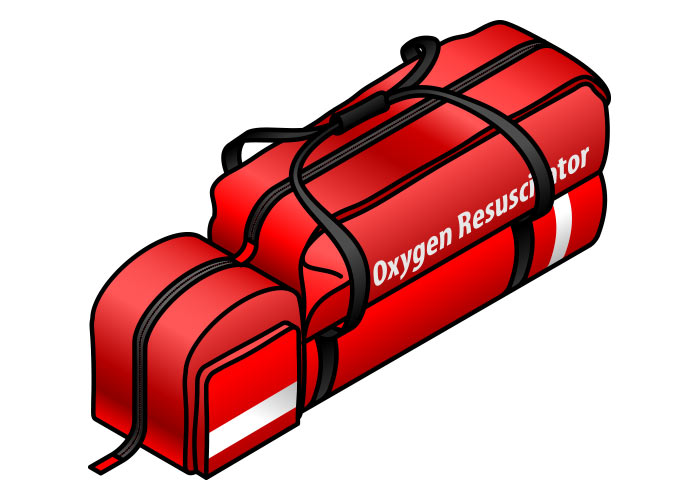
- Portable oxygen resuscitator
- First aid kit and
- safety harness and lifeline
- Emergency escape breathing apparatus
- tripod for lifting the person out of the space
The presence of these equipment is not enough. People outside should also know how to use these.
For example, when a person who has been unconscious because of lack of oxygen in his body would need oxygen immediately. The crew outside should know how to use the portable resuscitator. This will save the time in reading instructions.
I am also a big advocate of carrying EEBD inside the enclosed space while making entry. If a person feels uncomfortable, he can have the option to wear EEBD and come out. This can be life saving in some situations.
Follow the enclose space checklist
While I have covered most of the things and I may have missed few. But even if I have not missed, is it possible to remember all these points ?
Just following the guidelines and enclosed space entry checklist can ensure that all these point are covered.
What can a shore management do to ensure procedures are followed
Incident on board Sally Ann C is the latest example of enclosed space casualties. The chief office entered the cargo tanks without any checks and without any person standing by outside the space. Chief engineer and then 2nd officer followed to rescue him and they too collapsed. While chief officer and chief engineer died, 2nd officer sustained serious injuries.
It is foolish to believe that these three officers did not know anything about the enclosed space procedures. It is also foolish to believe that they were not aware of the dangers associated.
They were as competent as me and you, may be even more. The problem was same as identified by IMO as one of the serious problem in shipping right now.
IMO believes that there are enough regulations in shipping but what is lacking is the compliance with these regulation.
A company need to put in their efforts to ensure compliance. Compliance is only possible by having a safety culture that can be measured and improved over time.
Conclusion
Enclosed space casualties continue to be alarming. In spite of efforts by the industry experts to streamline the procedures, there has hardly been any decrease in these incidents.
Knowing the risks involved and reminding ourself about these risks again and again can be of some help. Company need to develop a safety culture strategy to ensure increasing compliance with the procedures. A Company can also make the procedure simpler to ensure that these are easy to follow and people are willing to follow these procedures.
Be in Command by Knowing These ECDIS Safety Settings
ECDIS has been the talk of the town. On every inspection on board, compliance with ECDIS procedures has been top agenda for the inspectors.
It will not be a new thing to say that good passage planning is the key for safer navigation. ECDIS now being a part of passage planning contributes to the safe navigation.
I had covered ECDIS in lengths earlier on the topic like
In these two posts I covered about the process of correcting the ENCs. Can we say we are all set if ENCs are corrected for Weekly corrections, T&P corrections, Navigational warnings and navtex warnings ?
But what if the settings on the ECDIS are not what it should be. Wrong settings pose even bigger threat to the safe naviagtion than the uncorrected ENCs.
In this post I will discuss about the what and how of all the settings on ECDIS.
Safety Settings
It is all in the name. Safety settings sets the safety parameters according to the ship’s static as well as dynamic particulars. That is a change ECDIS brought from the traditional paper charts. For example see this chart and I will ask one question.
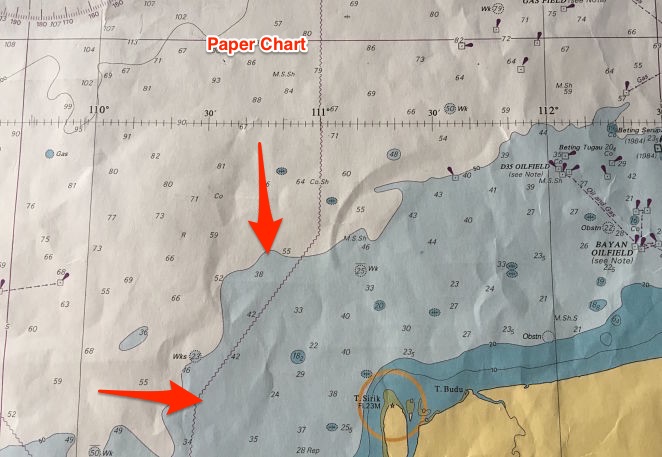
Can we say that blue part on this chart is shallow water ?
It is and it is not. For a small vessel with less draft, it is not a shallow water. For a big container ship with deep draft, may be.
So you see, the colors on the paper chart may not represent the shallow waters for all the ships. But on the ECDIS these can be set by the user according to their draft and other parameters.
There are 4 safety settings
- Safety contour Setting
- Shallow contour settings
- Deep contour setting
- Safety Depth setting
To enter a value for these settings on JRC ECDIS, go to
chart -> settings and then choose “S-57/C-Map/ARCS.
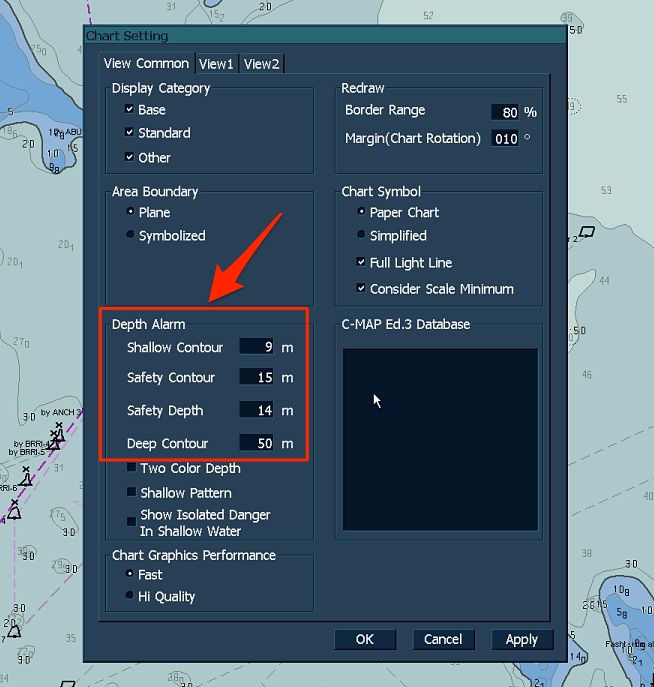
Now Let us discuss about these settings in detail and what values we need to enter in these settings
Shallow Contour setting
A contour is a line separating a minimum depth area. For example a 10 meter contour will be a line that separates waters below and above 10 meters depths.
The contours are in the value of 5, 10, 15, 20, 30 and so on.
Shallow contour value need to be used to tell ECDIS what is the value of shallow waters for our draft. This is the value of depth below which it is definite for the vessel to get aground.
The shallow contour value need to be equal to or more than the draft of the vessel.
Let us say the vessel’s draft is 9 meters and we enter the shallow contour value of 9 meter. The ECDIS will display 10 meter contour line as the shallow contour. If 10 meter contour is not available, it will take next contour as the shallow contour for the vessel.
The shallow contour lets the navigator know that between 0 meter depth and the shallow contour, the area is not navigable at all.
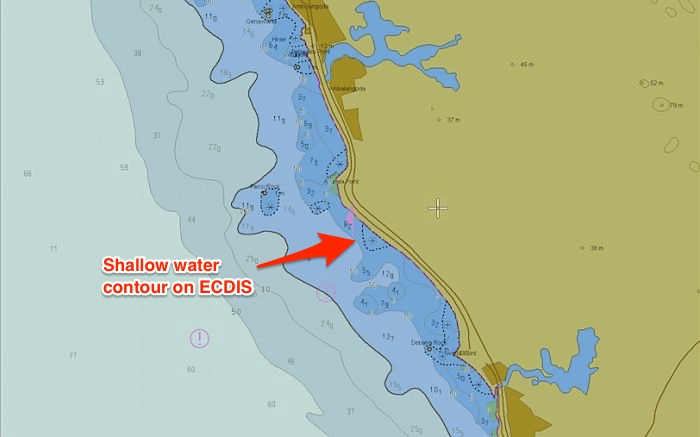
Safety Contour setting
Safety contour is the contour line above which we can navigate without any water depth concern.
So what is the depth of water required for the vessel to navigate without any concerns ? Off course it is the depth that complies with the company’s UKC policy.
Now again let us see it with an example. Vessel’s draft is 9 meters and at maximum speed, the expected squat is 1.1 meters. The company require the vessel to have UKC of 10% of the draft.
I assume you know the UKC calculation method and can easily arrive to the conclusion that this vessel would need 11 meters of water depth to navigate.
I have taken here the simplest of the case. In reality you need to follow your company’s UKC calculation sheet to arrive at the depths required to comply with UKC policy. This may take various factor such as sea conditions, increase in draft due to rolling, sea water density and the tide.
But the idea is to know the minimum depth of water at which you will comply with the company’s UKC policy.
This water depth becomes the safety contour setting. So if we enter 11 meters as safety contour setting, it will show 15 meter contour as the safety contour.
Some companies may give simpler instructions for the safety setting in the navigational manual. One form of these instruction can be based upon the draft of the vessel.
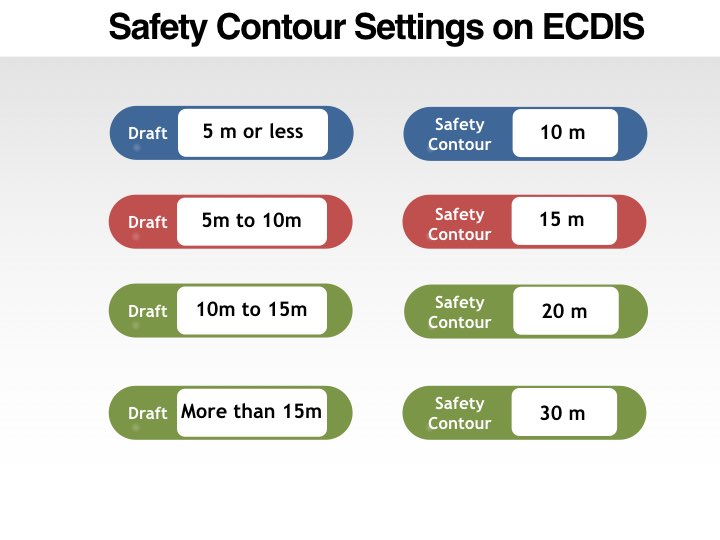
When safety contour value is entered in the ECDIS, it gives a safety contour line depths above which would meet the UKC requirement.
Safety Depth setting
So far we have only been talking about contours. We have not said anything about the actual safe depth. Safety depth is the only depth setting on ECDIS.
Safety depth is the depth of the water we can safely navigate upon. And it might sound repetitive but it is the depth that satisfies the UKC policy of the company.
In ECDIS we need to enter this minimum depth. It is same what we calculated as a simple example in safety contour setting. And as I said in that section, we need to follow the UKC calculation form of the company which may account for number of factors to calculate the safety depth required.
But the question is why do we need safety depth settings when we can navigate in waters above the safety contours ? This is because of two straight forward reasons
i) The depth above safety contour may not always be navigable.
This is in case of a shallow depth at one point in the navigable waters. Although we might be navigating in area above safety contour, this isolated depth pose a danger. Safety depth highlights this danger.
ii) The depths below safety contour may not always be non-navigable.
We can understand this If you allow me to again go through the safety contour value we entered. We entered the value of 11 meters and when we enter this value the ECDIS will take next available contour. This will be 15 meter contour.
Now the depths between 11 and 15 meters are navigable for us but it will show below the safety contour. So in the area between shallow contour and safety contour, safety depth will show the depth on which we can navigate.
Let us say we set the safety depth to 16 meters. On the ECDIS, all depths below 16 metes will be shown more prominently (in Black compared to others in grey color).
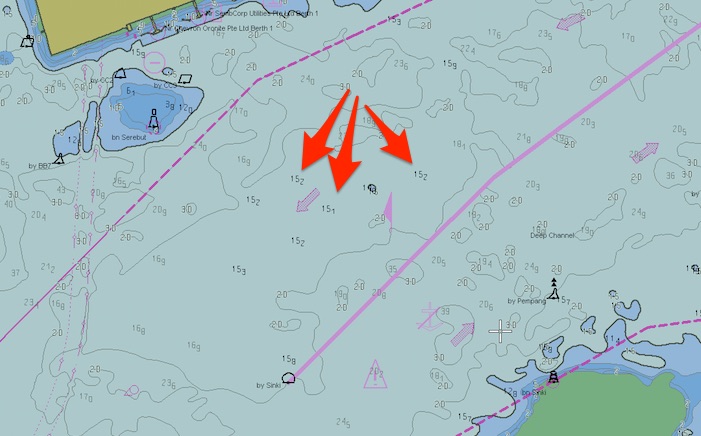
Deep water contour
This is a relative term and user is free to set as per what he believes could be deep water for him. For me deep water could be 50 meters while for others it could be 30 meters or 100 meters.
But there can be number of ways we can use the deep water contour setting.
For example you can set the deep water contour to show the maximum anchoring depths where vessel can drop anchor. So if your vessel can anchor maximum 105 meters depth, you can set the deep water contour to 100 meters.
Or if you are about to do ballast water exchange, you can set the deep water contour to 200 meters. This way you can easily see just by the color on the ECDIS if you are in depths where ballast exchange can be done.
The deep water contour setting can be used in number ways and navigators can use this to the way they wish to use it.
Differentiating the safety settings on ECDIS
Now let us see how the ECDIS screen will look like with all these settings. So let us say vessel’s draft is 9 meters and vessel require 14 meters depth to comply with company’s UKC policy.
So we have these settings
- Shallow contour: 9 meters
- Safety depth: 14 meters
- Safety Contour: 15 meters
- Deep Contour: 50 meters
And when I enter all these numbers in the ECDIS, this is how a ECDIS screen would display these settings.
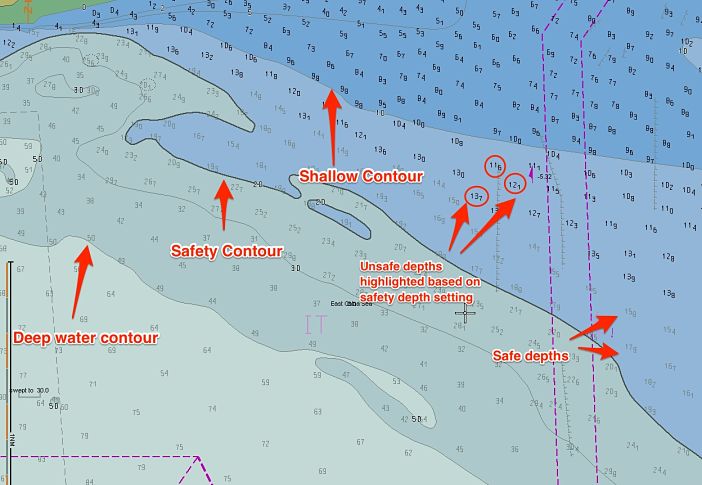
If you notice, for safety contour ECDIS has taken the 20 meter contour because 15 meter contour is not available.
There is another option in the ECDIS to use two colors to show these areas. When this option is selected, following will happen
- Safety contour and deep contour will merge
- Shallow contour and safety contour will merge
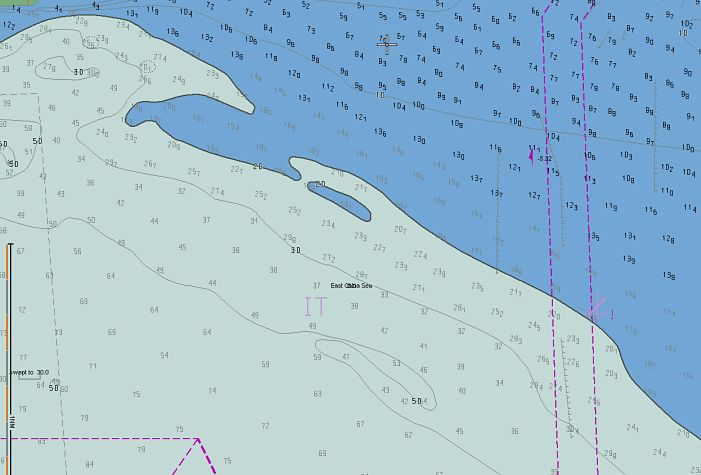
Or we can say that light blue and blue color will merge and become blue. Same way, grey and white color will merge and become white.
So there will be only two colors. One to show the shallow waters and other to show the navigable water.
Even in the two color display, it is not that we cannot navigate in the shallow waters. This is because it is showing the contour and not the depth.
In our example, the dividing line will be the 15 meters contour. The area below this contour will show as shallow waters (blue color). But as the safety depth is 11 meters (which will be below 15 meters contour), we can navigate in the shallow waters provided the depth is above 14 meters.
Danger detection settings
Entering the safety settings will warn us with an alarm when vessel enters in shallow waters. But when it gives the alarm it could be too late by then.
Danger detection settings can help in giving pre-warning of the dangers ahead. We only need to define the area in which we need the ECDIS to warn us.
We can define the area in two ways
- Vector area
- Sector Area
Vector area defines the area in length and width. Sector area defines the area in radius and width (angle).
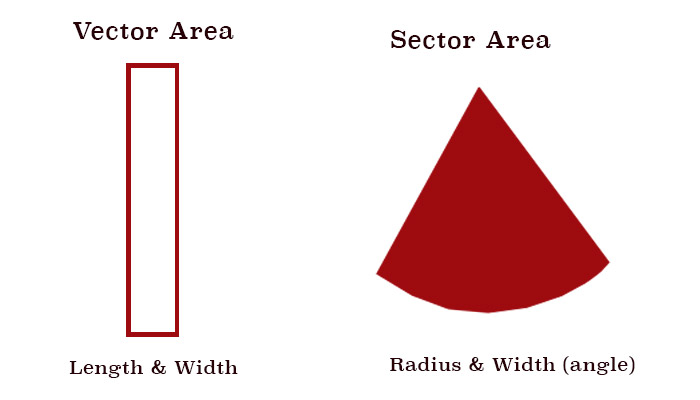
Vector area defines the area in length and width. Sector area defines the area in radius and width (angle).
Let us define this area on JRC ECDIS. On JRC ECDIS go to Menu, Settings and then choose Alarm settings.
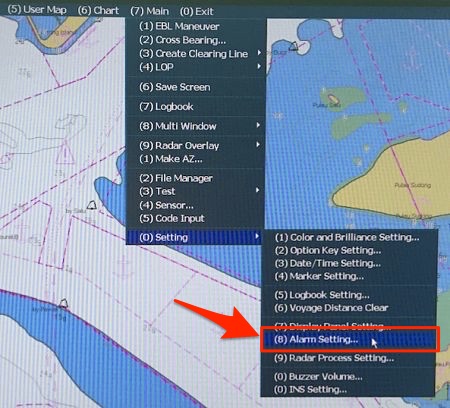 This will open the Alarm settings pane.
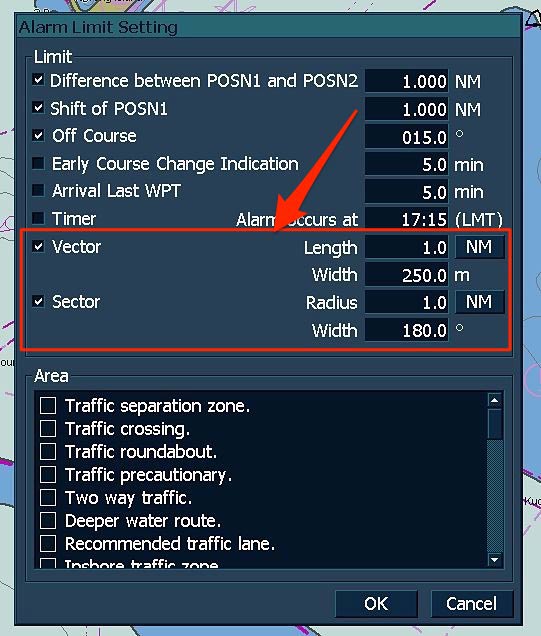
Under Vector and Sector section, you can define the area you want the ECDIS to look ahead. Once these areas are defined you can turn these on by going to “Ownship/Track” and then choosing “Settings”.
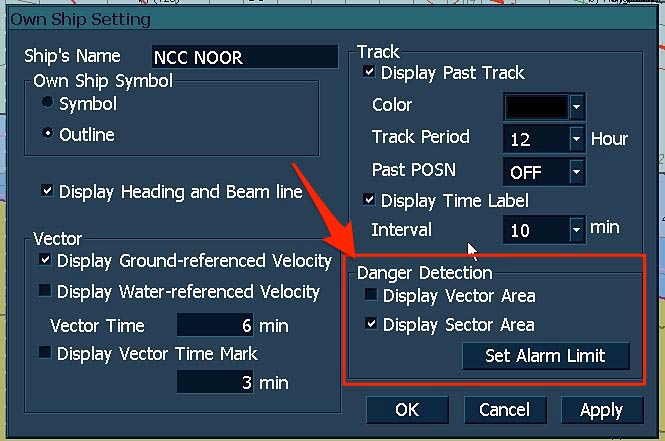
You can then choose to either “Vector area” or “Sector area”. You can even go to alarm settings page by clicking on “Set alarm limit” from danger detection section.
When you choose to display “Sector area”, it will look like this and ECDIS will trigger alarm if it detects any danger in this area.
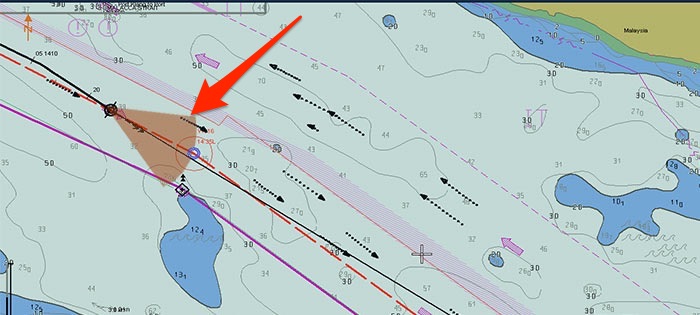
When you choose to display “Vector area”, it will look like this and ECDIS will trigger alarm if it detects any danger in this area.
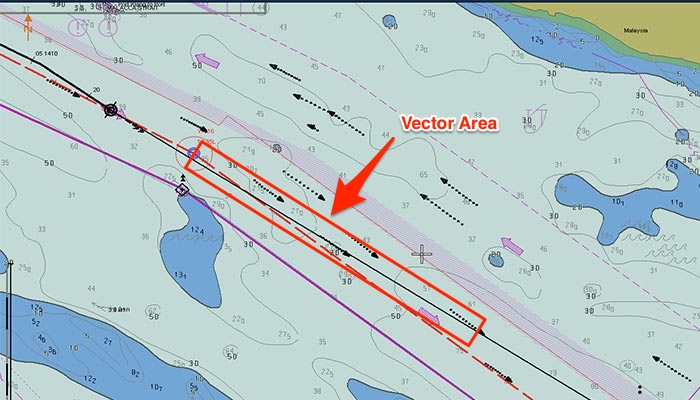
Alarm Buzzer settings
I have talked about different safety settings on ECDIS. But these settings are of no use if do not have the alarm buzzer volume on. If the volume of the buzzer is off, ECDIS would not be able to alert the navigator.
But there are times when we need to keep the buzzer off. Like in high traffic density area when we are constantly monitoring the traffic. In this case frequent alarms will be of lesser value.
Navigators must use their professional competence to decide when they need to turn on the alarm buzzer.
On JRC ECDIS to turn on the volume of the alarm buzzer, go to “Main”, “Setting” and then choose “buzzer volume”.
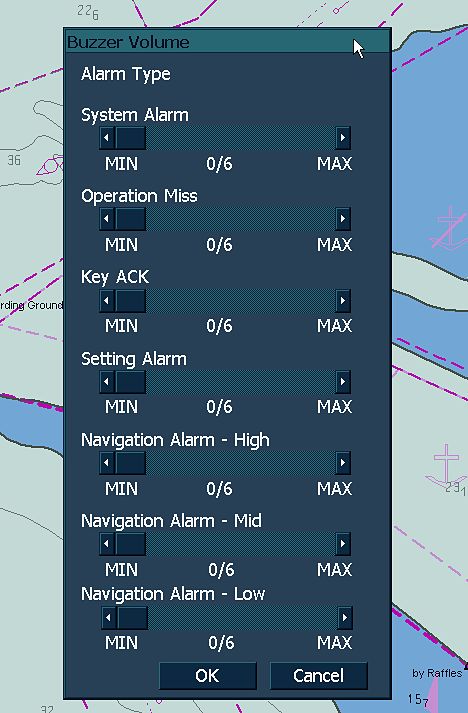
This will open a pane from where you can increase or decrease the volume of different type of alerts.
Conclusion
I am a big advocate of use of ECDIS on board for navigation. In my opinion ECDIS is making the shipping safer. Sure there have been number of incidents because of user’s interpretation of ECDIS display but the increase in training and good practices has helped to cover many gaps. Correct use of safety settings in ECDIS will definitely take it one step ahead .
Knowledge of what these safety settings mean can help in that.
Are You Doing All These Checks on Your Davit Type Lifeboats
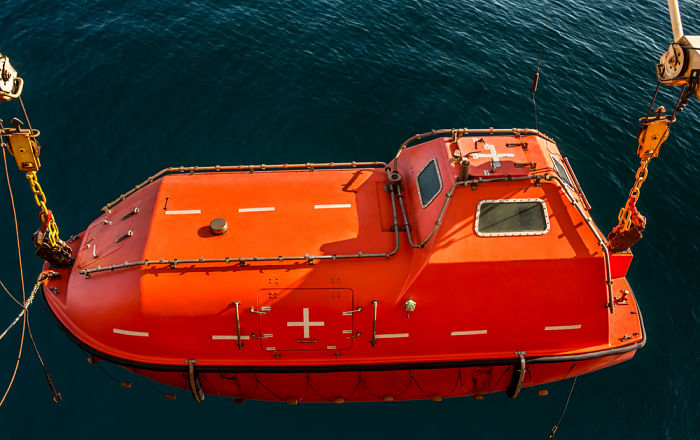
I earlier said, Life saving equipments are the best friends we have on board. And it is our responsibility to keep these in shape.
Each life saving equipment is our friend and we all agree that. But like in real friends we need to give “Life saving equipment” our time that it deserves.
How about saying a “Hello” to lifebuoy once every month. Or saying hello to lifeboat engine every week by testing it.
If we give our time to these appliances, these will remain our friends. If we do not, they will not. It is a simple give and take.
For example, Let me tell a short story of the times I was a 2nd mate.
The third mate told me, what can happen to a lifebuoy during its lifetime. These are there and we just need to check if these are in numbers that is required.
Few day after, during PSC inspection it was found that lifebuoys were too heavy. Lifebuoys had the sea water soaked into it through a plug that was supposed to be watertight.
You see how these friends can get angry !!
But can we keep these in shape if we do not know what is required to maintain these. Or what elements we need to check for life saving equipments.
This guide will deal with the inspections required on davit type lifeboats as well as the best way to conduct the inspection.
Let us start.
Life boat (except free fall lifeboats)
Lifeboat is the first thing that comes to mind when we talk about life saving appliances. But an empty lifeboat will be as bad as no lifeboat on ship. And defective equipments inside lifeboat will be as bad as an empty lifeboat.
Let us see what we need to do to ensure that lifeboat will be ready to help if required.
a) Checking the inventory
Frequency: Every month, Applicable to all ships
Ref: SOLAS Chapter III/20.7.2
As per SOLAS Chapter III/20.7.2, ship’s officer should check the inventory of the lifeboat equipment at least once every month. Most companies will have a checklist for this in their SMS manuals. Apart from physically checking the inventory, look for following
- Check that food ration packets are sealed and have vacuum.
- Check the expiry date of items like food ration, first aid kit, fresh water packets etc. Sometimes you will find the radar reflector with the expiry if it of cloth type.
- If one SART is placed in the lifeboat, check its operation with X-band radar.
b) Moving the lifeboat from the stowed position
Frequency: Every week, Applicable to all ships
Ref: SOLAS Chapter III/20.6.3
SOLAS require that at least every week the lifeboats should be moved from its stowed position.
Many PSC inspections findings report that many lifeboats would not move when winch brake is lifted. Most of the time reason for the lifeboat not moving is
- Frozen sheaves
- Davit arm stuck with the ship structure
- Harbor pin stuck because of rust, bent pin or because of it holding davit weight.
Whatever the reason, if we move the lifeboat from its stowed position every week ensures the lifeboat readiness.
c) Turning out from stowed position
Frequency: Every month, Applicable to all ships
Ref: SOLAS Chapter III / 20.7.1
We might get confused between moving from stowed position and turning out from stowed position. When we talk about moving out, we are required to move the lifeboat slightly. By turning out we need to lower the boat to the level where boat will be directly above water.
Usually this requirement is fulfilled during monthly lifeboat drill when we turn out the lifeboat from its stowed position.
d) Test run lifeboat engine
Frequency: Every week, Applicable to all ships
Ref: SOLAS Chapter III / 20.6.2 and MSC.1 / Circ 1206/Rev 1
A lifeboat is of no use if it cannot move away from a sinking ship. Or if it cannot move to the helping ship. We need to test the lifeboat engine every week.
But wait, what can happen to the lifeboat engine if we had tested it few months back ? You would be surprised to know that for the lifeboat related PSC deficiencies, more than 20% were for failing to start the lifeboat engine.
Remember, we need to say hello to all of our friends.
Coming back to the question !! What can happen to the lifeboat engine if we did not say hello every week by testing ?
- You may not realize that fuel tank is below the required level.
- You may not realize that starting batteries are either dead or are not charging. Or after the last lifeboat drill, someone forgot to connect the battery charger
- You may not realize that the engine is not starting in cold conditions.
All these points we can realize if we say hello to the lifeboat engine every week.
e) Visual inspection of lifeboat and launching appliances
There are few things that can only be inspected by naked eyes. No testing but just with the naked eyes. Visual inspection of the lifeboat aim to cover that.
While making visual inspection, look for
- any signs of lifeboat hull damage or cracks
- faded marking on the lifeboat
- Damages or old Retro-reflective tapes
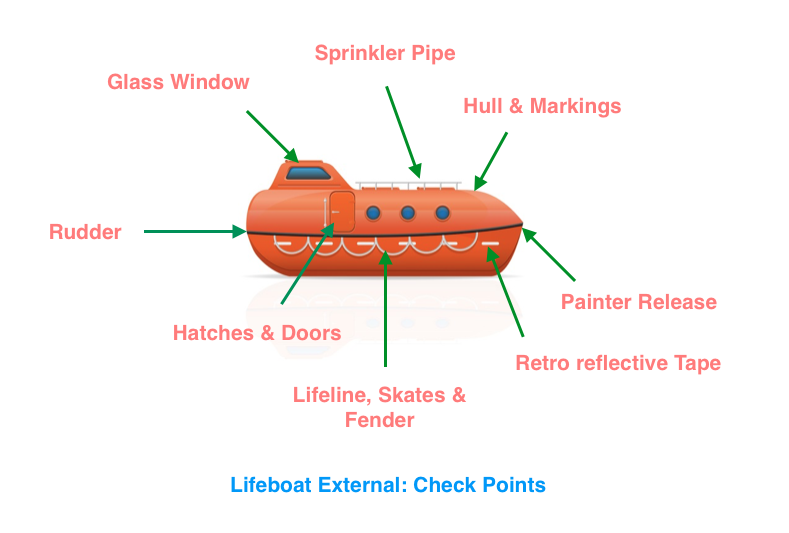
f) Self contained air support system
Applicable to: tankers
Ref: MSC.1/Circ.1206/Rev.1
Self contained air support system is used to maintain a positive pressure inside the boat. This prevents any toxic vapors to enter inside the lifeboat while abandoning the vessel in toxic environment.
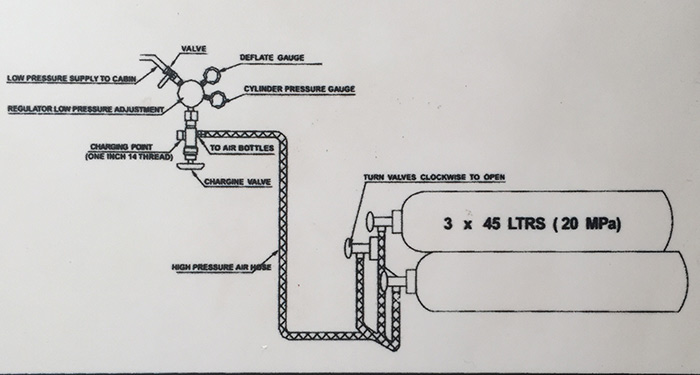
Let us see what we need to do to make this friend happy.
i) Monthly pressure check
We cannot use this system if the air bottles are empty. Every month we need to check if the air bottles are full. Upto 10% decrease in bottle pressure is allowed.
Most of the time there are three air bottles of around 45 Litres capacity.
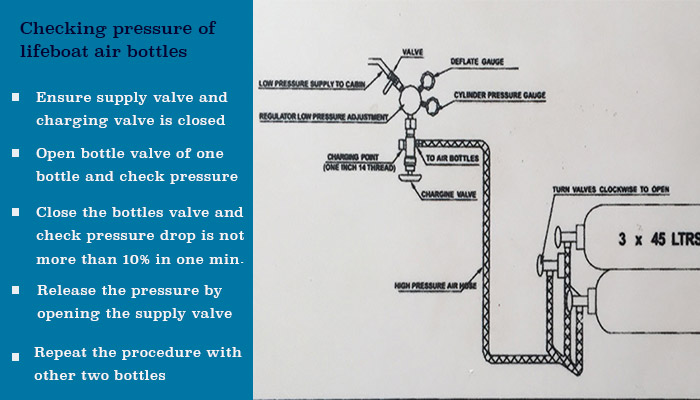
After you have checked the pressure of one bottle, we must ensure that we release the pressure in the line before we check the pressure of other bottles.
ii) Annual inspection by Shore
Reference: MSC.1/Circ.1206/Rev.1
MSC circular require the lifeboat air bottles to be visually examined by a competent authority atleast every year. This inspection is limited to
- checking the external condition
- Checking the pressure of the air bottles
- Checking any Leakage the air line
iii) Pressure testing of the air bottles
Ref: Class rules
Frequency: Every 5 year
While the pressure testing of the bottles is not a SOLAS requirement, but it required as per rules of Internaltion associated of classification societies.
Every 5 years (usually during 5 yearly dry docking of the vessel), the air bottles are taken ashore and pressure tested to 1.5 times the working pressure.
A certificate of pressure testing of life boat air bottles need to be on board.
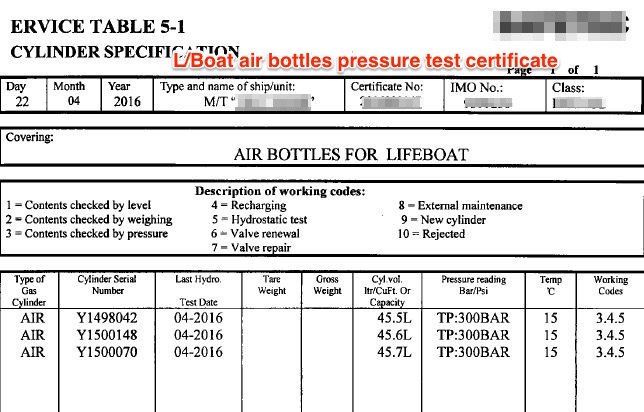
g) Lifeboat sprinkler system
The sprinkler system is required on the lifeboats of all oil tankers. And the idea of lifeboat sprinkler is same as is with any sprinkler system. To distinguish the fire.
Lifeboat sprinkler system is used if the oil fire has enveloped the lifeboat. To ensure that lifeboat sprinkler system can work in emergency would require regular testing. Here is how we can ensure this.
Test Every 3 month by ship staff & yearly by the maker
Ref: MSC.1/Circ.1206/Rev.1
During every occasion of launching the lifeboat into the water, we must test the sprinkler system. The components to check are
- All the nozzles are open and not clogged.
- The Sprinkler pump is free to rotate and can taken suction from the sea.
- The sprinkler system “open-close valve” is free to move
These tests are then required to be done by the maker during the annual thorough inspection of the lifeboat.
Lifeboat sprinkler system lines do not like the seawater to be retained in it for long time as the salt can block the nozzles. For this reason we must flush the sprinkler system with fresh water each time we test it with sea water.
Lifeboat Launching Appliances
Lifeboat needs some means to lower it. We should be able to lower Lifeboats without depending upon the ship’s power supply. That makes the gravity type lifeboat davits a first choice for the shipyards and ship owners.
In this type of launching appliances, we just need to release the brake to lower the lifeboat.
SOLAS require that we test these launching appliance periodically. After all our friend’s friend is our friend too. Isn’t it ?
Let us see how regulations require us to take care of the launching appliances
a) Annual thorough inspection of lifting appliances
Ref: SOLAS III/20.11.1.2 and MSC.1/Circ.1206/Rev.1/Appendix of Annex 1, para. 2.8 and 2.9 as applicable
SOLAS require the Maker to carry out annual thorough inspection of the lifeboat launching appliances.
The launching appliance have different components and MSC circular provides complete guidance on element to check on these components. Let us see what elements are inspected during annual thorough inspection
i) Lifeboat Davit
Every year, lifeboat davit is checked for any
- corrosion, misalignments, deformations and excessive free play
- lubrication of wires, sheaves and moving parts
- functioning of limit switches
- Any stored power systems or hydraulic system
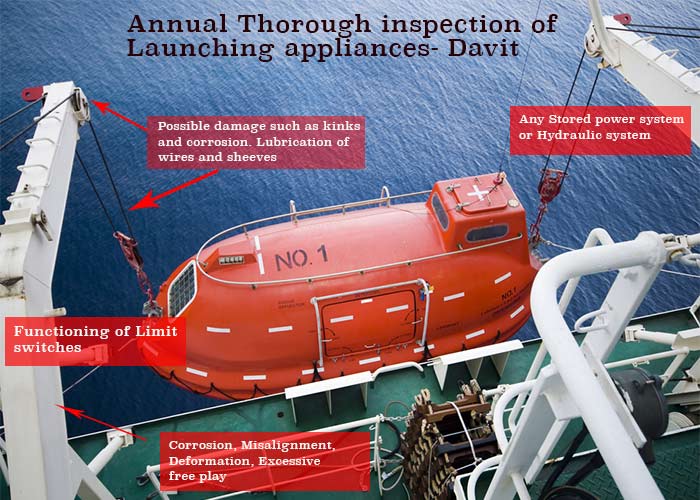
ii) Davit Winch
The main element of a davit winch is the braking system. If the brakes are not in good condition, lifeboat operations are liable to cause accidents.
There are two brakes in the gravity type lifeboats. One that holds the vessel (static brake) and second that controls the lowering speed (centrifugal brake).
During annual inspection by the maker, the brakes are opened up and condition of brake pads is checked. The brake pads are replaced if required.
Other than brake pads, the inspection of davit winch includes
- checking the condition of remote lowering system. Remote lowering of the lifeboat is done by a small wire that leads to inside the lifeboat. Pulling this wire lifts the brake handle remotely which lowers the boat. Sometimes you will also find remote lowering system on lifeboat deck from where the lowerer can visually see the lifeboat overside.
- Checking the power supply system for hoisting the lifeboat
- Checking the visual condition of winch foundation to ensure that it can take the load of the boat.
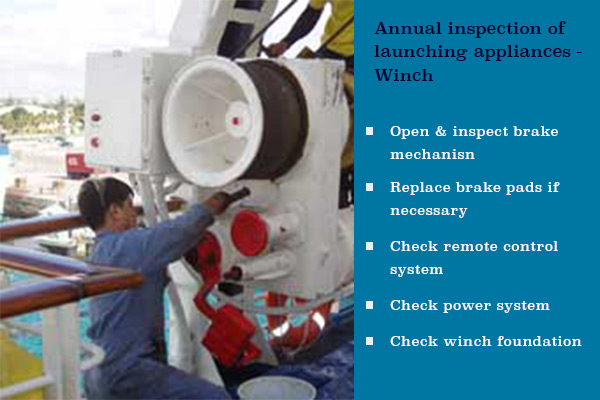
b) Dynamic winch brake test
Winch brake is an important part of the launching system which if fails can result in disastrous situations. So it is not just enough to inspect the which brake and replace the brake pads.
SOLAS require the maker to perform dynamic winch brake test. In the dynamic brake the boat is lowered by opening the brake. When it achieves the maximum lowering speed, the brake is applied abruptly. The brake pad and davit foundation is then inspected.
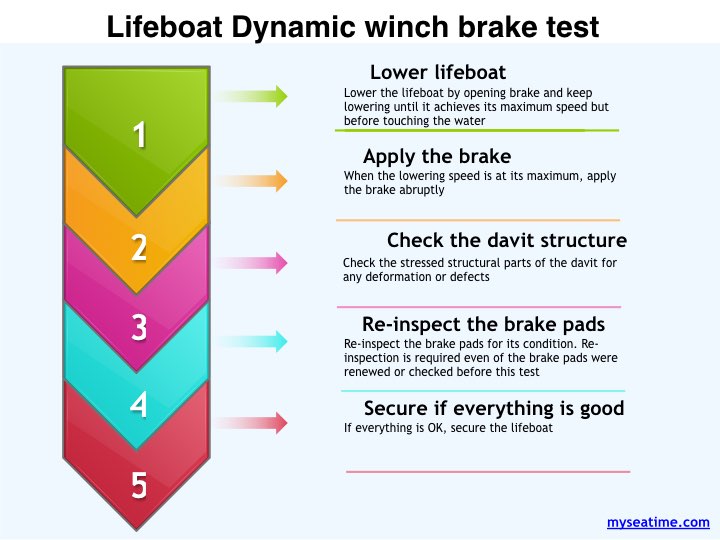
i) Annual winch dynamic brake test
Ref: SOLAS III/20.11.1.3 and MSC.1/Circ.1206/Rev.1/Appendix of Annex 1, para. 3.1 and 3.3 as applicable
Every year the dynamic load test is done with weight of the boat and its equipments.
ii) 5 Yearly winch dynamic brake test
Ref: SOLAS III/20.11.1.3 and MSC.1/Circ.1206/Rev.1/Appendix of Annex 1, para. 3.2 and 3.3 as applicable
Every 5 years the dynamic brake test is done with the weight of the lifeboat and its equipment alongwith the weight of the number of persons that lifeboat is designated for.
For the calculation, the weight of a person is taken as 75 Kgs. But for the following vessels the weight of the person is taken as 82.5 Kgs
- Cargo vessels with keel laid on or after 01st July 2010 or where lifeboat is installed after this date.
- For all other vessels with keel laid on or after 01st January 2012 or where lifeboat is installed after this date.
Conclusion
Shipping has become safer nowadays but even the unsinkable ship had to use the lifeboats on its maiden voyage. And when they required it, either the lifeboat was not ready or the people handling it.
The design and other requirements about lifeboats have changed drastically since then. All it requires now is for us to make sure that we follow the routine set out in SOLAS, company manual, MSC circulars and any other regulations.
20 Navtex Question (and answers) to Make Naxtex Your Friend For Life
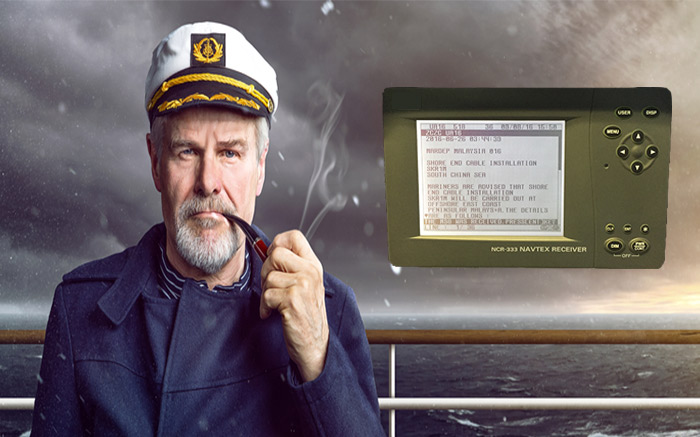
Do you struggle to sort out navtex warnings ? If yes, you are not alone.
Many believe that Navtex is not a perfect equipment for ocean going ships to receive nav warnings. I will be neutral to that statement. The reason is we do not receive in-force navtex list and so we cannot be sure if we have received all the navtex messages or not.
But not being perfect equipment for ocean going ships does not mean that it is of no use to us.
The only way you can use this imperfect equipment perfectly is by knowing everything about it and by keeping the navtex receiver in good shape.
I noticed that we have many questions related to Navtex that come to mind when we think of Navtex. And I thought best way to discuss Navtex would be to answer these questions individually. So here are the 20 questions about navtex and the answers to these 20 questions.
Lets Start…
1. Navtex: What it is ?
Navtex is short form for Navigation telex and as the name suggests, it is a one form of communication mode. Only thing is that it is for one way communication. What we have on board is a telex receiver, which receives navigational warnings sent by the Navtex station.
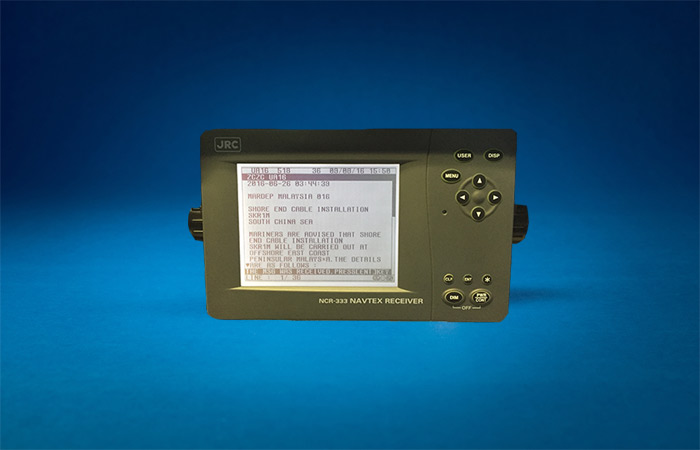
Navtex was developed to provide low cost, simple and automated maritime safety information to the ships in coastal waters.
Navtex is part of GMDSS equipments which is required to be fitted onboard every ship as per SOLAS Chapter IV Reg 7.
2. What is the source of Navtex messages
Navtex station receives these messages from navtex coordinator who in turn receives these messages from various sources. These sources include Meteorological office, Hyrdographic office or rescue coordination centers (RCC).
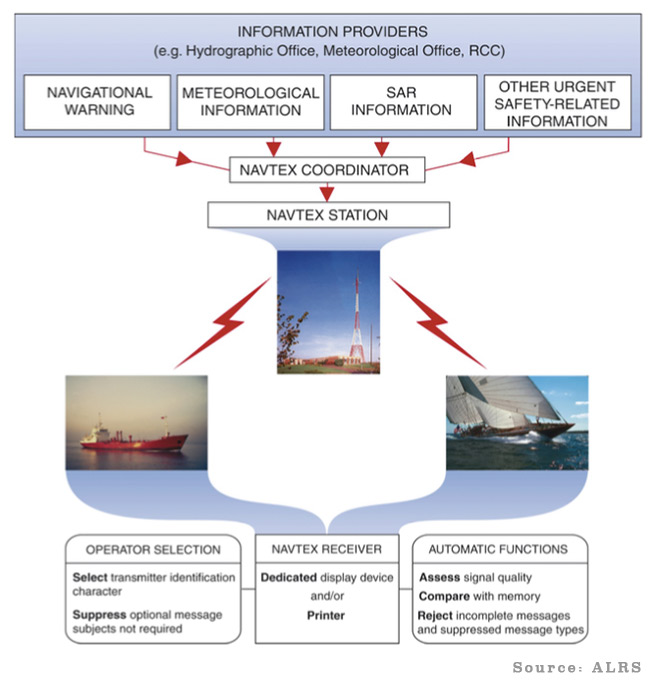
3. What is the difference between service area and range of the Navtex station ?
A navtex station have a pre-defined area for which it is responsible for sending information. This is called service area of navtex station. The Navtex coordinator of the country decides the service area for the navtex station when it is being set up initially.
If it does not overlap the service area of a navtex station of another adjoining country, usually there is no issue for the navtex coordinator to set up service area.
But if case any dispute over setting up the service area for a navtex station, IMO navtex coordination panel helps in setting this up.
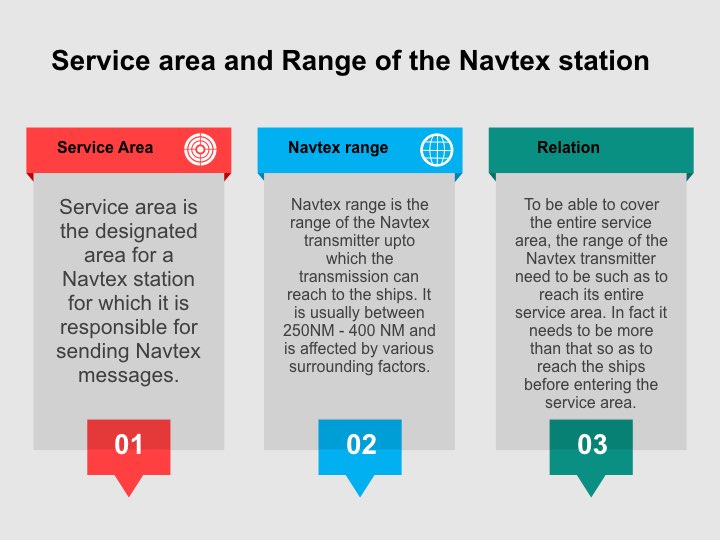
The range of transmitter of the navtex station need to be sufficient to cover its service area. In fact it need to be more than the service area of the navtex station. This way the ship’s proceeding from outside the service area can receive the navtex messages before entering the service area.
4. Do all navtex stations have equal range ?
As I said the range of the transmitter of the navtex station need to be sufficient to cover its service area. Each navtex station can have different size of the service area and hence the range of the transmitter of each of the navtex station will be different.
Exclusive Bonus: Download PDF version of these question answers
5. How can we know the transmitter range of a navtex station ?
This information is available in the ALRS or ADRS 1,3,4,5.
For example let us find the transmitter range of “Chennai” navtex station.
Open ADRS 1,3,4,5 on the dedicated computer and select “Navtex” under “View” option. From the left menu (Geographical area) scroll down to India.Under navtex option, click on Chennai.
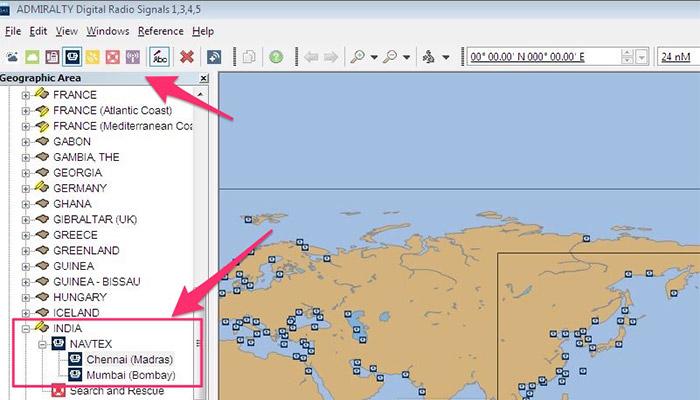
This will open a pop up showing the information about Chennai navtex station.
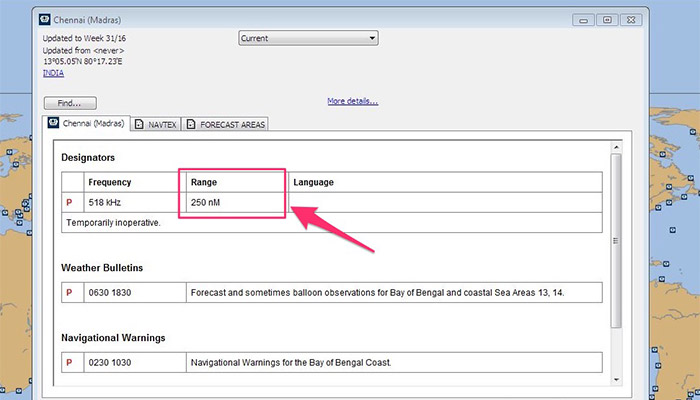
As we can see that Chennai navtex station has a range of 250 NM.
6. How to know which navtex station will be in range on my passage ?
Same like above, We can find this information in the ALRS or ADRS 1,3,4,5. Just open ADRS Vol 1,3,4,5 on your dedicated computer and make sure Navtex is selected from “View” option.
This will give you all the navtex stations which you can zoom the map to view a particular one you might be looking for.
Otherwise you can choose the area (or country) from the geographical area selection panel from left menu bar.
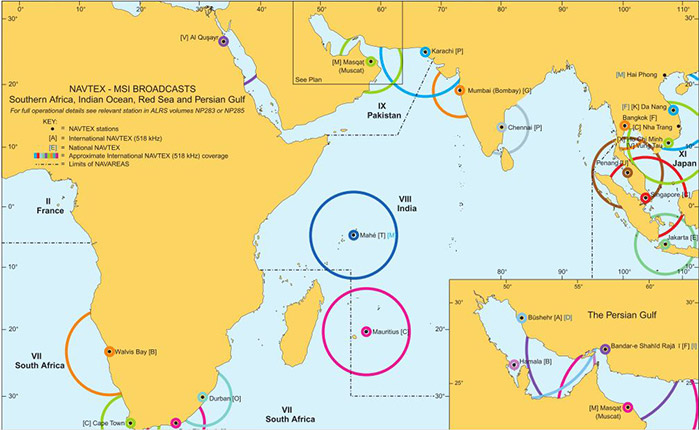
You can then see which all navtex station you can expect in your passage.
7. At what time a navtex station transmits the navtex messages
Like our phones, Navtex also cannot receive two transmissions at the same time. While receiving transmission from one station, the navtex will reject the reception of second transmission if received.
For this reason, each Navtex station is alloted fixed time to transmit their messages. Each Navtex station type (Character B1) get fixed 10 minutes of time to transmit the message.
The time schedule is as follows
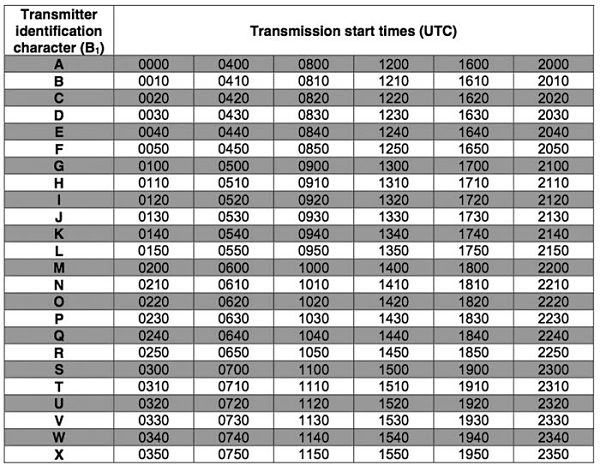
8. Can Navtex station send a message outside these timings
Yes, they can if the message is of utmost priority. There are three message priorities that a navtex message can have.
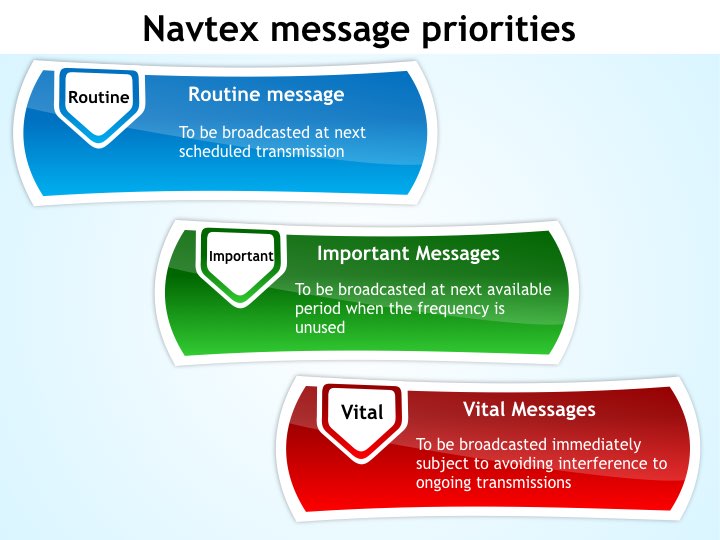
Vital messages will be broadcasted immediately and do not need to wait for the scheduled transmission.
9. Do Navtex station repeat all the messages in each transmission
Navtex station repeats all the valid messages in each transmission provided it can be transmitted in allotted 10 minutes time.
The navtex receiver onboard stores the successfully received messages for 72 hours. In next transmission, if vessel is still in the range, it will only receive and print any new messages.
Now let us say that you received the navtex messages just now. And you wish to receive all the messages again in next scheduled transmission of the station.
You can switch off the navtex receiver and then switch on again. This will clear the memory from the Navtex and you will receive all the valid messages again.
10. What if I have received few corrupted message
As I pointed out in previous question, we can switch off and switch on the navtex again. During next scheduled transmission, you will receive all the navtex messaged again.
But if you will be in the service area of the navtex before next transmission, you can send the email to the navtex co-ordinator about the corrupted message.
This way not only you will get the corrupted message by email but also you have given a feedback to the navtex station about the corrupt message.
11. How does navtex station sends navtex messages
The Navtex station sends these message on a designated frequency and we receive it on board if we are in range of that navtex station.
If you have a thing for numbers, then here are few numbers you may wish to know
- Navtex uses frequency 518 KHz for transmitting messages in english.
- Navtex uses another frequency 490 kHz for transmitting messages in local language.
- The range of the navtex transmission is between 250NM to 400NM
12. What is the format of Navtex message
Every navtex message starts with letters ZCZC which indicates the start of the message. This is followed by two letters (we call it B1B2) and two numbers (B3B4). In the last, end of the message is denoted by “NNNN”.
The entire process of receiving the transmission from a navtex station looks something like this.
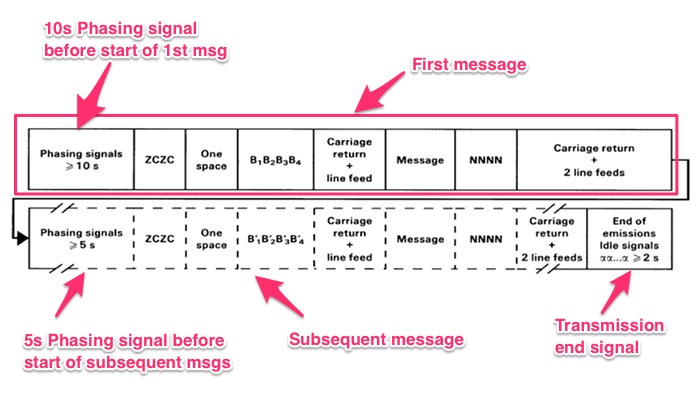
ZCZC : As I said it denotes the start of the message
B1 : First letter denotes the identity of the navtex station broadcasting this message. This can be anything from letter A to Letter X.
B2: The second letter denotes the message type.
B3B4 : The two numbers denotes the message number of the navtex message.
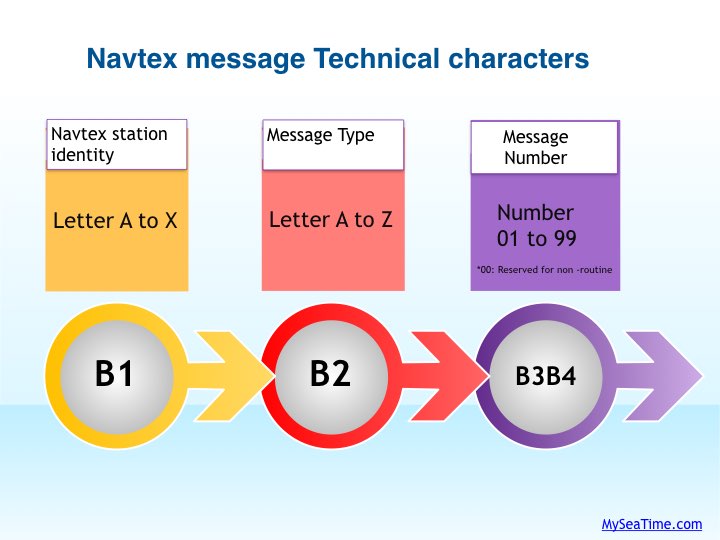
NNNN: indicates the “End of the message”
Here is the actual navtex message received on ship’s navtex. Can you identify the format described above ? I am sure you will be.
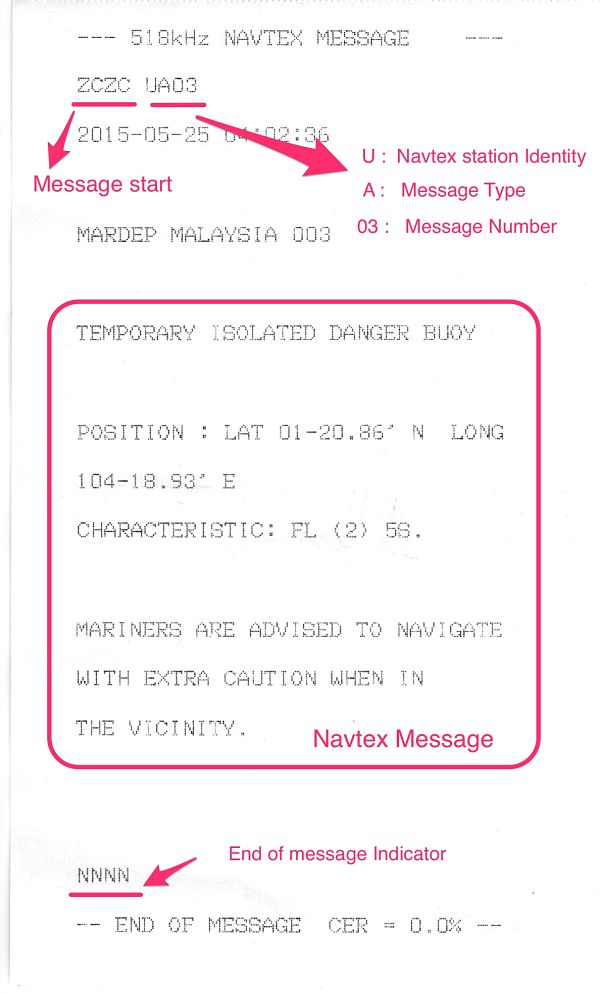
13. What does phasing signal means ?
This is the signal that is used to lock into the transmission of a particular navtex station. Now if this signal is not used what can happen.
If there is another station in range and which also sends its transmission, the message will be corrupted. This is because navtex receivers will try to receive messages from both the stations.
When a particular station is locked in with the phasing signal, navtex receiver will block reception of all other stations.
14. What are the type of messages received through Navtex
As I said earlier character B2 in navtex message identity represent the type of navtex message. A letter from A to Z denotes the message type. For example letter A means the message type is “Navigational warning” and letter B mean the message type is “Meteorological warning”. Here is the list of what all message type we can receive through navtex.
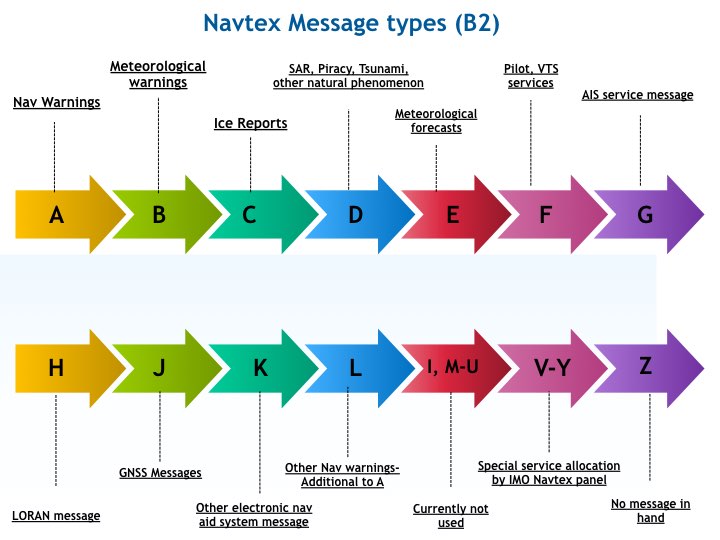
15. How do we know what type of messages will a Navtex station send in each transmission schedule
We can find this information in ALRS or ADRS 1,3,4,5. For example if we look for Manila Navtex station, you can find its transmission schedule as well as what type of messages will it send during each transmission.
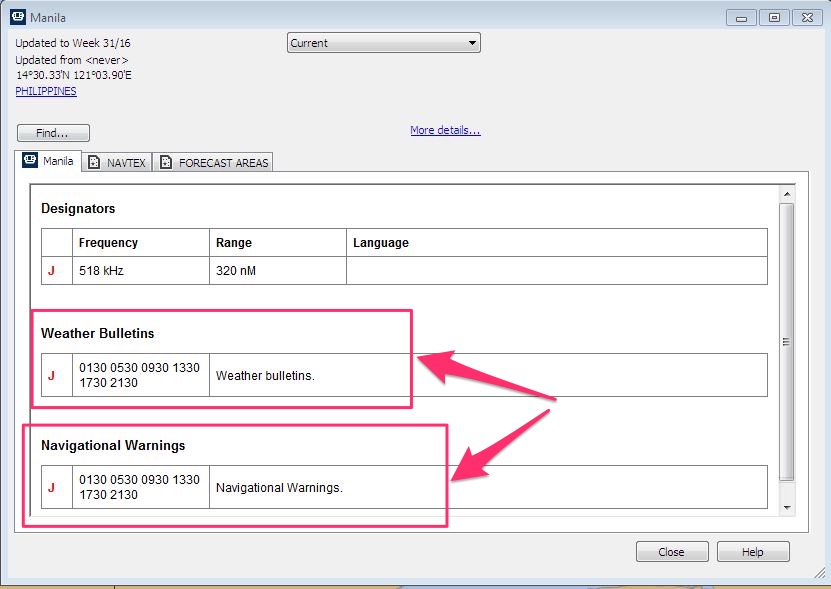
16. How the message number (B3B4) allotted to a Navtex message ?
The message numbers are given between 01 to 99. When a navtex station is first set up and it sends its first message, it will be numbered as 01.
After that the message number count will keep on increasing until it reaches message number 99. Now when the message number reaches 99, there can be 2 possibilities
- There can be few messages (from 01~99) that are canceled or
- All the messages are valid
If there are some messages that are cancelled, the next message after 99 will get the message number of first cancelled message after 01. This cycle goes on.
Let us understand this with an example.
A Navtex station (B1=P) has sent total 97 message since it was put into service few day back. In these 97 messages, message number 03, 11 and 16 are cancelled. Its next scheduled transmission is after 3 hours and it got 3 new Nav warnings (B2=A) to send. What will be the message identification of these 3 messages.
Think.
You Got it. right ?
PA98, PA99, PA03. I hope you have same answers.
Now let us see the second condition. In case all the 99 Navtex messages are valid. In this case the navtex station will use the message type “L” for issuing new nav warnings through Navtex.
17. Do Navtex stations send the in force warning list ?
IMO encourages Navtex stations to send the in-force list every week. But most of the times you would not receive the in-force list.
Navtex stations have limited time (10 minutes) to transmit the messages. Including in-force list will only reduce the time for actual transmission.
Though I have experienced that Japan Navtex stations send in-force list every week.
We can download the in-force warnings from the internet (Official sites of the navtex stations) but
- This is highly discouraged by IMO as well as industry experts like Oil majors.
- Not all nav area coordinators have the in force list for navtex posted on the web
Even if navtex stations send the in-force list every week, not all ocean going ships will receive it. Ship will pass the service area of the station in less than one day. So if the ship passes this area on the day other than the day in-force list is sent, they will not receive it.
18. How do I know if I have received all the navtex warnings ?
We cannot know for sure if we have received all the Navtex warnings. We have to assume that we have all the Navtex warnings.
But the best we can do is to keep the Navtex receiver in good condition so that it does not miss out receiving any navtex messages.
Also we should select the correct station well before entry into the service area. It is a good practice to select all the station that would be in our range during the passage, before we begin the passage.
Apart from following the Maker’s guidelines for maintenance, cleaning of navtex antenna can increase the reception quality.
19. Do I need to log the Navtex messages in the GMDSS log
As per SOLAS Chapter IV, reg 17 we need to maintain the radio records for all the importnat activities. But IMO has clarified this that we are not required to log receiving navtex messages in the GMDSS log. Maintaining the print out of the navtex messages is sufficient to satisfy the regulation 17 of the SOLAS chapter 17.
20. How to plot navtex warnings on chart.
Plotting navtex warnings on chart is no different than plotting any other warnings. This guide on navigational warnings can be useful for information on how to plot navigational warnings on chart.
21. Do you have any other question that I may have missed
Ya I know I said 20 questions but this final question is from me to you. Do you have any other question that I may have missed. I would be happy to include that.
Conclusion
Naxtex is as important equipment as any other equipment on the wheel house. But sometimes we tend to give Navtex a step motherly treatment by keeing it last in priority list. One reason for that is we are never sure how to handle Navtex.
If we know how it works and how best we can handle Navtex on board, handling Navtex messages will be as easy as eating a pie of cake.
5 Tanker Terms That Can Help You in Being Safe On Tankers
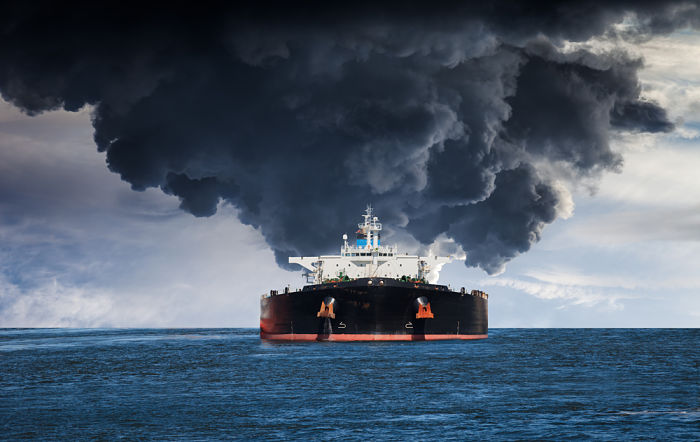
Did you know a rich flammable mixture can ignite with just 1 Joule of energy ? If that does not surprise you yet, let me tell you how much energy we are talking about here.
By just rubbing your hands with force for just one time produces 12 Joules of energy. Surprised ?
When the ships started exporting oil cargoes, people were too afraid to sail on them. And those who sailed on them had to listen to something like
You are sailing on a bomb, you never know when it is going to explode.
And they were absolutely right about that. Back then there were no procedures and controls to mitigate the risks imposed by carrying flammable cargoes in bulk.
Fast forward today and we have all the controls to avoid explosions on tankers.
But irrespective of type of tanker and controls in place, explosions are always a concern. But what will be a even bigger concern is the people working on tankers not knowing about these controls and the basic terms used on tankers.
Well I am sure we all have gone through basic and then advanced courses on tanker operations. But sometimes all that we are taught does not seems to sink in.
In this post we will discuss 5 of the basic terms very commonly used on tankers.
1. Fire Triangle
Ahh !! We all know what is fire triangle ?
But when we talk about safety on tankers, fire triangle has to have first mention. It is because every thing we are doing for the safety on tankers is to avoid the three sides of the fire triangle to meet.
Fire needs three things to start and continue burning. Fuel, air (or Oxygen) and source of ignition. And when three of these meet, Fuel will catch fire.
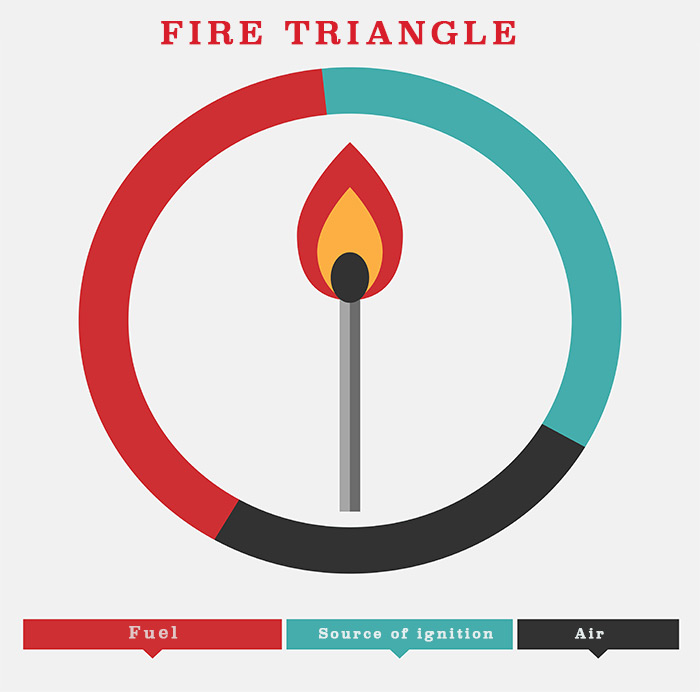
On tankers all the three are present in abundance.
The cargo carried on tankers acts as fuel. Air is present on tankers as it is present elsewhere. And there are few but enough sources of ignitions which if not controlled can make a tanker explode.
Our only aim is that these three elements of a fire triangle should not be present at the same location. In fact almost all fire safety related regulations are based on achieving this.
For example, regulation for inert gas is for reducing the oxygen level in the tank. Not allowing lighters, match boxes on deck is for removing the source of ignition.
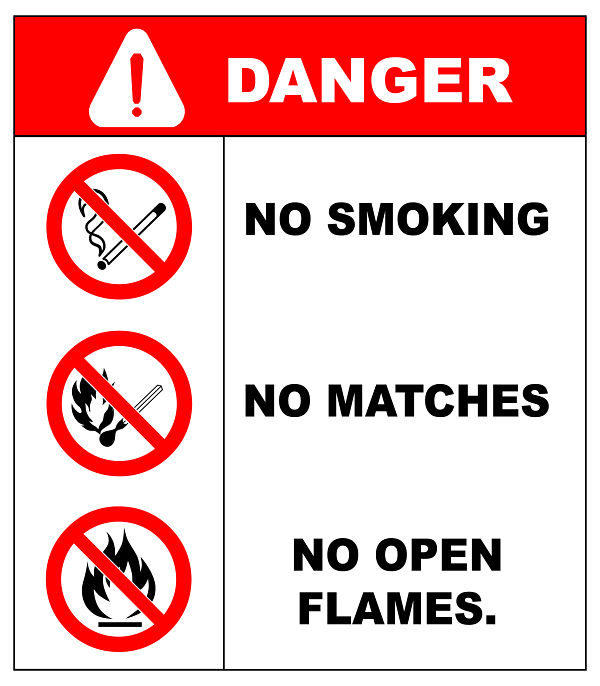
Requirement of maximum Loading rate of 1 m/s for static cargoes is to avoid a spark inside a tank (source of ignition).
There are many things we do on tankers to ensure that three elements of the fire triangle do not meet. Even the deck foam system used for deck fires uses the smothering effect to extinguish fire, which aims to remove one element (air) from the fire to extinguish it.
When we follow these guidelines, we succeed. But if we do not then this there can be explosion and casualties . Only the knowledge of the atmosphere on and around tanker vessel can help in avoiding these situation.
2. Flammable limits
Let me ask a question. You are on a tanker and you measure the atmosphere of cargo tank by a portable gas meter. The reading shows 80% LEL value. Now if there is any spark inside the tank, will the tank explode ?
If you know the answer, well done. If you do not know or are in doubt I hope you will get the answer in this post.
As I said fire (or explosion) needs three things to occur. If we leave aside the spark, for something not to explode, either there should be insufficient fuel or insufficient oxygen or both.
Lets talk about insufficient fuel. How much less is insufficient ?
A 10 litres Jar containing 1 litre of gasoline will explode if we spark it. But a 10000 m3 tank containing same 1 litre of same gasoline may not explode.
This is because It is not the fuel that burn but the vapors. A mixture of hydrocarbons and air cannot be burned unless its composition is in the correct range. This range is called flammable range.
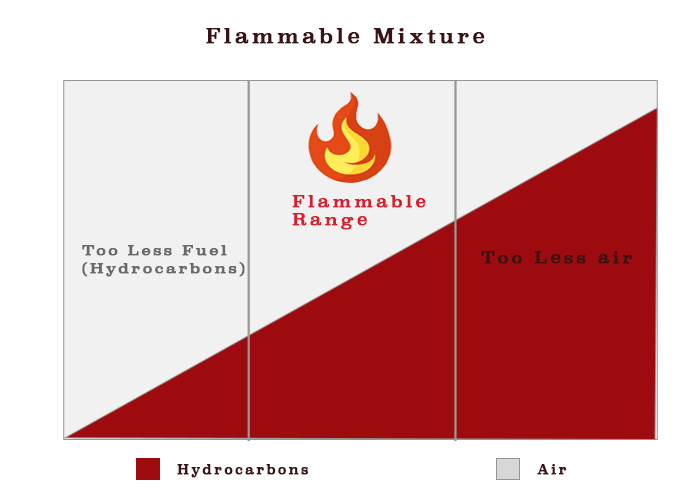
Vapors of 1 litres of gasoline in 10 litres jar are enough for ignition but in 10000 m3 tank, these are too small and will get diluted in the air inside the tank.
This concentration of hydrocarbons is measured as percentage of volume.
When we say 10% hydrocarbons by volume inside the empty tank of 10000 m3 capacity, it means around 1000 m3 of hydrocarbons are present. Rest 9000 m3 is air.
Now how much percentage of volume of hydrocarbons is insufficient to burn ? Each gas will have different percentage. Isn’t it ?
For example, for propane this concentration is 2.3% and for pentane this concentration is 1.5%.
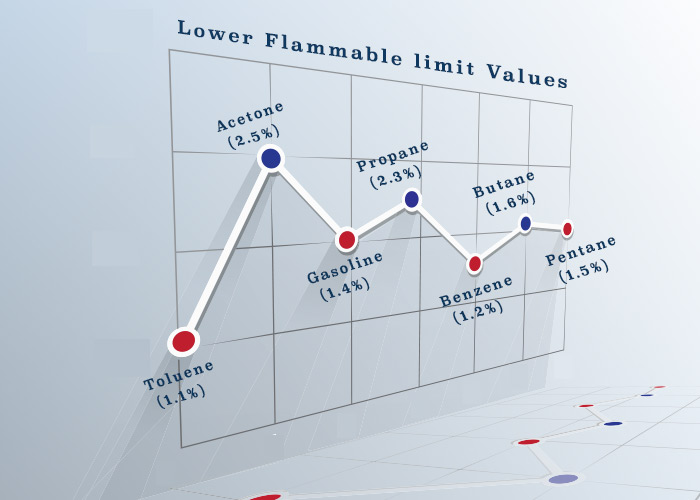
If the concentration of propane in a tank is 1.5%, and we spark it, it will not burn. That is because the concentration is below minimum required to burn the mixture of air and propane.
This minimum concentration of hydrocarbons required in the air for it to be able to ignite is called lower flammable (or explosion) limit.
Want the text book definition of lower flammable (or explosion) limit ? Here it is..
Lower flammable (or explosion) limit is the concentration of hydrocarbons below which there is insufficient hydrocarbon to support and propagate combustion
Now let us talk about the insufficient oxygen.
When oil is placed in a container, it has a tendency to vaporise. Different liquids (and different oils) have different tendency to vaporise. The amount of vapors emitted also depends upon the surrounding temperature.
The concentration of these vapors dilutes the concentration of other gases in the air including oxygen.
At some point, these vapors may dilutes the air to a level when there is insufficient oxygen to ignite these vapors.
This concentration of hydrocarbons is called upper flammable (or explosion) limit. The text book definition of UFL is
Upper flammable limit is the concentration of hydrocarbons above which there is insufficient air (or oxygen) to support the combustion.
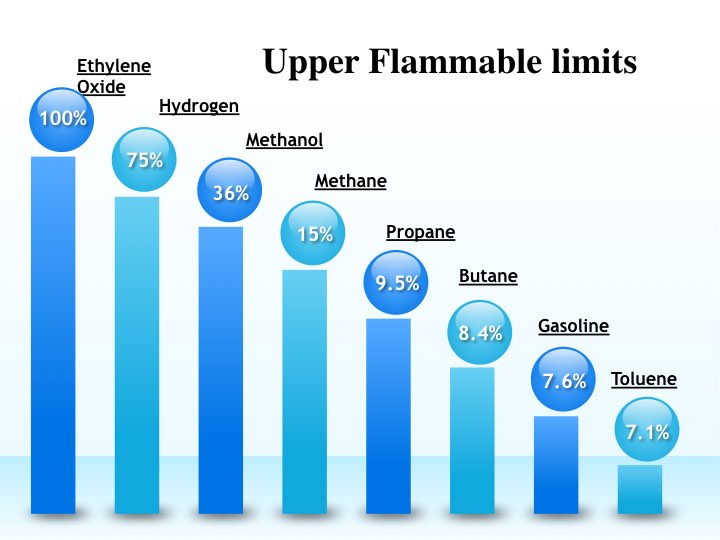
Again let us take example of propane. Propane has UFL of 9.5% by volume. So if the concentration of propane is 11%, we can say that there will not be enough air to support combustion and this mixture will not ignite.
Now lets say you measure the concentration of butane in a tank and found it to be 2.0% by volume. Are you in flammable range ?
Ahh !!
You need to check what is the lower explosive limit of Butane. Right ? And so do we need to know the LEL of each cargo we load. That sounds like crazy. But wait, how about this ?
What if we say for any cargo or flammable liquid,
LEL by percentage of volume = 100% LEL. And then we get an equipment to measure percentage of LEL.
So, for propane 2.3% Volume = 100% LEL
Now if this equipment shows a reading of 70% LEL, it means it is 30% below the lower explosion limit.
Returning back to our question, we now understand that when we say 100% LEL, we have just touched the lower explosive limit. Anything below 100% LEL, we are not in the flammable limit.
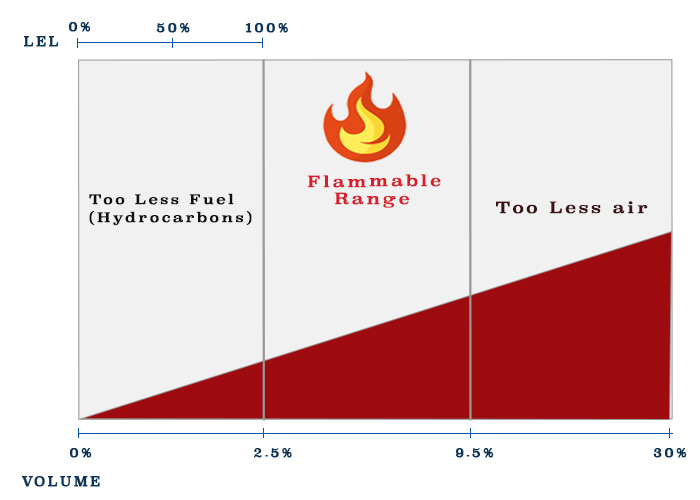
When the concentration is above 100% LEL, we need to measure the concentration in percentage of volume.
Now have you ever come across this flowchart ? This flow chart is from ISGOTT.
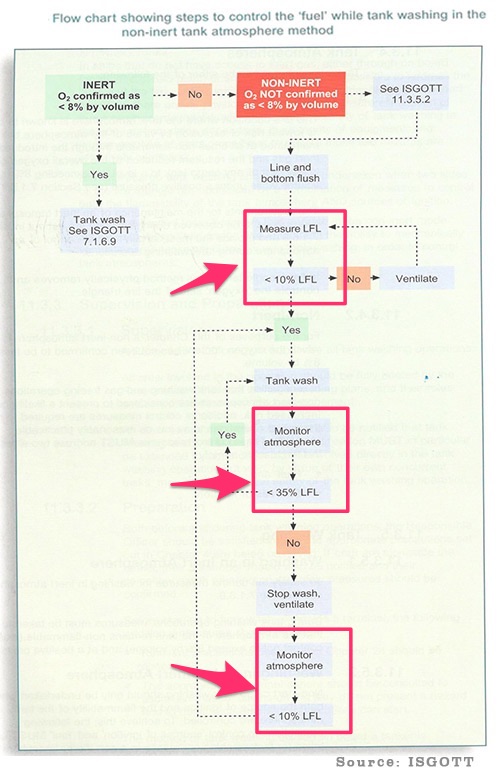
This is the flowchart for tank cleaning on oil tankers in non-inert atmosphere. If you notice the flowchart tries to maintain the hydrocarbon concentration between 10% to 35% LEL. The whole idea is not to allow the tank atmosphere reach in the flammable range (100% LEL).
3. Flash Point
Flammable liquids has a tendency to vaporise. Some of the the vapors also turns back into the liquid and these finally attain an equilibrium state. At this equilibrium state, these flammable liquid may have a mixture of hydrocarbon and air that is between LFL and UFL (flammable range).
But not all the flammable liquids will be in flammable range at this equilibrium. This depends upon the tendency of the flammable liquid to vaporise.
It won’t be hard to believe that with more temperature, the liquid will vaporise more. And at some temperature it will release sufficient vapors to form a flammable mixture.
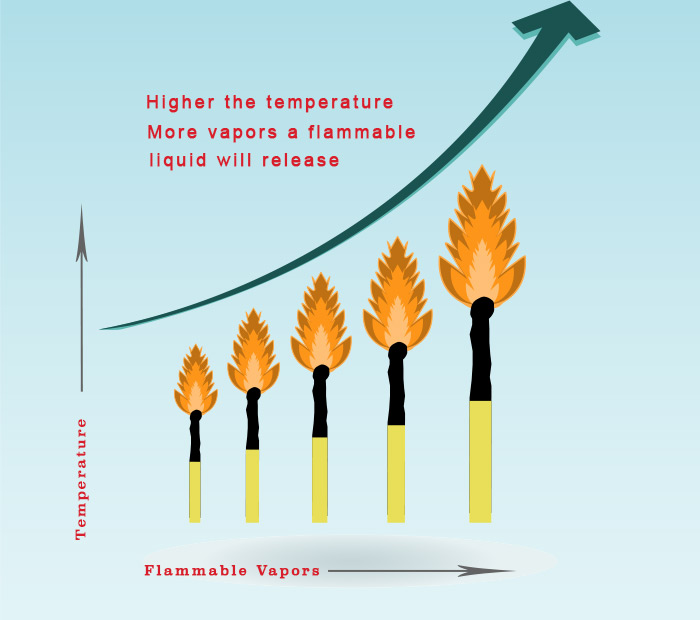
Flash point is the minimum temperature at which the liquid emits sufficient vapors to form flammable mixture with the air.
Flash point is calculated by heating a liquid slowly and then a spark is applied to the surface of the liquid. The temperature at which surface of the liquid catches fire indicates the presence of flammable mixture. This temperature will be the Flash point of that liquid. This method of determining the flash point is called close cup method.
Now why knowledge of flash point is important ? If the flash point of a liquid is less than the ambient temperature, it just needs a spark (source of ignition) to explode. We need to have more stringent controls for these cargoes.
This is also the criteria for determining the cargoes that would need stringent controls. Industry has set the ambient temperature criteria as 60 C as a safety margin.
Liquids with the flash point of less than 60 C are called volatile liquids. And the one with flash point above 60 C are called non-valatile liquids.
4. Flammability Diagram
Anyone who is or have been on tankers would have seen this diagram called “flammability diagram”.
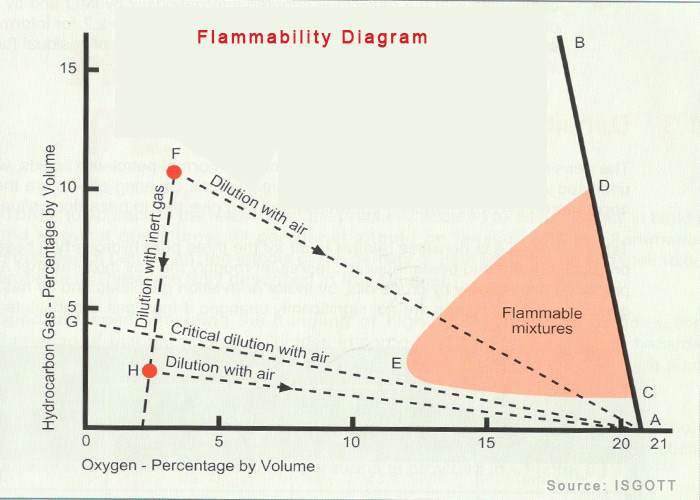
The principle used in the flammability diagram is simple. It emphasizes on the fact that at no point we should be in flammable range during a critical operation. It also shows us a way to do it.
The principle used in the flammability diagram is simple. It emphasizes on the fact that at no point we should be in flammable range during a critical operation. It also shows us a way to do it.
Let us say our cargo tank is at point F (10% flammable cargo vapors, oxygen reduced by inert gas). We wish to gas free the tank to arrive at point A where there are no flammable vapors and oxygen content is 21%.
If we start putting air inside the tank, the decrease in concentration of flammable vapor and increase in oxygen level will follow a line FA. This passes through flammable range which we need to avoid.
It is thus required to first reduce the concentration of flammable vapors by inert gas to a point H . After this when we introduce air inside the tank, the dilution of flammable mixture will follow the line HA which ensures that we are never in the flammable range during this process.
Knowledge of flammability diagram reminds us how important it is to be outside the flammability range.
5. Exposure limits
While we cannot deny that flammability is the top concern for anyone involved with the tanker operations. But no one can deny this too that human exposure to toxic gases is will be a close second if not top concern.
It is the fact that many of he cargoes carried on all tankers contain deadly gases like benzene and H2S. Even WHO has recognised the exposure to benzene as a major public health concern. This makes it of utmost importance that a person taking first step on a tanker is aware of presence and exposure limits of these gases.
To know how best to protect ourselves from the health hazards of these gases, we must know the terms related to exposure limits.
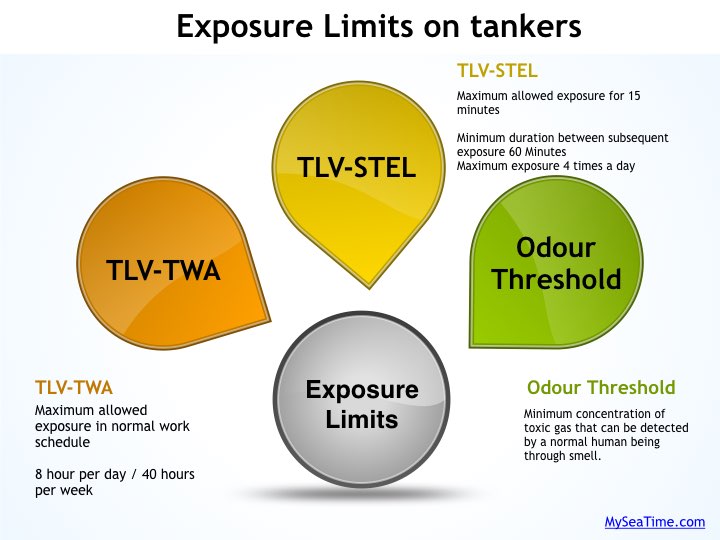
i) Threshold limit value (TLV)
This is also sometimes known as Permissible exposure limit (PEL). However the term PEL is not used on tankers these days. This is because the word “permissible” gives the feeling of allowed. Though this is safer limit but we need to aim for minimum exposure (and not the permissible exposure) of toxic vapors. Threshold seem to be a better word for that.
TLV is the maximum concentration of toxic vapors that a person can be subject to each day without any adverse health effect.
Though there are three types of TLVs , persons working on tankers should know at least two of these.
TLV-TWA (Threshhold limit value – Time weighted average)
This is concentration of toxic vapours that a person can be subject to continuously for 8 hours in a day without any adverse health effect.
TLV-TWA takes into account the normal working schedule of 8 hours per day and 40 hours per week.
TLV-STEL (Threshold limit value- Short term exposure limit)
TLV-STEL is the maximum concentration of toxic vapours that a person can be subjected to for a short duration of 15 minutes without any adverse health hazard.
Since STEL is for shorter duration than TWA, it will always be more than TWA value. But does that mean we can expose a person to the value of STEL for 15 minutes, take a break for 5 minutes and then again expose him for 15 minutes. A time duration need to be set. Right ?
So if a person is exposed to toxic vapors concentration above TWA but below STEL,
- The person can be exposed to maximum 15 minutes
- The minimum duration between subsequent exposure should be 60 minutes
- Exposure cannot be more than 4 times in one day
ii) Odour threshold value
This is the minimum concentration of toxic vapors at which a normal human being can sense the smell (odour) of the gas.
Why it is important to know the odour threshold value of a toxic gas ? If odour threshold value is more than TWA or STEL, you may get exposed to the toxic gas before you can even smell the presence of the toxic vapours.
Everyone working on tankers must be aware of the exposure limits of the vapours released by the cargo onboard. And they should not enter any compartment which has the vapour concentration in excess of these exposure limits.
Conclusion
Every vessel type have some must know terms. And like all the vessels, tankers too have some of these terms which any one associated with tankers must know before they board a tanker. On tankers these terms are related to the flammability and exposure limits of the toxic vapours.
Knowledge of these terms helps the seafarers in identifying the risks. And once you know the risks, it just needs you to follow standard practices to mitigate these risks.