
Infographic: A Comparison Between Hague Rules and Hague Visby Rules
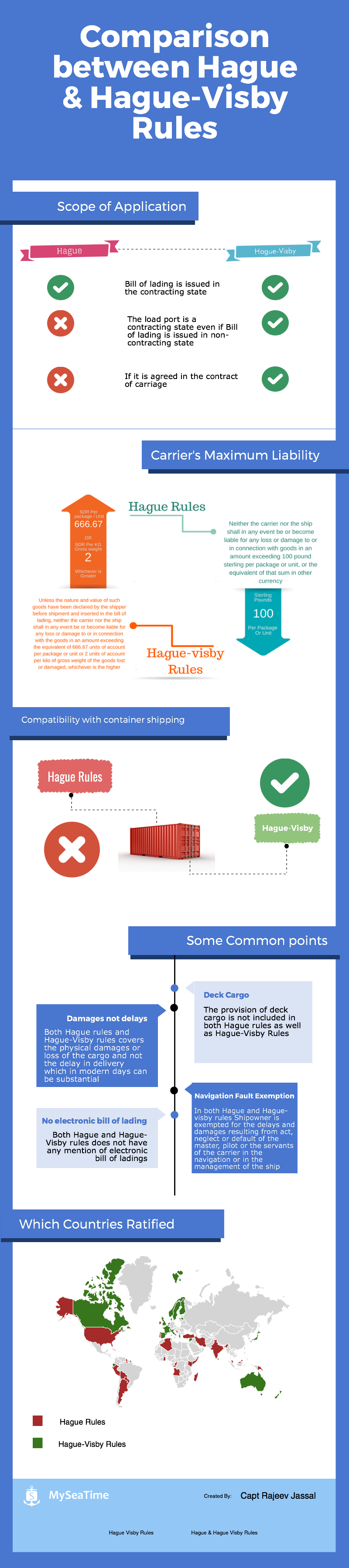
Hague rules brought a balance between shipper-carrier agreement. Before these rules the contract of carriage used to be in favour of the party that had the edge in the shipping market.
But there were few weaknesses in the Hague rules. To address these weaknesses, more modernised version of Hague rules were introduced.
These rules were called “Hague Visby rule“.
Hague and Hague Visby rules are often compared. This infographic draws a comparison between these two rules used in contract of carriage.
Conclusion
Even though there have been more moderanised rules for contract of carriage such as Hamburg rules and Rotterdam rules, Hague Visby rules are here to stay.
The Hague rules are slightly in favor of shippers. The Hague Visby rules are considered to have an advantage to the carrier compared to the Hague rules.
The ship owning countries have ratified the Hague-Visby rules. Where as the shipper prominent countries like Malaysia has not ratified the Hague visby rules and are happy with Hague rules.
5 Basic Marine engineering Principles Every Deck Officer Must Understand
I am sure all seafarers will be on same page when I say seafarers are over occupied with their own work on ship. But if deck officers specially senior officers do not understand the basic marine engineering principles, it can create a communication gap.
This communication gap can be critical during emergencies related to engine room.
But it can be of great help during engine room related urgencies if deck officers have the basic knowledge of engineering principles.
We all would agree that shipping is more commercial these days. In case of engine break down, every one ashore need to have an update every single second.
It is of great help if someone other than chief engineer (who will be extremely busy) can communicate with the shore staff.
But to do so deck officers need to understand at least the basic engineering principles.
So in this post we will discuss at least 5 of such engineering principles. As this post is mainly for the deck officers, I will not go deep into the engineering part. I will just stick to the overview of these principles.
Let us start.
1. How an engine works
I think this is basic stuff but each deck officer must know the principle of how an engine works. We all have studied this in school physics.
In a four stroke diesel engine, engine moves in four stages.
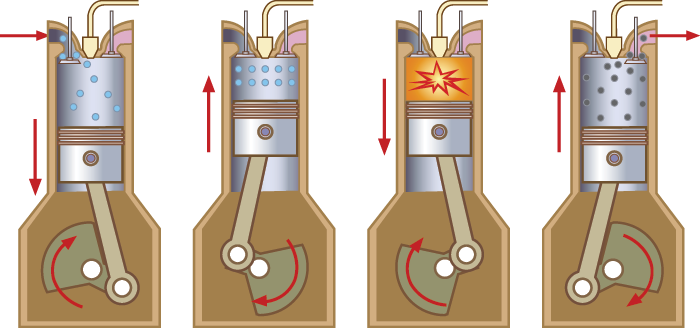
- In the first stage (Suction stroke) the piston moves down and it sucks air into the ignition chamber.
- In the second stage (Compression stroke), the piston moves up and compresses the air which increases the air temperature and pressure inside the combustion chamber. At the end of the compression stroke, fuel is injected in the combustion chamber.
- In the third stage (power stroke), the fuel gets ignited that produces the power which pushes the piston down.
- In the fourth stage (Exhaust stroke), the piston is pushed up because of inertia and it throws out the exhaust gases.
Watch this video on how a diesel engine works.
2. Main engine air starting system
Most of the ships would have the main engine air bottle pressure showing on the wheel house. This is an important information that the bridge officers should have on the bridge.
So what exactly is the main engine air starting system and why do we need it ?
We have discussed that there are different stages of running of an engine. For example the engine rotates the propeller because the piston is continuously moving up and down which compresses the fuel mixture to ignite it.
This is the continuous process until we stop the engine by cutting off the fuel supply.
But from where the engine gets its initial energy, when the engine is stopped and we give it a moment to dead slow ahead.
To initially burn the fuel, the piston need to move up and compress the fuel mixture. But the piston cannot move on its own. This is where starting air system is used.
This starting air is provided from the air bottle that is continuously filled by the main air compressors.
To start the engine, a minimum pressure of air is required. If the bottle pressure drops below this minimum level, the engine cannot start and we have to wait until the bottle is filled.
There can be few reasons of air bottle getting empty.
1) We have given too many consecutive starting kicks on the engine.
The starting air system of a ship is designed to provide sufficient air to give a number of consecutive kicks. For example it may be that starting air system is designed to give 12 consecutive kicks in one minute.
If during maneouvring, we have given more than 12 consecutive kicks in a minute then we may find ourself in a situation where there is no air to start the engine.
All deck officer must know the number of consecutive kick they have at their disposal. In fact this information is also a part of pilot card and master pilot exchange. Most of the times, we can get this information from the wheel house poster.
2) problem with air compressor
We usually have two air compressors for main engine. One of these compressor has the source from the emergency supply and is the emergency compressor.
Now if one of the compressor is not working, then it may be the case where one compressor is not able to fill the air bottle quick enough.
This is a dangerous situation. Even if the vessel has to sail out or berth in this condition, a thorough risk assessment must be conducted. It is important that we have the approval from the required authorities to sail in these conditions.
Even when we have all the permissions, we must ensure few points.
One of the main point is that if we have to sail with one working compressor, it is the emergency compressor that should be working.
This is because of the obvious reasons. In case of black out, we still should have a running compressor.
Even if the problem is with the other compressor, we can switch the faulty parts and make the emergency compressor workable.
3) Leaking air lines
We all have seen chief engineers so worried about the air line leak on deck as well as in the engine room. Given the severity of the situation if a compressor becomes faulty, we must understand his concern.
So leakage of air can also cause the air bottle getting empty too quickly.
Whatever the reason, during maneouvering deck officer must keep an eye on the air bottle pressure. If they see the bottle pressure dropping too fast, the engine room must be informed.
3. Turbo-Charging
In absolute lay man’s words, a marine engine burns fuel to generate heat energy. This heat energy is used to rotate the propeller through a shaft.
The shaft and thus propeller would turn faster when more and more fuel is burnt.
Fuel can only burn when it has sufficient amount of air. For example if we inject more fuel and there is only a small amount of air available, there will be unburnt fuel in the system. There are lot of other problems in case of unburnt fuel but let us not dwell the topic beyond our limits !!!
So the point is more air we have, the better a fuel will burn and better will be the efficiency of the engine.
In simple engine (without turbocharger), it can only burn fuel in proportion to the air that it can naturally suck during the combustion process (during suction stroke). So if we want to increase the power of the engine, we need to increase the size of the engine. This way it will be able to suck more air and thus burn more fuel.
But with turbocharger, engine can get far more air and thus its efficiency increases many fold.
Turbocharger uses the engine’s exhaust gas to rotate the compressor which supplies the air to the engine.
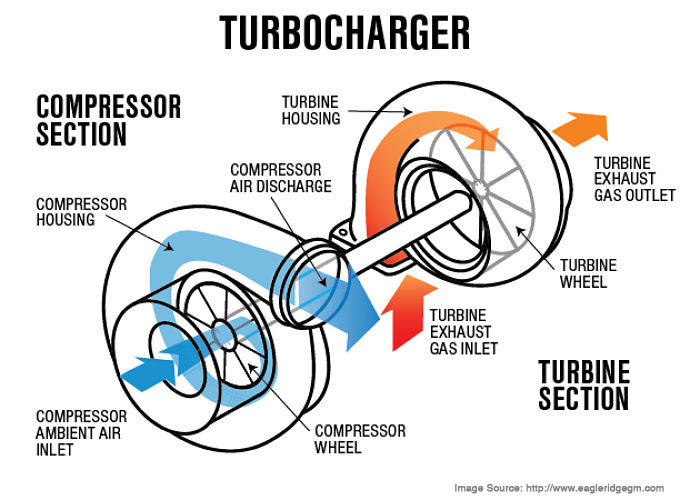
It has a turbine section and a compressor section. The engine exhaust rotates the turbine wheel. The turbine wheel is connected with the compressor wheel. As the compressor wheel rotates, it draws the ambient air which is supplied to the main engine.
Cool air is more dense than hot air and dense air can carry more volume of air than hot air. So if we can cool the air before supplying it to the engine, we are pumping in more air.
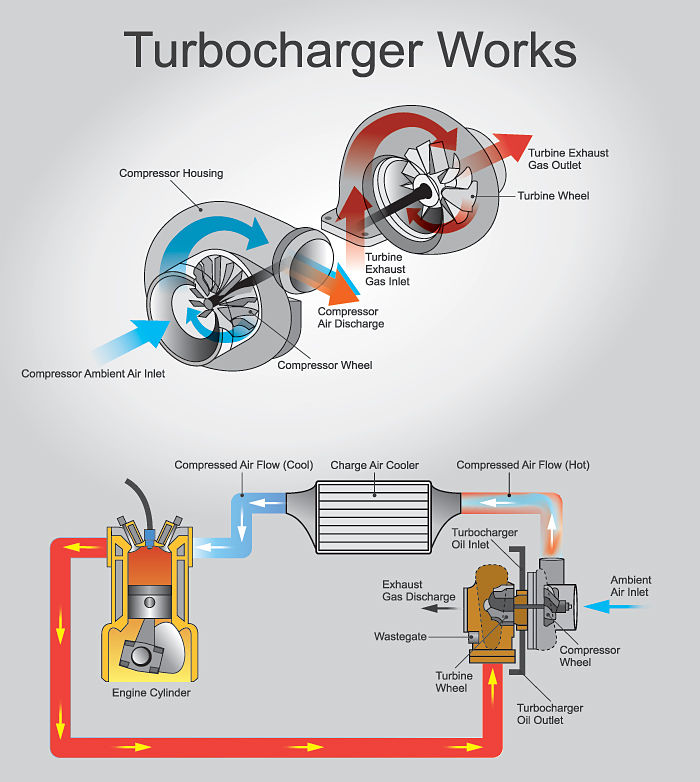
So the air from the turbocharger compressor is cooled by the air cooler before supplying to the engine.
So if I have to sum up function of turbocharger in few words, it will be like this.
Turbocharger uses the engine’s exhaust gas to drive the compressor which supplies the air to the engine.
If you still in doubt as to what turbocharger of a marine engine does, watch this video.
4. Scavenging
We all have heard about scavenge space. Most of the companies would also have a specific emergency checklist for the scavenge space fire.
If we have a specific emergency checklist for scavenge space fire, we as deck officers must know about scavenge space and the process of scavenging.
We can only handle these emergencies better if we know what we are dealing with.
So what is scavenging ?
A combustion cycle of four stroke engine has following four stages
- Intake
- Compression
- Power
- exhaust
After exhaust, a new cycle will start. For an effective new cycle, the exhaust gases need to escape from the engine and fresh air need to enter.
The process of pushing the exhaust gases and drawing in of fresh air for next cycle is called scavenging.
Scavenge space is the trunking from where the engine gets the fresh air during intake cycle.
The scavenge space need to be regularly inspected and cleaned. This space can have oil because of any oil leakages inside the engine (like cylinder oil).
Air and heat inside the engine completes the fire triangle and this space can catch fire.
In case of scavenge space fire, engineers have two objectives. To extinguish the fire and to avoid the damage to the engine.
To avoid the damage to the engine, the rpm would need to be reduced.
In case of UMS ships, this reduction in rpm could be automatic.
From the navigator’s point of view we must understand that in case of scavenge space fire, the rpm of the engine would need to be reduced.
So if we get a call from engine room to let us know about possibility of scavenge fire, we should be ready for the reduction of speed. It may even require to stop the engine completely.
5. Crankcase explosion
Crankcase is the space which has many of the engine’s moving parts. But the main part that it has is the crankshaft. Quite obviously the name “crankcase” is derived from the “crankshaft”.
I am not sure if we can say that it is the case (cover) for the crankshaft ?
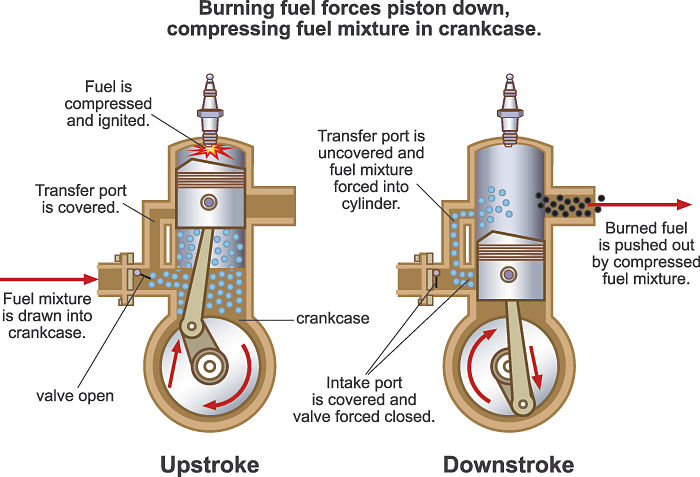
When the engine is running, lubricating oil used in crankshaft bearing splash around the crankcase.
This splashing creates a mist inside the crankcase but this mist is not of the level that can get ignited.
The oil mist detector fitted in the crankcase warns the ship’s engineers when the mist density has increased to the alarm point.
The mist density can increase because of many reasons such as hot spots inside the crankcase. There can be many reasons for the hot spots in the crankcase but the most common is the friction between the two metal surfaces.
The friction off course can be because of lack of lubrication or contaminated lubricating oil.
The bottom point is that whenever the oil mist gets ignited there can be explosion inside the crankcase.
Crankcase explosion is serious, far more serious than scavenge space fire.
As deck officer we must understand the severity of the situation in case of crankcase explosion and act to minimise its impact from our side too. Here is how ?
We must be aware that in case of crankcase explosion, engine rpm would need to be reduced and engine stopped. We must keep ourself ready for that and try to be proactive in quickly appraising ourself for the nearby traffic.
Even if there is no crankcase explosion, the engine rpm would still need to be reduced if the oil mist high density alarm is activated.
Reducing the engine rpm will reduce the temperatures inside the crankcase and thus will reduce the oil mist density.
Conclusion
Deck officers are not required to have a thorough knowledge of marine engineering. But knowledge of basic engineering terms used during ship operations goes a long way.
This post has discussed the five of these principles but we must try to keep gaining the knowledge of basic marine engineering term that we encounter during our tenure.
10 Things You Should Know About Fund Convention 92
I have earlier discussed at length about the civil liability convention. If you want to know about fund convention, I would strongly recommend reading the civil liability convention first as both are connected.
Here are few of the points to recap about civil liability convention.
- CLC applies to the pollution incidents of persistent oils.
- Leaving few exceptions, it is ship owner who needs to pay for the damages resulting from the oil pollution incidents
- The maximum liability of the ship owner in any one pollution incident would be limited to 4,510,000 SDR for the vessel up to 5000 GRT. For vessels more than 5000 GRT, maximum liability would be SDR 631 per addition GRT. Maximum liability, in any case, will not be more than SDR 89,770,000.
- All ships that carry more than 2000 T of oil as cargo need to maintain insurance equal to the ship owner’s liability as per CLC 92.
Let us come straight to the point. If we have the CLC convention then what is the need of fund convention?
1. Why Fund convention ?
Now let me tell you a story (I always like stories !!!).
There is a loaded oil tanker of 5000 GRT and it gets aground. The oil spilled into the water because of this grounding. The estimate of the damages because of this oil spills are more than 10 million SDR.
We all know that ship owner need to pay as per CLC convention. But as per CLC convention, his liability is limited to 4.51 Million SDR.
So who would pay for rest of the 5.49 Million SDR? That should be a cause for concern, isn’t it?
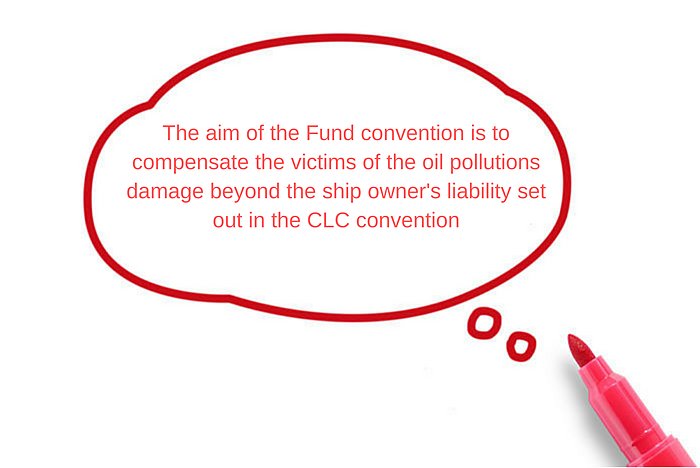
When the CLC convention was being adopted at the IMO, this was one of the unanswered questions. It was later decided to create a centralized fund that would be used where the limits of CLC convention ends.
But who would contribute to this fund? After much of thought process, it was decided that the parties that are direct beneficiaries of the oil trade should contribute to this fund.
Exclusive Bonus: Download the Bullet point list on fund convention
The whole oil trade exists because there are parties who need oil. If no one requires oil from other corners of the world, there would be no ships transporting oil and thus no chance of any oil pollution.
So in the countries which would ratify the Fund Convention, the receivers of the oil in that country need to contribute to this fund.
2. Who needs to contribute to the fund?
Article 10 to Article 15 of the fund convention deals with the contribution part of the funds.
As per article 10 of the fund convention,
Annual contributions to the Fund shall be made in respect of each Contracting State by any person who, in the calendar year has received in total quantities exceeding 150,000 tons
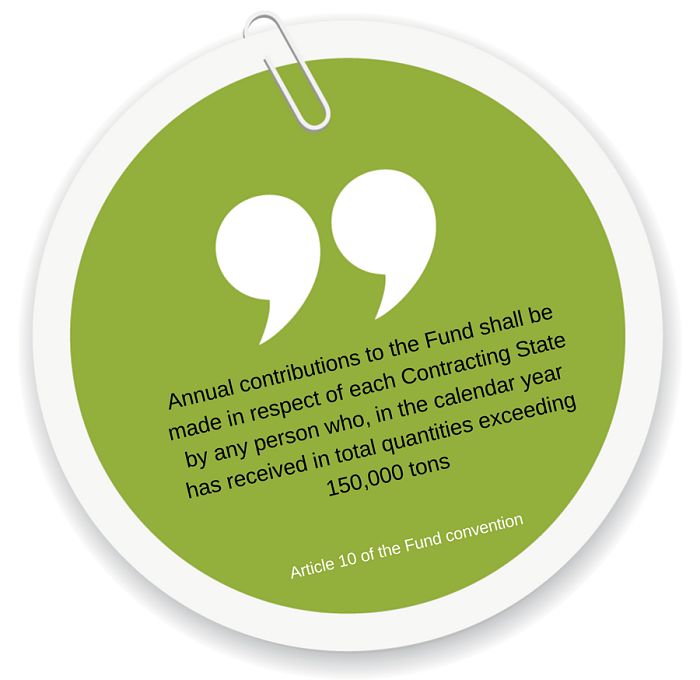
The idea is to put the burden of contribution only on the big players.
But to not to fall in this category, a receiver can try to have many subsidiaries, each one receiving less than 150,000 tons of oil.
Fund convention takes care of this. As per fund convention, the quantity of oil received is total for the receiver and any person associated with it.
It is the responsibility of each contracting state to give the list of the receivers who received more than 150,000 tons of oil in the calendar year to the IOPC Fund. It is also their responsibility to provide the tons of oil received by each of these receivers.
This is because the contribution to the fund is based on the amount of oil received by the receivers.
3. How much each receiver need to contribute?
The fund maintains a fixed balance to deal with the oil pollution damage payments. Every year it takes into account the total expenditures and total incomes to assess if any contribution is required for that year.
The expenses from the IOPC Fund may include
- Administration expenses like salaries of employees of IOPC Fund
- Payments made to cover the oil pollution damages that comes under IOPC Fund
The incomes to the IOPC Fund may include
- The interest received from the surplus funds
- Annual contribution from the members
So let us see this with an example.
After reviewing the expenditures and incomes, it is decided that USD 40 Million is required to be contributed to the fund. Let us say there are 100 receivers in all the contracting states who received more than 150,000 T of oil in the year. Total tons of oil received by all these 100 receivers is 500 Millions tons.
Let us assume, I am one of them (It feels so good to assume this !!!). I received a total of 200,000 T of oil in that year. How much I need to contribute?
Money contribution required per ton of oil is USD 0.08 (40 / 500).
Each receiver will need to contribute 0.08 USD for each ton of oil received. So I for one need to contribute USD 16000 (200,000 x 0.08) towards the fund.
4. Applicability of the fund convention
Fund convention is not a stand alone convention. It is connected to the CLC convention. Countries who have ratified the CLC convention only become eligible to ratify the Fund Convention.
Scope of application for fund convention is same as CLC convention, which is
- oil pollution damage resulting from spills of persistent oil from tankers
- pollution damage suffered in the territory, territorial sea or exclusive economic zone (EEZ) or equivalent area of a State Party to the Convention
Apart from this, while compensating or the pollution damage, there are three situations when money from the fund may be paid.
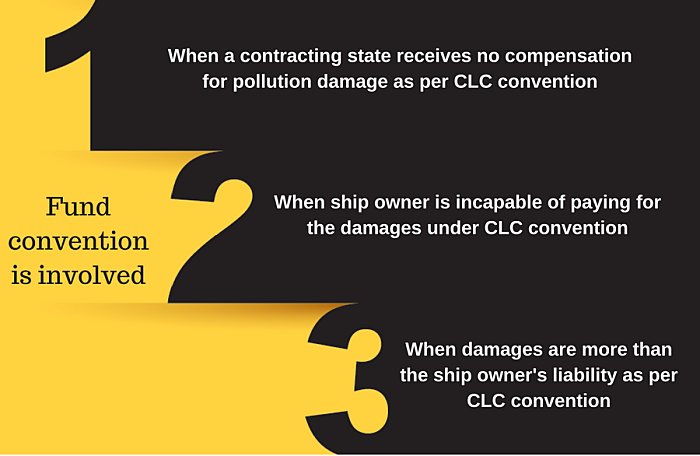
i. When state receives no compensation as per CLC convention
Under CLC convention, I discussed 3 such instances when shipowner would pay nothing.
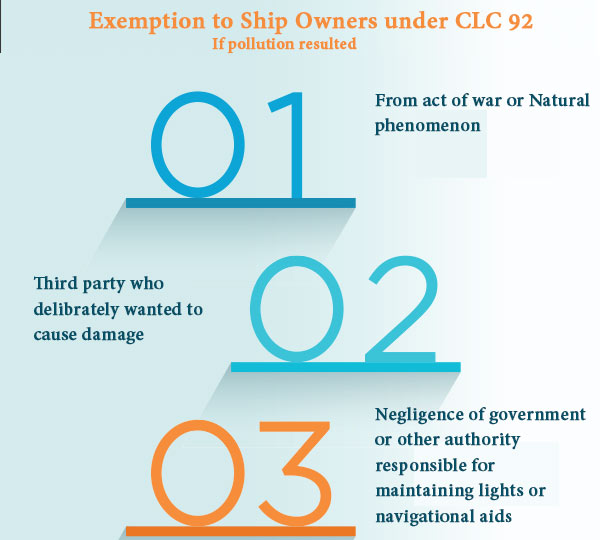
Out of these three instances, pollution damage resulted from an act of war is not covered by the fund convention. It is a simple (& logical) way of saying that if you are at war with another country, why should we pay you for any damage?
But consider the other two instances. For example, Let us say the pollution was caused by deliberate intent of a third party.
Ship owner is exempted from paying for the pollution damages under CLC convention. The third party may not be legally bound to pay for the damages. Or even if it was, he may not be financially capable of paying for all the damages.
In this case, who would pay for the damages? Yes, the answer is the fund created as per fund convention.
ii. When ship owner is incapable of paying for the damages under CLC convention
CLC convention requires that the ship owner whose ships carry more than 2000 T of oil as cargo need to maintain insurance equal to their liability in case of pollution damage from their ship.
This means that a ship which carries less than 2000 T of oil as cargo need not maintain any insurance for oil pollution damages.
Now say one of these ships carrying 1900 T of oil gets aground and this oil is spilled into the water.
Ship owner still has the liability to pay for the damages. But let us say, the ship owner has only one ship and he declares bankruptcy. Who would pay for the damages resulted from this pollution?
Again the answer is the fund created as per fund convention.
iii. When damages are more than the ship owner’s liability as per CLC convention
Liability of the ship owners under CLC convention is a strict liability. By strict liability, it means that there are very few exemptions for the ship owners in case of pollution incident resulting from their ships.
CLC convention limits the maximum liability of the ship owner. But what if the damages are far more than the ship owner’s liability as per CLC convention.
Who would pay the additional amount to cover the damages? Again the answer is the fund created as per fund convention.
5. Maximum amount of compensation allowed from IOPC Fund
As per fund convention, the maximum compensation that can be paid for the damages from a single incident is 203 million SDR.
This compensation will be 300.74 million SDR in the year when there are three contracting states whose combined quantity of the oil received is equal to or more than 600 million ton.
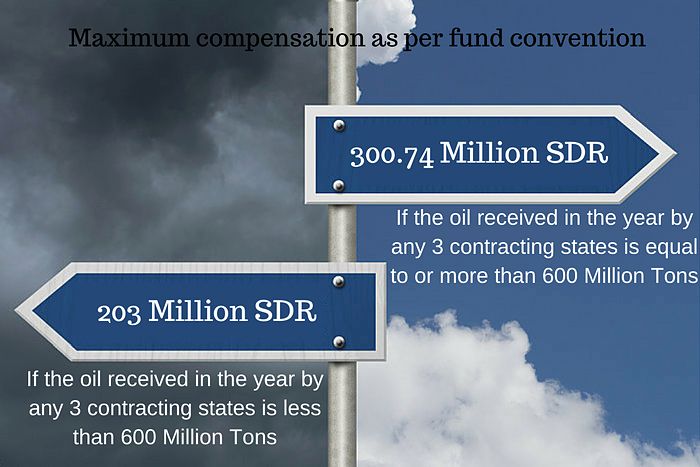
So in terms of the amount of oil received, if the top three contracting States have received more than 600 million tons for a year, in that year the maximum compensation will be 300.74 million SDR. If not then for that year it would be 203 million SDR.
This compensation amount includes the compensation paid by the ship owner as per the CLC convention. So if the damages because of a pollution incident from a ship of 5000 GRT were estimated to be 10 million SDR, then
- 4.51 Million SDR would be paid by ship owner as per CLC convention
- Remaining 5.49 million SDR would be paid from IOPC fund as per fund convention
6. Functions of IOPC Fund
The fund maintained as per fund convention is called “International oil pollution compensation funds” or IOPC Fund.
Although the fund convention was developed by the IMO, IOPC is completely independent of the IMO and the UN framework.
IOPC fund has its own Governing body (Assembly), Oversight bodies (Auditors) and Secretariat and does not have anything to do with the IMO for its functioning.
The governing bodies meet two to three times in a year at the IMO headquarters in London.
One of the main function of IOPC Fund is to provide compensation to the contracting states who is the victim of an oil pollution incident and where CLC compensation is not enough.
Another function of the IOPC Fund is to collect the contribution from each contracting States or its receivers.
7. 2003 Protocol to the fund convention (Supplementary Fund)
In 2003 a protocol to the fund convention was adopted. The protocol was to create a supplementary fund in addition to the fund convention. The purpose of the Supplementary Fund was to create a third tier of compensation for the pollution incidents where even the compensation under CLC and Fund Convention were not sufficient.
Though this was a protocol to a convention and not a stand-alone convention, a different supplementary fund was created which was optional for the member states who have ratified the fund convention.
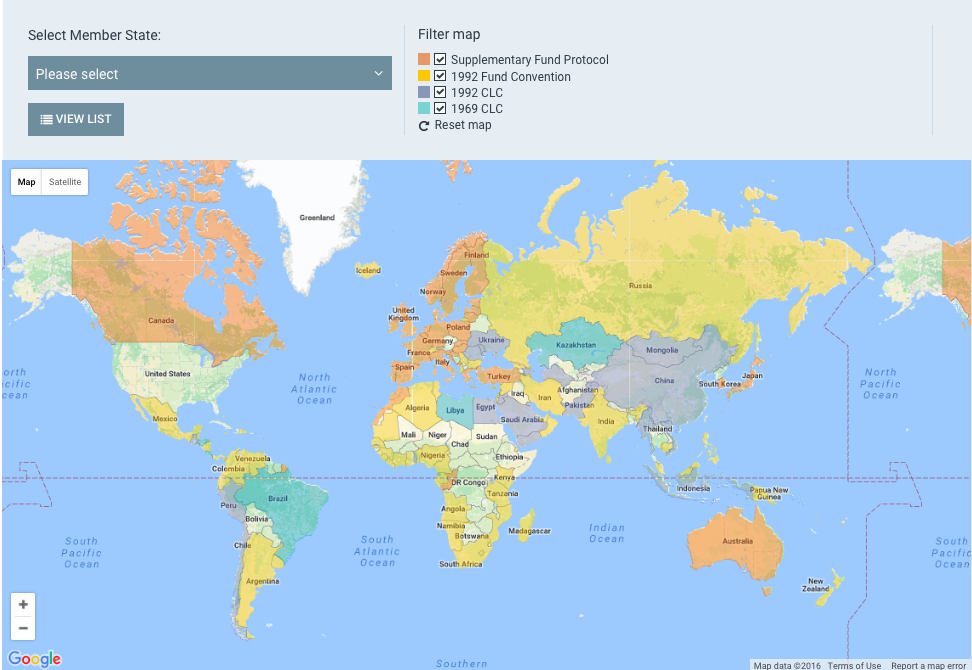
Most of the factors for the supplementary fund are same as that of the fund convention. For example, the Supplementary Fund is also applicable in the pollution incidents in the territorial waters and EEZ.
8. Who contributes to the supplementary fund
The answer is, same parties who contribute to the fund required as per fund convention. That is the receivers in the contracting states that receives at least 150,000 T of oil in one calendar year.
But there is one more condition for contribution to the supplementary fund. For a contracting state to qualify for contribution towards the supplementary fund, the total oil received in the contracting state should be 1 million ton or more.
The supplementary IOPC Fund is financed by the same method as IOPC Fund. Annual contributions are made by the contracting states (which has received 1 million ton of oil or more in the year).
The contracting state must pay a part of this contribution by 01st of March. The remaining amount is only paid if it is required. That is if there is a claim to settle. This system of “deferred payment” is same what is used for the IOPC Fund.
Fortunately, there has not been any incident where compensation was required to be paid from the supplementary fund. This means that till now no contracting state has paid the contribution towards the supplementary fund.
But the contracting states still need to pay for the administrative expenses of the supplementary fund. Like I said earlier, only contracting states that received more than 1 million ton or more of the oil in the year would pay for these expenses.
9. Amount of compensation as per supplementary fund
As per the supplementary fund, the maximum compensation (including as per CLC and Fund Convention) for one incident can be no more than 750 million SDR.
10. Functions of Supplementary Fund
Though the supplementary fund is the part of fund convention, it is managed by different setup. The supplementary fund has its own Assembly. But it is administered by the 1992 fund secretariat.
The functions of the supplementary fund are same. That is to pay the compensation to the contracting state in case of a pollution incident where compensation as per CLC and Fund convention is not enough.
The other function of the supplementary fund is to collect the contributions of the contracting states.
Conclusion
The fund convention aims to have a fund whereby money is not a concern when handling and minimizing the damages of an oil pollution incidents.
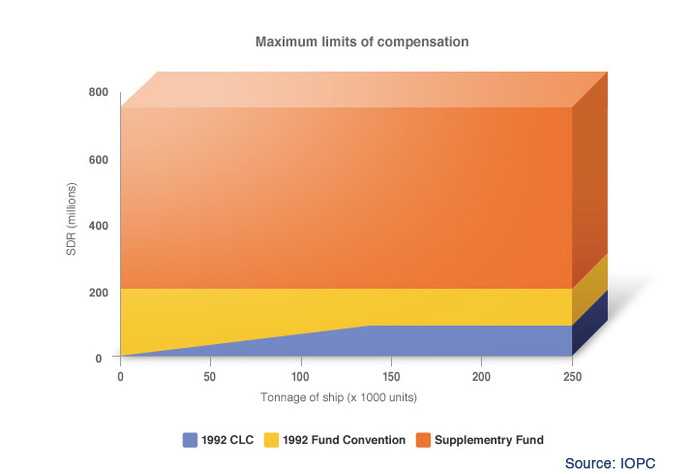
The biggest damage that funds from the fund convention (& supplementary fund) can handle is 700 million SDR.
And the fact that there has not been an incident post fund convention requiring this much money may prove that compensation provided will be enough to handle any incident.
IMO set 2020 as the low sulphur compliance date and other stories of October 2016
Each month we post the main happenings of the shipping industry. Here is the 3rd edition of this newsletter which highlights the main shipping stories of October 2016.
1. News from IMO
IMO sets 2020 date for ships to comply with low sulphur fuel oil requirement
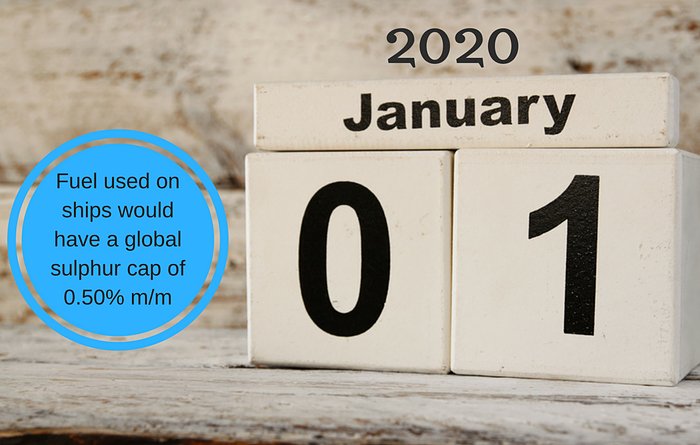
Mark this date “1 January 2020”. This has been set as the implementation date for a significant reduction in the sulphur content of the fuel oil used by ships.
After this date the fuel used on all the ships would have a global sulphur cap of 0.50% m/m (mass/mass). This decision was taken by the International Maritime Organization (IMO), during its Marine Environment Protection Committee (MEPC), meeting for its 70th session in London.
It represents a significant cut from the 3.5% m/m global limit currently in place. This also demonstrates a commitment by IMO to ensuring shipping meets its environmental obligations.
IMO Secretary-General Kitack Lim welcomed the decision. He said it reflects the Organization’s determination to ensure that international shipping remains the most environmentally sound mode of transport.
Regulations governing sulphur oxide emissions from ships are included in Annex VI to MARPOL Convention.
The date of 2020 was agreed in amendments adopted in 2008. When those amendments were adopted, it was also agreed that a review should be undertaken by 2018 to assess whether sufficient compliant fuel oil would be available to meet the 2020 date.
If not, the date could be deferred to 2025. That review was completed in 2016 and submitted to MEPC 70. The review concluded that sufficient compliant fuel oil would be available to meet the fuel oil requirements.
Wreck removal convention ratified by Finland
Finland has become the 32nd State to ratify IMO’s Nairobi International Convention on the Removal of Wrecks.
The treaty, which entered into force in 2015, provides the legal basis for States to remove, or have removed, shipwrecks that may threaten the safety of lives, goods and property at sea, as well as the marine environment.
The Convention was adopted in 2007 and its Contracting States currently represent just over 60% of the world’s merchant fleet tonnage.
New requirements for international shipping as UN body continues to address greenhouse gas emissions
An important milestone on the road to controlling greenhouse gas emissions from international shipping has been achieved with the adoption of new mandatory requirements by IMO.
Under the new requirements, ships of 5,000 gross tonnage and above will have to collect consumption data for each type of fuel oil they use. These ships account for approximately 85% of CO2 emissions from international shipping. The data collected will provide a firm basis on which future decisions on additional measures, over and above those already adopted by IMO, can be made.
The requirements were adopted by the IMO’s MEPC meeting in London for its 70th session (24-28 October).
IMO Secretary-General Kitack Lim said the new requirements sent a clear signal that IMO was ready to build on the existing technical and operational measures for ship energy efficiency.
The data collection system will equip IMO with concrete data to help it make the right decisions, as well as enhancing its credentials as the best placed and competent forum for regulating international shipping, Mr Lim said.
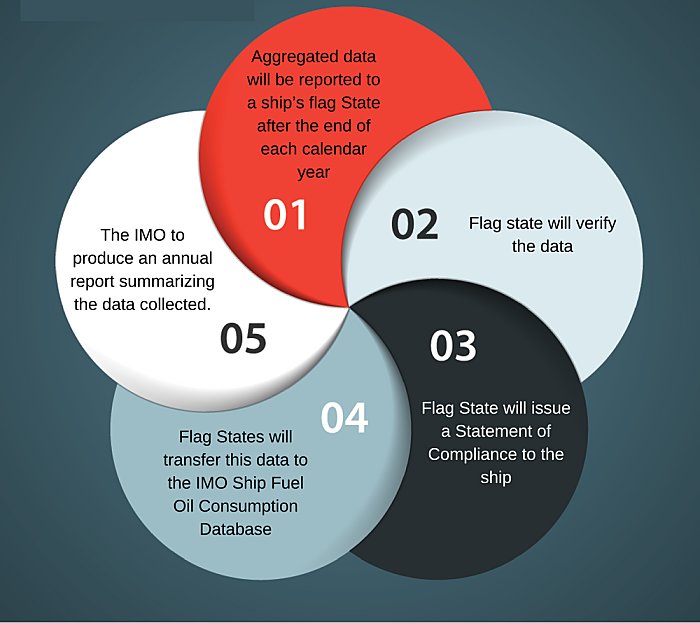
Under the new data collection system, aggregated data will be reported to a ship’s flag State after the end of each calendar year. The flag State, having determined that the data has been reported in accordance with the requirements, will issue a Statement of Compliance to the ship.
Flag States will be required to subsequently transfer this data to the IMO Ship Fuel Oil Consumption Database.
The IMO Secretariat would be required to produce an annual report to IMO’s MEPC, summarizing the data collected. Data would be anonymized so individual ship data would not be recognized.
The MEPC adopted the mandatory requirements as amendments to chapter 4 of annex VI of the International Convention for the Prevention of Pollution from Ships (MARPOL).
They are expected to enter into force on 1 March 2018, under the tacit acceptance procedure. They added new Regulation 22A on Collection and reporting of ship fuel oil consumption data.
It also has a new appendices covering Information to be submitted to the IMO, Ship Fuel Oil Consumption Database and form of the Statement of Compliance, which would be issued to the ship once the relevant data had been reported.
Other regulations are amended to cater for the new requirement, including those related to certificates, surveys and port State control.
2. Incidents During the month
Ship pilot killed while boarding a ship
A pilot was killed while boarding MV Sunmi in the river thames on 05th Oct 2016. MV Sunmi is a 4100 DWT general cargo ship flagged in Bahamas.
While the investigation is still on, the inadequate pilot boarding arrangements cannot be rules out as the cause of the accident.
Magic pipe cases
In one of the case involving use of magic pipes, two German shipping companies have pleaded guilty.
According to plea agreement, on 5th August 2014, US coast gaurd found that crew had not maintained the oil record book properly. They also found that modifications were made to the piping of the oily water separator.
The company and the USCG has agreed on the recommendations of a criminal penalty of USD 750,000.
3. Shipping Business
The worst is over for container shipping
According to the new report published by Drewry, the Hanjin’s receivership represents the trough of the container shipping market.
Despite continuing concerns of weak trade growth and fleet oversupply, Drewry is optimistic about a gradual market recovery.
But Drewry still expects container carriers to record a collective operating loss of $5 billion this year.
However, this anticipated recovery needs to be put into perspective. While average freight rates are expected to improve next year, this will follow several years of negative returns and will still leave pricing well below the average for 2015.
Fuel prices are also on the increase and carriers are extremely wary of costs. This may support higher freight rates via the bunker surcharge mechanism, but it also increases operational costs.
The fact that the orderbook is at a virtual standstill is a major positive as is rapidly increased scrapping. But even so, the next two years will still be very challenging on the supply side with annual fleet growth of between 5% and 6% and many more ultra large container vessels (ULCVs) to be delivered.
In reaction, the industry is rapidly consolidating by necessity rather than by design. Those carriers who can weather this prolonged storm have a chance of emerging the strongest in 2019/20.
Joint Venture of NYK line, MOL and K-Line
Kawasaki Kisen Kaisha, Ltd., Mitsui O.S.K. Lines Ltd., and Nippon Yusen Kabushiki Kaisha have agreed to establish a new joint-venture company to integrate the container shipping businesses (including worldwide terminal operating businesses excluding Japan) of all three companies and to sign a business integration contract and a shareholders agreement.
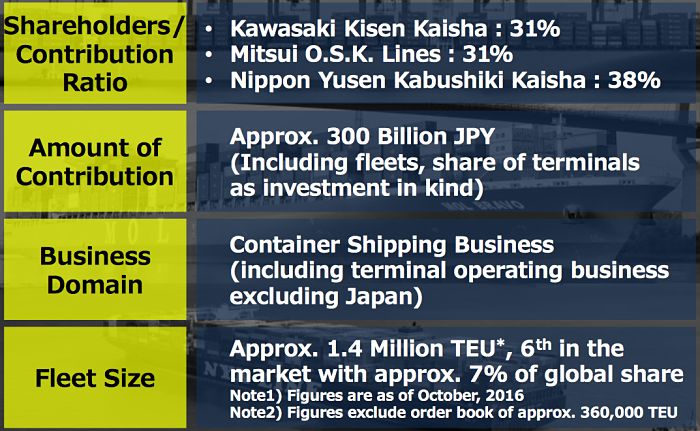
This off course is subject to regulatory approval from the authorities.
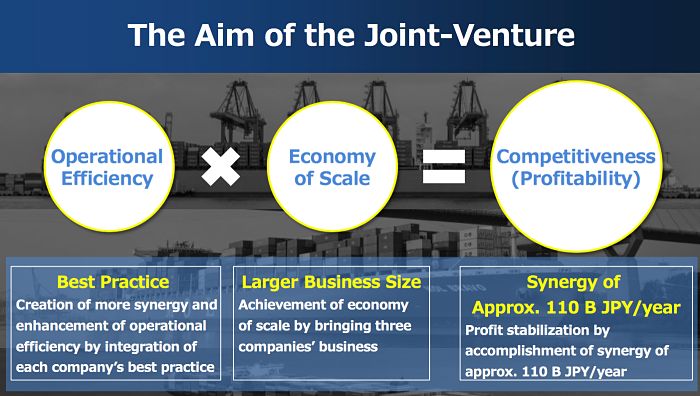
The new joint-venture company is expected to create a synergy effect by utilizing the best practices of the three companies. And by taking advantage of scale merit of its vessel fleet totaling 1.4 million TEUs.
4. Inspections and deficiencies
MCA Cardiff has detained a Malta registered ship for number of deficiencies including non-payment of the wages to the crew.
“The state of the vessel is bad enough from a maintenance point of view,” explained International Transport Workers Federation (ITF) inspector Tommy Molloy.
“It is self-evident that no money is being spent on the basics and, as is usual with such shipowners, the crew are also not being paid.”
ITF learnt from maritime welfare organisations in Cardiff that the third officer was sacked after the non-payment of the wages was reported to the ITF.
“It seems the company has determined that as he is the only claimant who speaks fluent English it must have been him who called the ITF to complain about not getting paid. This is his reward. In fact he did not call us. The request to visit came from the MCA.”
“We have had similar dealings with this operator before. They have been described as being at the very low end of the industry, and the MLC was designed to give seafarers protection against exactly this kind of sub-standard outfit.”
5. Ports
UKHO launches three new Port Approach Guides for Singapore
The United Kingdom Hydrographic Office (UKHO) has launched three new Port Approach Guides with the support of the Maritime and Port Authority of Singapore (MPA).
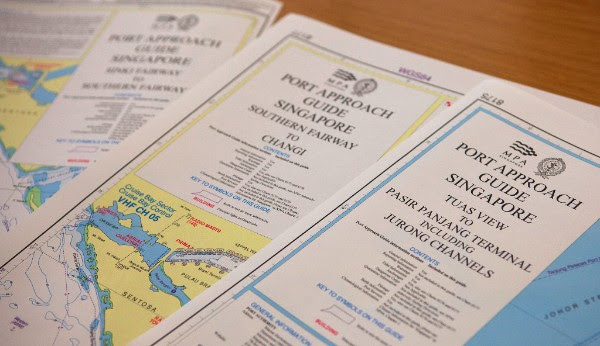
The three new Port Approach Guides cover
- Tuas View to Pasir Panjang including Jurong Channel (number 8175)
- Sinki Fairway to Southern Fairway (8176) and
- Southern Fairway to Changi (8177).
Forming part of the UKHO’s global series of Port Approach Guides, each one is a single chart that contains specific passage planning information for the port in question.
We hope that this would also reduce the number of incidents in this area.
6. Video of the Month
Every month we choose one video for our readers and this month we have this video of anchoring incident.
https://www.youtube.com/watch?v=a-XlbUDPt7A
It is important that we know the anchor handling procedures to avoid these kind of accidents.
Conclusion
Joint venture of NYK, K-Line and MOL is a good thing for the container industry. This is followed by the optimistic views of Drewry about the container shipping.
Ship owners need to draw the implementation plan for use of low sulpher fuel on their ships by 2020. Apart from this, ship operators also need to work on collecting the emission data for sending it to the flag of the ship.
That is all from this edition of the monthly newsletter. Share your views on this newsletter and how what you would like us to include in this.
Why it is so Important to Know About Statutory and Mandatory Certificates ?
A ship without certificates is a dead ship. It is impossible to sail a ship in high seas without valid certificates. Also any insurance taken up by the ship owner will be null and void if any certificate is invalid and expired.
I cannot say it enough, how important it is for a ship to have all valid certificates.
But apart from the certificates being valid, there is another requirement that we need to fulfill. All these original certificates need to be on board at all the times.
This makes it so much more important to know which all certificates a ship is required to carry on board.
But are all the certificates carried on board have equal importance ? Can the absence of any of these certificate make a ship unseaworthy ?
If we do not know the answers to these questions, we probably would not know the seriousness of the situation in case a certificate is expired or expiring.
That is where understanding the difference between statutory and mandatory certificate is important.
Difference between Statutory certificates and Mandatory certificates
Statutory certificates are required by the statute. Statute means law. So these are the certificates that are required by the law.
Mandatory certificates, as the name suggests are mandatory to carry on board.
But doesn’t that mean, all statutory certificates are mandatory ? Confusing right ?
While it is important that we have both type of certificates on board, there is a principle difference between statutory and mandatory certificates.
If we sail a ship without a statutory certificate (the one required by law), we are breaking the law. And like any other form of breaking law, it can be charged under criminal law.
Exclusive Bonus: Download the complete list of statutory certificates for ships
If we sail the ship without a mandatory certificate, we are not breaking the law.
But as these certificates are mandatory, we may not be allowed to enter into the port limit of a country. Or we may not be allowed to start the cargo operation.
Statutory and mandatory certificates together are called trading certificates. That is the certificates required for a ship to trade freely.
Now when we talk about statute or law, which laws are applicable to a ship ?
A ship need to follow the laws of the flag state whose flag it is flying. That is the laws of the country where the ship is registered.
An international convention is not a law. It becomes law only when a country adopts the convention by ratification or accession. That is when a country incorporate the convention into its local law.
Let us take an example of certificate required as per SOLAS convention. I am sailing on a ship whose flag has not ratified SOLAS convention.
is it statutory (required by law) to have the SOLAS certificates (safety equipments, safety construction etc) on board my ship ?
No, these will not be statutory certificates. But these certificates would become mandatory if the ship need to go to a country that has ratified SOLAS convention.
In this case SOLAS certificates will be mandatory but not statutory.
But with more that 99% of the world tonnage retified the SOLAS convention, we can safely say that certificates required as per SOLAS convention are statutory certificates.
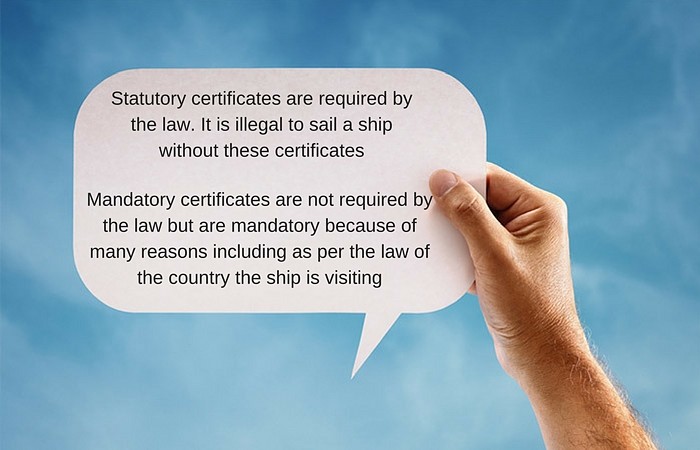
I hope the difference in statutory and mandatory certificates is clear. Even if it is not clear, we can take two points home.
- Statutory certificates are required by law. The only law a ship need to follow is the laws of the country where it is registered
- Mandatory certificates are not required by law but are mandatory for international trading
Let us discuss few of these certificates.
1) Certificate of registry
This is the trading certificate issued to the ship by the flag state. This is the certificate that defines the nationality of the ship. This certificate also has the port of registry information.
If I can say it in simple words, this certificate is no different from the certificate of registry of our cars.
If you notice in the registration certificate of a car, it has following minimum information
- Place & country of registration
- Name and address of the owner of vehicle
- Physical particulars of the vehicle (for example length and width)
- Other details of the vehicle (like seating capacity, engine details etc)
Now the details in the certificate of registry of the ship is no different than this. It has the
- port of registry of the ship
- Name and address of the ship owner
- Basic ship particulars like Length overall, Breadth, gross tonnage etc
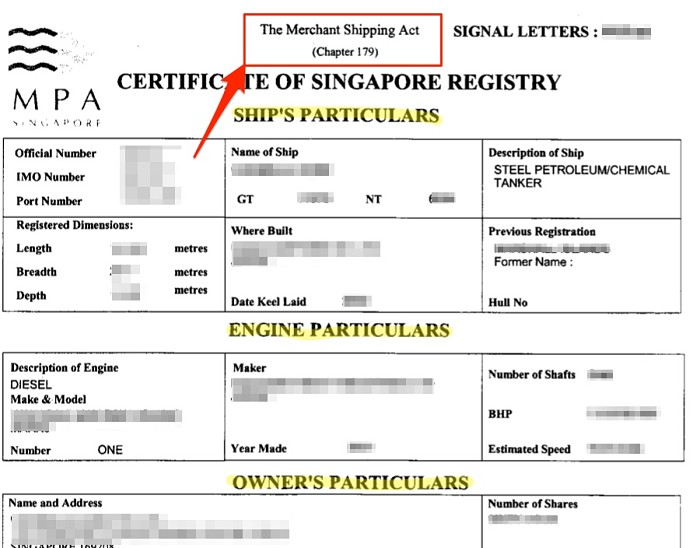
For a ship to qualify for registration in a particular country, the ship owner need to meet the conditions set by that country. For example for a ship to be registered in India, the ship should be
i) owned by a citizen of India or
ii) owned by a company or body established by or under any central or state Act which has its principle place of business in India. Or
iii) owned by a co-operative society which is registered or deemed to be registered under the Co-operative Society Act, 1912, or any other law relating to Co-operative Societies for the time being in force in any state.
When a ship qualifies to be registered in a country, the certificate of registry is issued based upon
- Certificate of sale to the ship owner
- Builder’s certificate containing the details of the ship
While “Certificate of registry” does not have any expiry date, some flag state may give a validity period to this certificate.
As this certificate is required by local laws of the flag state as well as UNCLOS, this certificate would fall under statutory certificate category.
Certificates as per SOLAS Convention
SOLAS convention requires each ship to have and maintain certain certificates on board. Each ship whose flag state has ratified this convention would need to have these certificate as per law.
So for the ships whose flag has ratified the SOLAS convention, these certificate will be statutory certificates.
Let us discuss few of the certificates a ship need to have on board as per SOLAS convention.
2) Minimum safe manning certificate
As the name suggests, this certificate mentions how many minimum crew need to be on board to run the ship.
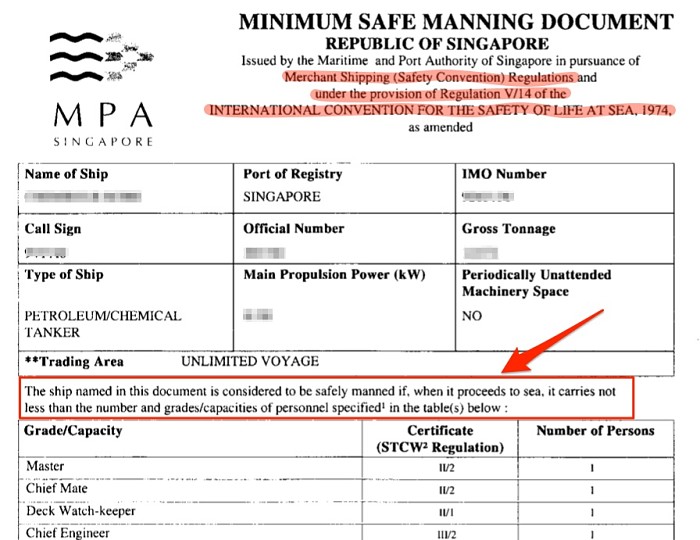
This is as per the rules of the each flag state and SOLAS chapter V regulation 14.
SOLAS chapter V asks flag states to set up manning level to ensure ships are adequately manned. As a general rule the number of crew required would depend upon
- The trade of the vessel
- If the engine room is manned or unmanned (UMS)
Minimum safe manning certificate usually does not have any expiry except for some flags. For example “minimum safe manning certificate” issued by Saudi Arabia have validity of 2 years.
The certificate is a statutory certificate as it is required by the flag states rules and SOLAS.
3) International ship safety equipments certificate
This certificate is issued to the ship after verifying the operational readiness of all the safety equipments on board.
The certificate need to have a form E attached with it. Form E of this certificate gives the detail of each safety equipment that need to be on board.
The certificate is valid maximum for 5 years. The class stamps the certificate for annual endorsement each year.
This certificate is required by SOLAS convention chapter III.
4) International ship construction certificate
This certificate is issued as per the requirements of SOLAS chapter II.
The certificate is valid maximum for 5 years. The class stamps the certificate for annual endorsement each year.
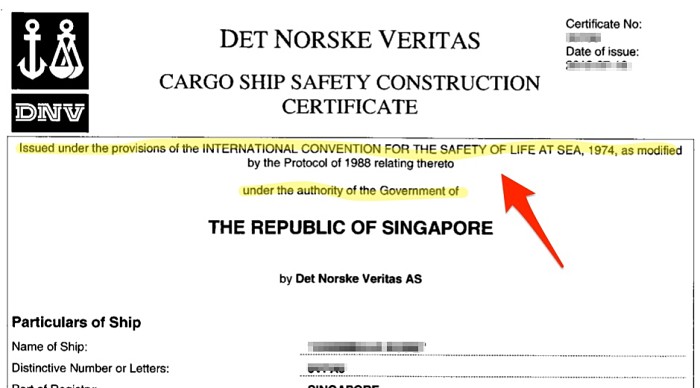
5) International Ship safety radio certificate
This certificate is issued as per the requirements of SOLAS chapter IV. The certificate is issued after verifying that all the radio equipments are in good working condition.
The certificate also has a Form R attached to it. Form R gives the details of all the radio equipments required and available on board.
The certificate is valid maximum for 5 years. The class stamps the certificate for annual endorsement each year after verifying each element.
6) Safety management system certificate
Safety management system certificate is issued as per the requirements of SOLAS chapter IX and ISM code. The issuance of this certificate to a ship means that it complies with the ISM code and the requirements of SOLAS chapter IX.
The certificate is valid for maximum 5 years. This certificate need to be endorsed for intermediate verification every 2.5 years. This intermediate endorsement is done after successful completion of external SMS audit which is done by the RSO (usually class) on behalf of the flag.
Certificates as per Marpol Convention
MARPOL convention requires each ship to have and maintain certain certificates on board. Each ship whose flag state has ratified this convention would need to have these certificate as per law.
So for the ships whose flag has ratified the MARPOL convention, these certificate will be statutory certificates.
Let us discuss few of the certificates a ship need to have on board as per SOLAS convention.
7) International oil pollution prevention certificate
IOPP certificate is issued to all the ships to which annex I of the MARPOL applies. Annex I is not only applicable to the ships that carry oil as cargo but also to the ships that carry bunker oil as fuel.
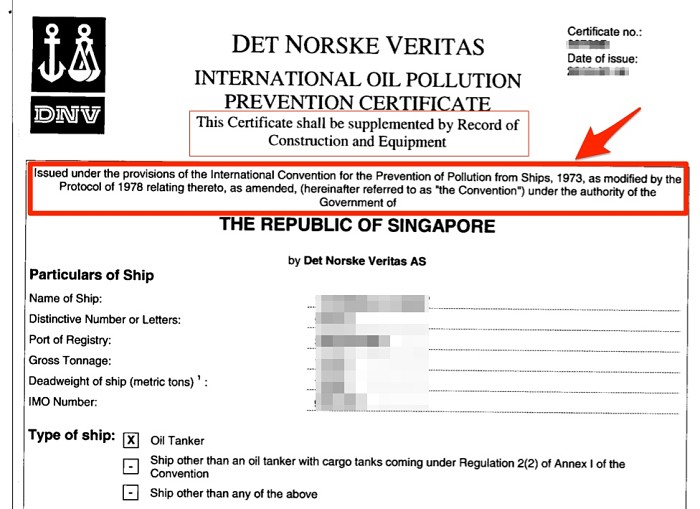
IOPP certificate will have either the Form A or Form B attached to it. Form A applies to the ships that do not carry oil as cargo. Form B applies to the oil tankers or the ships that carry oil as cargo.
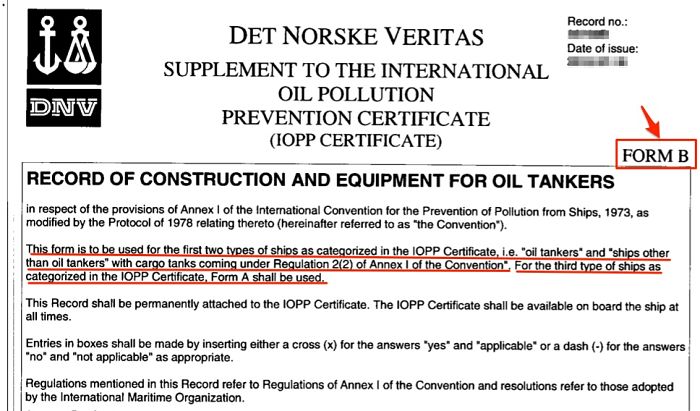
Form A and form B gives the details of the equipments required as per MARPOL annex I that are fitted on board. These equipments may include
- Oil discharge monitoring equipment
- Oily water separator
- Incinerator
- details and capacity of engine room bilges
- Inert gas system or Inert gas generator
The certificate also has maximum 5 years validity and is endorsed annually. The certificate is endorsed after class verifies
- all the MARPOL equipments
- Operations of the Marpol equipments
- All the Marpol related records
8) International sewage pollution prevention certificate
Issuance of this certificate certifies that ship is in compliant with the annex IV of the marpol. The certificate gives the details of
- Sewage treatment plant (if fitted)
- Sewage holding tank & its capacity (if fitted)
- number of persons the sewage treatment plant or sewage holding tank is certified for
The certificate is valid for maximum 5 years.
9) International air pollution prevention certificate
This certificate certifies that ship complies with the Annex VI of the marpol. The certificate have
- the detail of the all the engines (main as well as auxilary).
- information if the vessel comes under tier I, II or III
The certificate can have maximum validity of 5 years.
Certificate as per Loadline convention
10) International loadline certificate
This certificate gives the detail of the loadlines of the vessel. In simple words from this certificate we can get following information
- Draft corresponding to each loadline (for example Summer loadline draft, tropical loadline draft etc)
- Freeboard corresponding to each loadline (for example freeboard of the ship at summer loadline, tropical loadline etc).
The certificate is issued after loadlines are assigned to the vessel. The loadline convention requires each ship to maintain a minimum freeboard. So it is in fact the freeboard that is assigned to the ship.
“Freeboard assignment certificate” gives the entire calculation for freeboard assignment to the ship. The corresponding drafts are are then calculated by substracting the freeboard from the total depth of the ship.
The assignment of freeboard depends upon a lots of factors. These are the factors that contributes to the reserve buoyancy of the ship. Some of these factors include
- Air pipes of the ballast tanks
- Water tightness of the water tight doors
- Mast houses & store rooms on deck
- drain plugs of the water tight compartments such as mast houses
Checking and verification of all these factors becomes the basis of annual endorsement and renewal of loadline certificate.
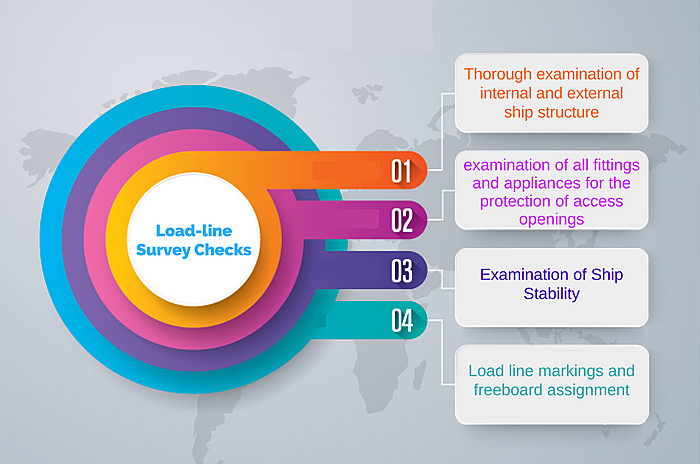
The certificate is valid for maximum 5 years and it requires annual endorsement on the certificate.
11) Certificate of class
Involvement of classification societies in ship building and ship machinery has become a necessity because of their expertise in the field.
Solas Chapter II has a mention of the role of classification societies.
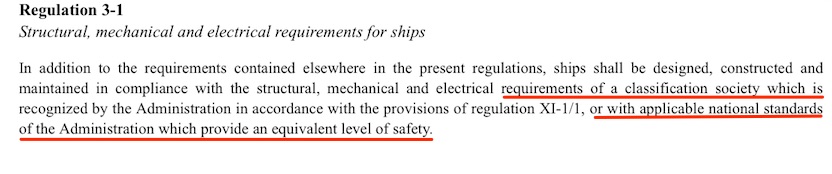
So ships either need to be constructed as per the rules of class or as per national standards of the administration.
But it is so much easy for the flags to follow the rules of the class than develop its own rules which also need to be updated as per the amendments to the various regulations.
So having the ships comply with the classification rules along with the statutory requirements have become a norm for international standards for ships.
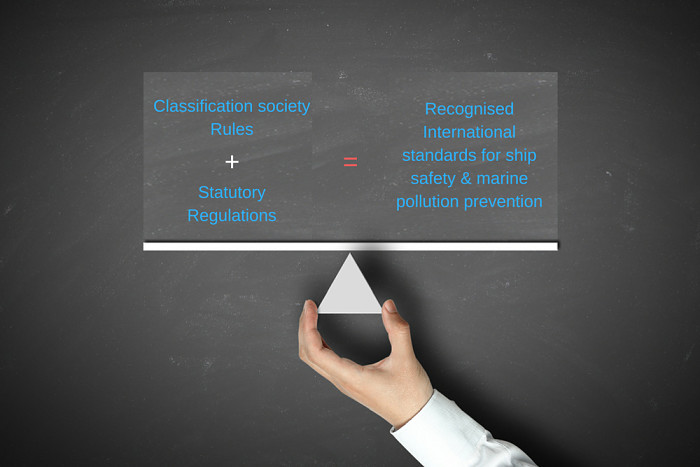
If the ship is constructed as per the rules of classification societies, It is statutory for ship to have certificate of class that proves that ship is constructed that way.
Ship can also be constructed as per the national standards of the flag state in which case class certificate would not be required. But it is very rare that a classification society is not involved in the construction of a ship.
Mandatory certificates
So far we have discussed some of the statutory certificates. We have also discussed that if a flag has not ratified a convention, for the ships flying its flag these certificate would not be statutory.
But for these ships, the certificates required under these conventions would be mandatory for international trading.
Mandatory certificates are also sometimes referred to as obligatory certificates.
But are there any other certificates that are not statutory but are mandatory. Yes, there are. Let us discuss few of these certificates.
12) Certificate of entry for P&I club
This certificate shows that ship is covered under the P&I club which has issued this certificate. If the ship is not covered by a P&I club, the port authorities may not allow the ship to enter or start cargo operation.
But if the ship has not entered into a P&I club, this would not make the ship unseaworthy.
Similarly for a ship to call a US port, it would need to have “Certificate of financial responsibility”. If a vessel do not have this certificate, the US authorities do not allow the ship to operate in US waters.
Again, if a ship has been sailing at sea without this certificate will not be an unseaworthy ship. So these certificate even though not statutory, are mandatory to have on board.
Non-mandatory certificates
There are few certificates that are neither mandatory nor statutory. These can be called non-mandatory certificates.
If these certificates are not on board, this will neither make the ship unseaworthy nor will it hamper the ship operations. Garbage management certificate is one such example.
Though there is no requirement for a certificate for compliance with annex V of the Marpol, class sometime issues such certificate.
Conclusion
It is so important for us to know about ship’s certificates. Which certificates makes a ship seaworthy ? Which certificate if not available on board can delay the ship ?
Only when we know the importance of a certificate and implications for not having a certificate on board, we can timely alert our shore office.
Ship staff in general and masters in particular must be aware of what all certificates are statutory. That is the certificates that are required to be onboard by the law.
When we know this, we would know that taking a ship to sea without any of these certificate can have drastic implications.
10 Simple Terms to Understand Ship Construction Better
A seafarer may not be involved in the ship construction so much. But that does not mean that they need not know anything about it. For example if you see a crack in ballast tank, you should be able to tell exactly where the crack is.
It is only possible if you can identify the structures inside the ballast tank. Same applies to the other parts of the ship too.
We read about ship construction during our competency exams. Only problem is ship construction topics starts from the medium level and not from the basic level.
For example if we need to draw the construction of double bottom, learning just involves placing each component at its place without answering why.
The first step of studying the ship construction need to be knowing about the basic terms of ship constructions.
In this post I will discuss and explain 10 basic terms used in ship construction.
But before we do that, first lets discuss briefly what ship is made of.
What are ships made of
Ships are made of steel and we all know that. But what all forms of steel are used in building ships. I mean what shape of steel ?
Before learning anything about ship construction we need to know the shapes used in ship construction. Let us discuss few of these.
Plate
We all know what we mean by plate. It is a rectangular shape steel with certain thickness. The most common place you can see the plate in ship construction is the main deck and side of the ship.
Bar
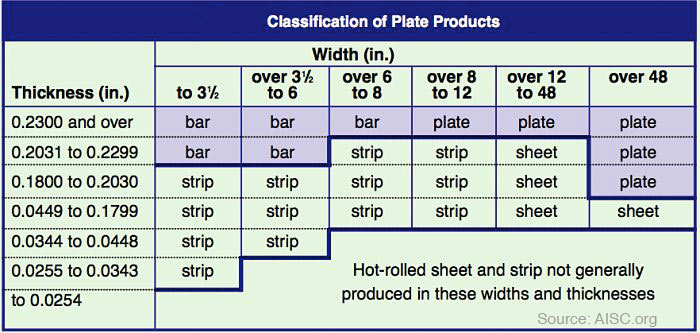
There is only one principle difference between steel plate and steel bar. The steel bar has lesser cross sectional width than the steel plate.
This table gives a fair idea what cross section of a steel can be called a plate/sheet or a bar.
Beam
A beam is a structural element that increases load bearing capability and avoid bending of the structure. Beams can be categorized by many types but from point of ship construction, we need to categorize it through cross sectional shape.
For example, there are L-Shaped beams, C-shaped beams, I-shaped beams and SI-shaped beams. SI shaped beams are I-shaped beams with slight curved cross section.

Shape of the beams are not limited to these ones. It can be in many other shapes.
Now that we know the shapes and structure of the steel used in ship construction, we can discuss the ship construction terms. But we have to understand that all these structure will be a form of plate, bar or beam.
1. Keel
First thing first. When we say “Keel of the ship”, we are referring to a steel plate. Though it can also be in the form of steel bar but it is very rare these days.
Keel of the ship is the bottom most plate of the ship laid along the entire length of the ship.
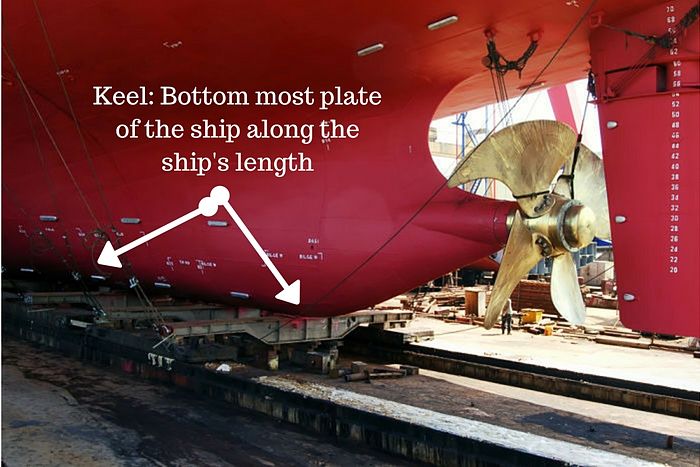
During construction of the ship this is the first thing that is placed on the blocks. Because of this, laying the keep is considered to be the time when construction of the ship begins.
Keel laying also has the importance with respect to many IMO conventions as this is the date construction of the ship starts.
So keel is the steel plate with slightly more thickness than the other adjoining plates on its sides. This area need more strengthening because the ship sits on this area on the blocks, during construction as well as during dry docks.
We can consider the keel of the ship as the backbone or spine of the ship.
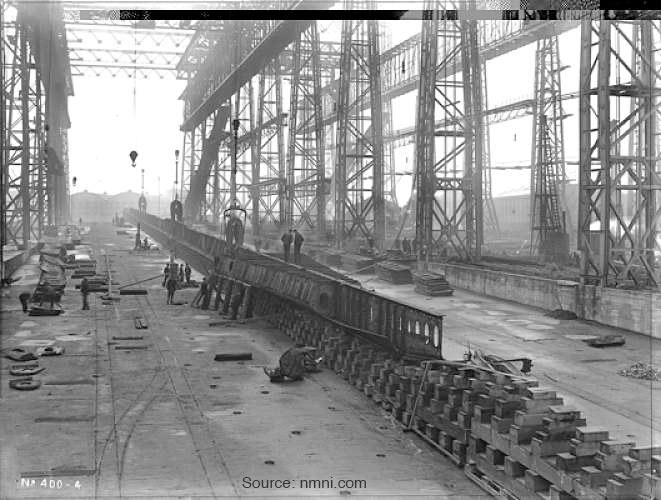
Years back keel laying involved actually laying the keel of the ship on the blocks. See below the keel of the titanic being laid.
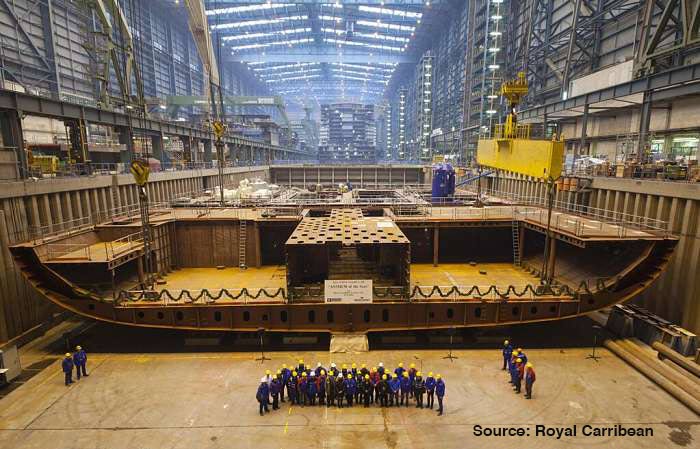
Nowadays keel laying is considered to be the time when first piece of the ship structure is placed on the the wooden blocks. Like see below the keel laying of cruise ship “Anthem of the seas“.
2. Shell plating
Again when we say shell plating, we are referring to a steel plate. In this case it is too obvious from the name.
Shell plating is the steel plate used on the shell of the ship. The dictionary meaning of the shell is “hard outer covering”. So shell plating is whatever we see on outer side of the ship.
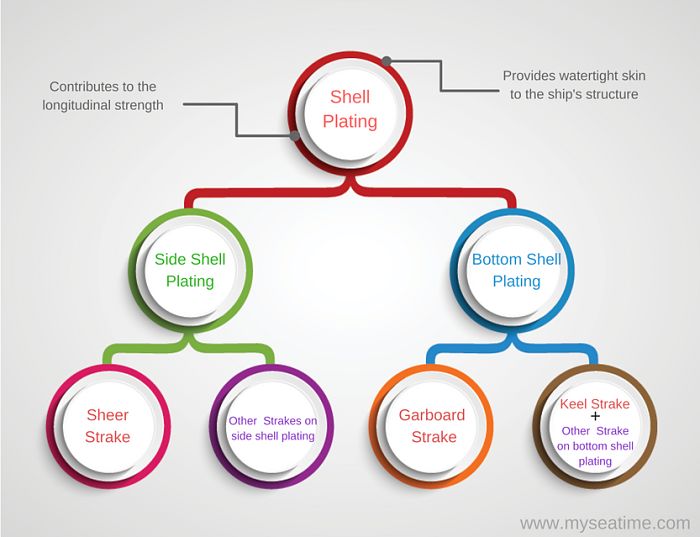
One of the main purpose of shell plating is to provide watertight skin of the ship. Apart from that it also adds to the longitudinal strength of the ship.
Ship construction requires us to be able to pin point each component. So when we say shell plating, it is a huge area. We can further divide this area in two broad parts, which is
- Bottom shell plating
- Side shell plating
I am so much sure that you already would know what these two terms mean.
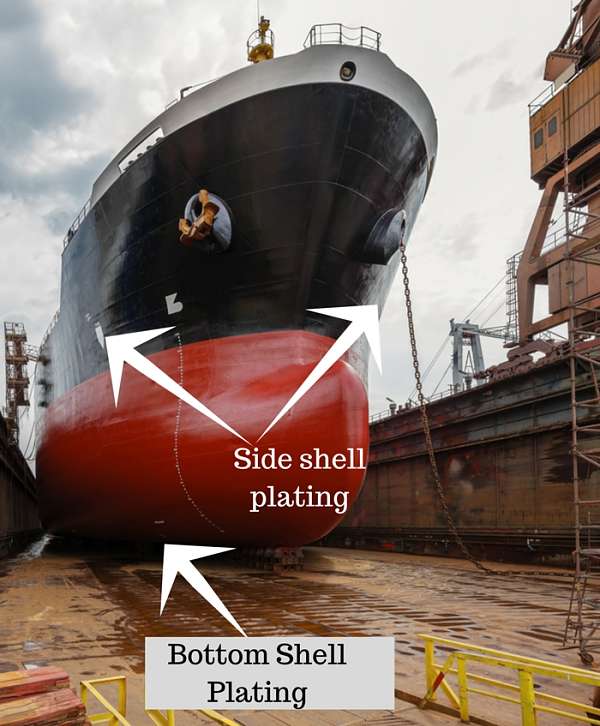
Bottom shell plating is the shell plating on the bottom part of the ship. Or we can can that bottom shell plating form the watertight skin of the bottom of the ship. It is the plate laid in the horizontal direction.
To a certain extent we can say that even keel of the ship is also bottom shell plate.
Side shell plating is the shell plating on the sides of the ship that forms the watertight skin along the ship side. It is the plate laid in the vertical direction.
3. Deck plating
This is one is too obvious. Deck plating again is a plate. It is steel plate that forms the main deck of the ship.
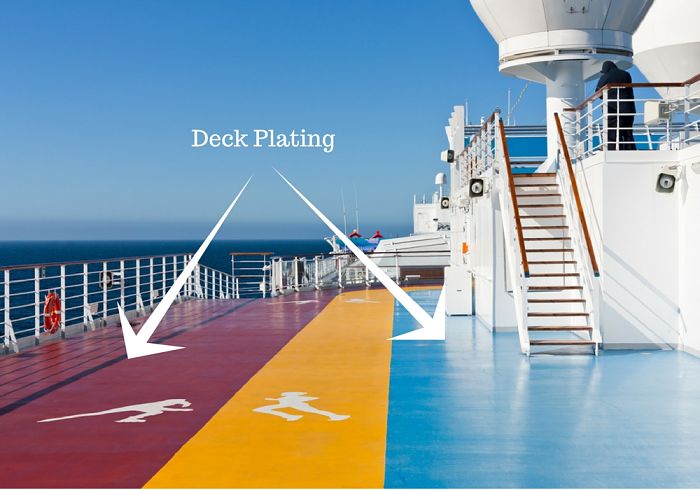
As per the location, we can give a more specific name to the deck plating. For example accommodation deck plating or main deck plating.
4. Strake
To understand what strake is, we need to again understand the construction of shell plating.
I am dead sure you know that ship’s side plate (Shell plating) is not made of single metal sheet. It is made of smaller sections of steel plates. These smaller sections of the plate are welded together.
In old days these were riveted instead of welding.
Irrespective of with what method these plates are joined together, these are placed in a certain pattern.
Let us understand this with an example of box shaped ship. The smaller plates that we are talking about would look something like this for the box shaped ship.
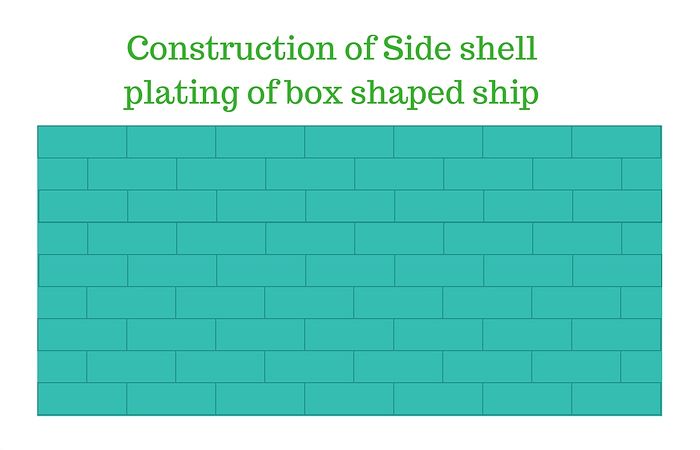
In naval architecture and ship construction each of these plate has an identification. These are numbered in certain pattern. For example the plates on the side shell plating are numbered like this.
- The plates are identified by a letter and a number
- Each plate is given a letter in the vertical direction starting with A from the bottom.
- Each plate is given a number in the horizontal direction starting from aft.
Now based on these numbering system the identification of plates for the box shaped ship would look something like this.
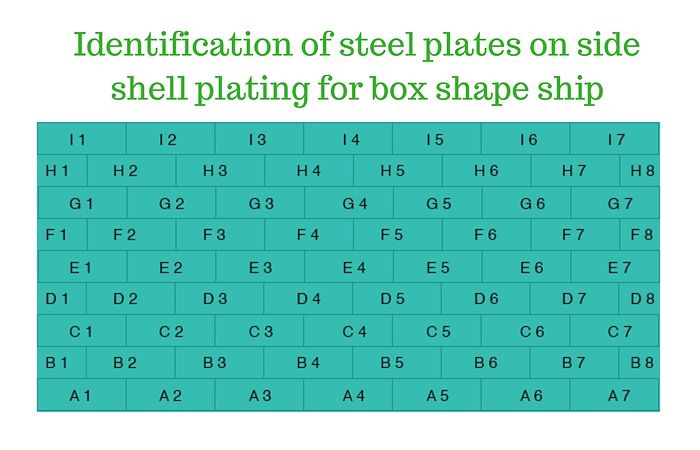
Each section of the plate placed in fore and aft direction is called a “strake”.
So in the above example, we have A-Strake, B-Strake and so on.
If we want to be more specific, We can say that we have starboard A-Strake , starboard B-strake and so on. Similar naming will be on the port side.
For the bottom shell plating, similar numbering is done for the plates forming it. For the bottom shell plating
- Plates are given a letter starting with “A” to the plate adjacent to the keel plate.
- Plates and given a number starting from the aft
So the plate adjacent to the keel plate will have a identification of A1, A2 and so on starting with A1 from the after most plate.
Now there are three type of strakes that you would hear in ship construction. Let us see what these are.
Shear Strake
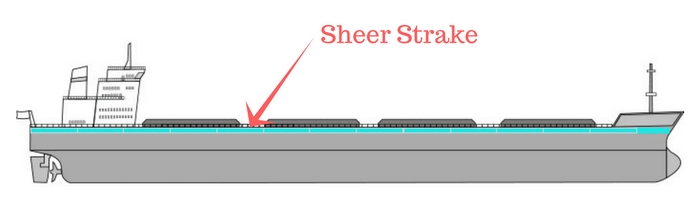
Shear strake is the top most strake of the Side shell plating. So if side shell plating has strakes from A to K, then K-strake is the shear strake. This is the strake that connects with the deck plating.
Can you identify the shear strake in the box shape ship example that i gave above ? Yes, you got it right. I-Strake is the shear strake in this case.
Shear strake is usually of higher thickness and strength than other strakes. This is because this strake can have lot of physical damages during the life of ship.
Keel Strake
I earlier said that keel is a plate that is back bone of the ship. But keel plate is also made up of smaller sections of the steel plates. These strake of plates that form the keel of the ship is called Keel Strake.
The plates in the keel strake are number from aft to forward starting from the aft one which has the number “1”.
Unlike other strakes, keel strakes do not have letter associated with its naming.
Garboard Strake
Garboard strake is the first strake on each side of the keel strake. As we discussed in the bottom strakes, the first stake from the keel is named A-strake.
So we can also say that Bottom A-strake is called Garboard strake.
Now for the box shape ship, the naming of strakes might look simple but for actual ship with curved sides and flared bottom, it might not be that simple.
The naming and construction of side and bottom shell plating is provided in the “Shell expansion plan”.
Next time you get your hands on a shell expansion plan of your ship, try to read it to identify shear strake, keel strake and garboard strake.
So below picture shows how shell plating and Strakes are connected with each other.
5. Stiffners
A steel plate of 2mm thickness can be easily bent. If you lift this plate with the crane from its ends, it will most likely bend at the center. Now what can you do to avoid it from bending ?
One easy solution is to increase the thickness of the plate by welding two or more plates together. But in ship construction this is not a good idea. One among many reasons for this is that we do not want to increase the light weight of the ship.
The better option is to weld two of more flat bars either in fore and aft direction or athwartship direction.
In this case these flat bars will be called stiffners. Anything that is used solely to provide strength to a ship structure can be called a stiffner.
A stiffner welded in longitudinal direction is called “Longitudinal stiffner”. Same way a stiffners welded in transverse direction is simply called “transverse stiffner”.
Longitudinal stiffners and transverse stiffners can further will named according to various factors including the amount of strength these provide to the structure.
Let us discuss few of these.
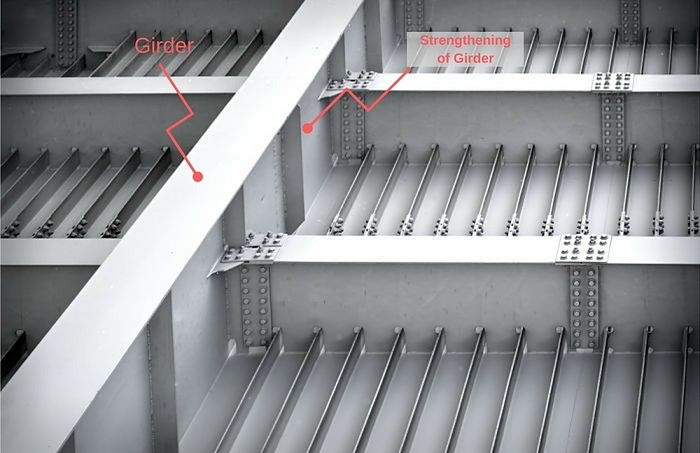
6. Girder
Girders are one form of longitudinal stiffners. These are
- Big size steel plate (or sometimes beams) connected to bottom of the ship
- Runs in fore and aft direction
- strengthen the ship against bending moment
Girders are also named according to its location. The girder at the center of the ship is called center girder.
In double bottom tanks, the thick solid metal plate that divides the ballast tanks into port and starboard tank is the center girder.
Apart from the center girder, there can be few girders on each side of the ship or double bottom.
Depending upon the breadth of the ship, there can be more than one side girder on each side.
While center girder runs in full depth of the double bottom tank, side girders may or may not run in full depth.
Though below photo is not that of a ship, it is good representation of a ship’s strengthening components. If you see in this case girder is further strengthened with something we may call “Vertical Stiffners” as there is no other specific name for it.
7. Longitudinals
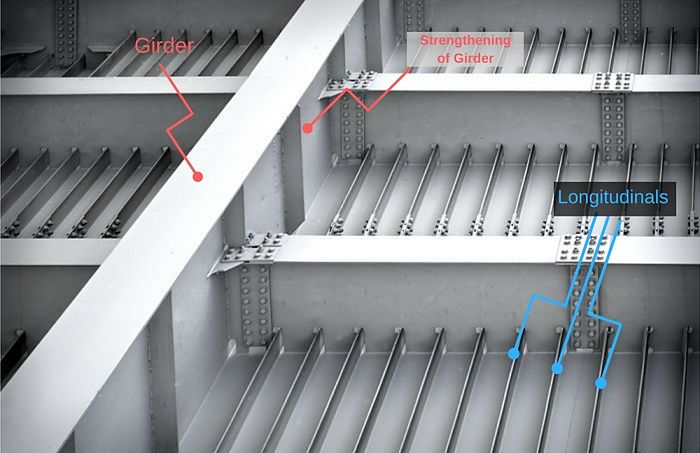
Longitudinal is short name for longitudinal stiffners.
In most cases the longitudinals are beams (mostly L-beams) and runs along the length of the ship. Double bottom space is the most common space where you can easliy identify longitudinals.
Longitudinals are further named depending upon what section these longitudinals are strengthening.
In double bottom ballast tank, longitudinals strengthening the bottom are called “bottom longitudinals”. Longitudinals strenghtening the top of the ballast tank are called “top longitudinals”.
If you have been to a double bottom tank, these longitudinals are difficult to miss. The bottom longitudinals are the one we sometime step on to avoid stepping in the left over water (or mud) of the ballast tank.
I am sure you can locate the longitudinals in above picture that I shared. If you cannot, I share it again with marking of longitudinals.
8. Frames
Frames act as major transverse stiffners. Frames are
- Big size steel plate connected to bottom of the ship
- Runs in athwartship direction
- strengthen the ship against buckling and bending.
We can consider the frames to be similar to the girders but with only one difference. Frames runs in transverse (Athwartship) direction.
If keel is the backbone of the ship, the frames are considered to be the rib cage.
Frames are numbered starting from aft perpendiculars.
9. Transverse
Transverse is the short name for “transverse stiffners”. These are different from frames in two ways. First unlike frames these do not extend to full height of the compartment. Second transverse are of lesser strength and thickness than frames.
Based on the location of transverse, these may be called “bottom transverse”, “inner bottom transverse” or even “deck transverse”.
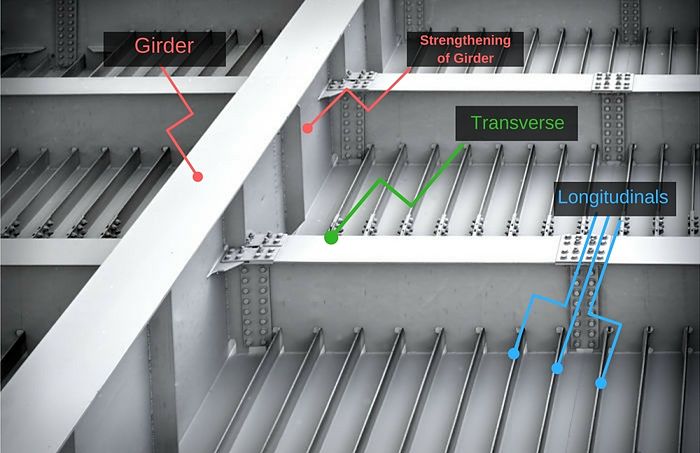
10. Stringers
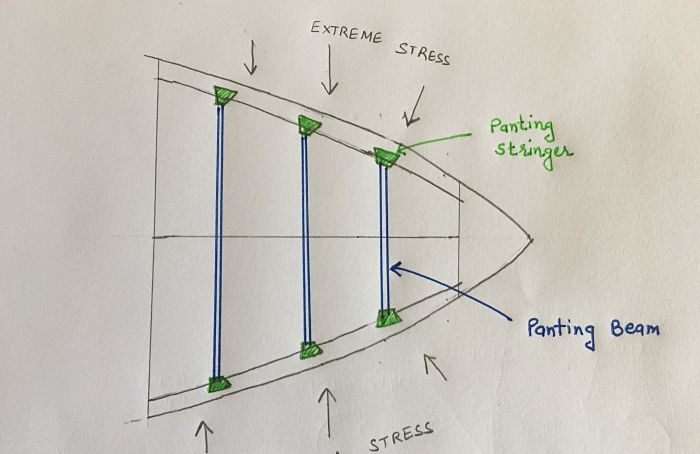
In the above photo, notice how the girder is stiffned. The stiffner is welded in vertical direction. If same stiffner is required to be welded in horizontal direction, it will be called stringer.
One of the location where stringer is mostly used is the forward part of the ship. Bow of the ship has to bear lots of stress and so requires extra strengthening.
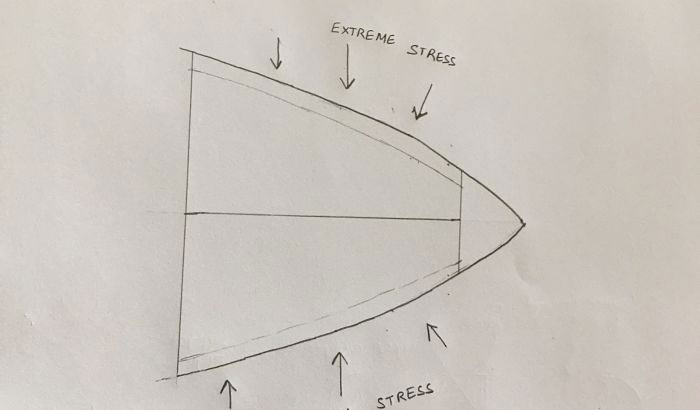
I will limit myself with discussion of bow construction just to understand stringers. I will cover bow construction in detail some other day.
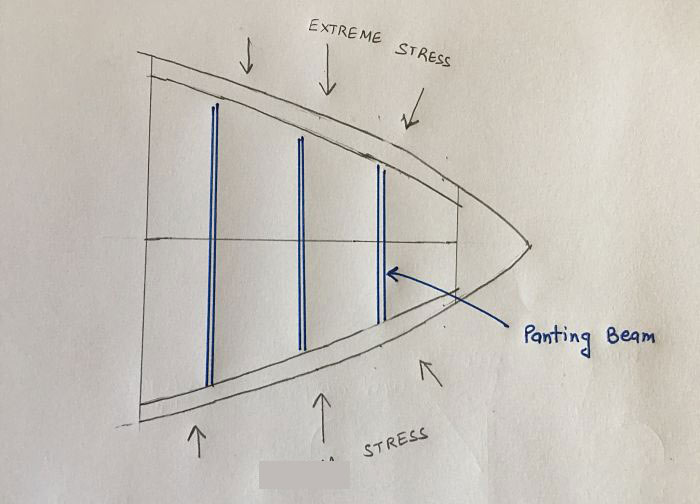
So among many other strengthening members, panting beams are used in this area to counter these stresses.
But even these beams need to be stiffened at the point where these connects with the side frame. Panting stringers does this job. As I said stringers are horizontal stiffeners (parallel to the water line).
Conclusion
Ship construction is something that requires a lot of imagination to understand. But even if someone has a strong imagination bone in the body, knowledge of ship construction will still be difficult without knowing basic terms used in it.
These 10 terms are the basic of ship constructions and once we know these, ship construction will be a little easier task.
York Antwerp Rules and General Average, Everything you Need to Know
It is not uncommon these days for people to share the spendings of a group equally. For example, for a group of five friends having lunch together, they share the bill in five equal parts. Each one contributes one fifth of the total amount.
Or for example three to four people sharing a ride back home from office.

This is so easy. Right ? Dividing the fare or food bill is easy and everyone saves some money. But this looks easy because of two reasons.
One because the amount is divided in equal parts. And second because the money involved is not so big to draw a controversy. It would be much more difficult to draw an average if one person said that he has eaten less so he should pay less.
Or for that matter one person said he weighs less so he will pay less for the cab ride.
Oh!! I was supposed to talk about York Antwerp rules, right ? Why am I even talking about sharing a ride and food bill.
Well the York-Antwerp rules are also about sharing the expenditures with certain conditions attached.
Take this example.
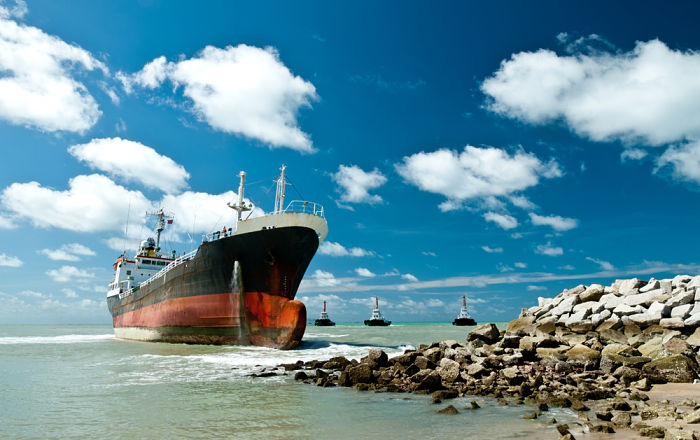
A hold on a bulk carrier with cargo in it catches fire. The hold is flooded with water to extinguish the fire and to avoid the fire spreading in other parts of the ship.
We have saved the ship and we have saved the cargo in other holds of the ship. What have we lost ? The cargo loaded in one hold.
Now who would pay for the cargo lost in this case ?
Both the cargo interests as well as the ship owner has saved themselves damages which could have been more. If it was up to me and you to decide, it could be almost impossible to draw a balance on who should pay how much. After all it isn’t as simple as averaging for the food bill or cab fare.
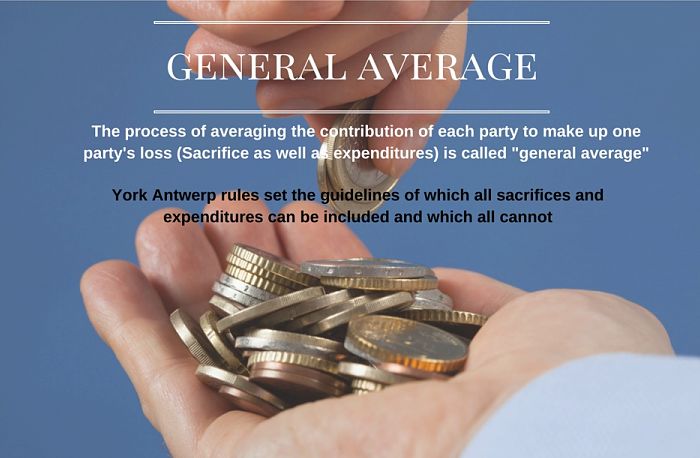
This is what York Antwerp rules aims to do. The process of averaging the contribution of each party (who benefitted) to make up one party’s loss (Sacrifice as well as expenditures) is called “general average“.
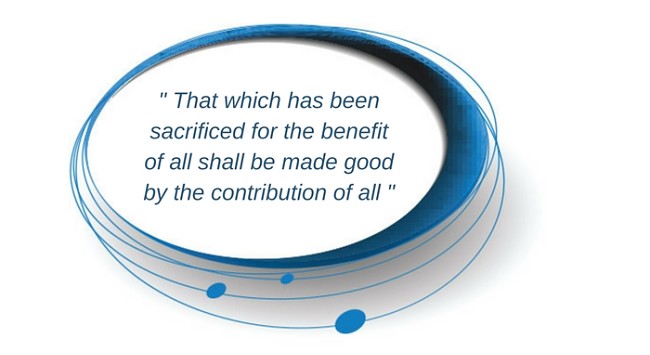
General average is based upon the principle
That which has been sacrificed for the benefit of all shall be made good by the contribution of all
So not all sacrifices and expenditure qualify to be averaged and shared by other parties.
York Antwerp rules sets the guidelines of which all sacrifices and expenditures can be included during “General Average” and which all cannot.
How General Average works ?
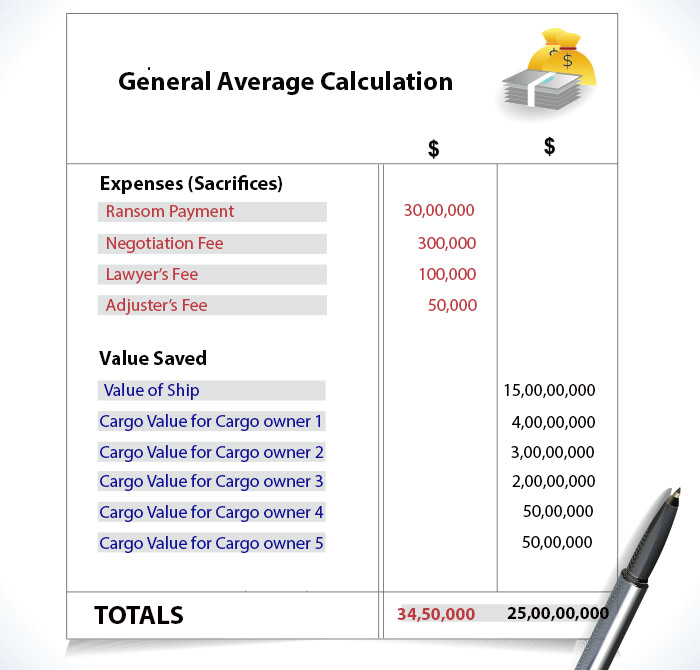
Let me give an example. A loaded ship is hijacked in Somalian waters and pirates demanded the ransom for release of the ship. After much of negotiations the ransom was brought down to 30,00,000 (3 Million) US dollars.
The ransom amount was delivered and the ship was released. Let us see the break up of total expenses incurred in releasing the ship.
Now who do you think will pay this huge amount ?
The principle of general average says that all the parties that benefit from this sacrifice of the ship owner should pay. But how much each one need to pay ?
Cargo owner who had small parcel on board the ship should not pay same as other cargo owners who had huge amount of cargo on board.
So the break up need to be in proportion of how much each party saved from this sacrifice.
As per general average, each party will pay the same percentage of amount that they have saved. For example of the total value saved, 60% belongs to the ship owner. So ship owner need to contribute 60% of the expenditures or amount sacrificed.
Here are the general average contributions from each party in this example.
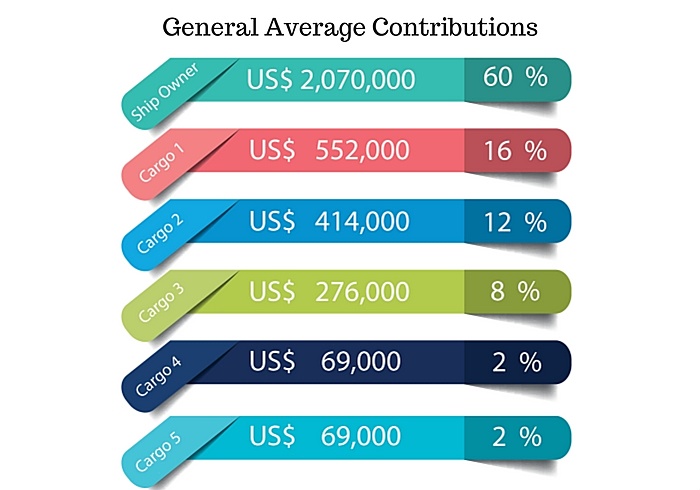
Now in this example, I have over simplified this for the sake of understanding but in realty these calculations can be extremely complex.
Some can even argue if the ransom paid for piracy can give rise to claims under general average ? All this may not be that simple.
For example it may be that ship was taken to Somalia and then upon release ship joined its planned route after one day sailing.
In this case the ship owner’s expenses like fuel cost and ship staff’s wages etc for this period also need to be shared.
But if we do not have a pre defined set of rules, the cargo owners may refuse to share the fuel costs or crew wages. They may say that we will only share the ransom amount.
So there need to be rules which each party will agree upon before the start of voyage. These rules already exists and are known as “York Antwerp rules”.
York Antwerp rules
The first version of York Antwerp rules were issued in 1890. But it was second version of York Antwerp rules that got much of applaud. Even though the latest version of the rules were issued in 2004, most companies use 1994 version of the rules.
Recently a new version of rules were issued in 2016.
York Antwerp rules has two sections. First section has rules that are identified by the letters (Rule A, Rule B .. ). These rules give general guidelines on what can be included in the general average.
Second section has rules that are identified by numbers (Rule I, Rule II .. ). These rules give specific situations, sacrifices and expenditures that can be included in the general average.
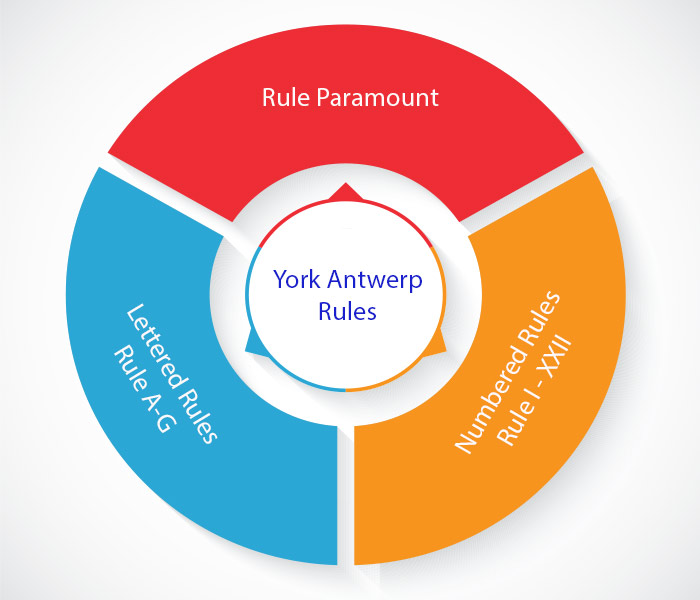
Let is discuss few of the important rules.
Rule Paramount
While all the rules in York Antwerp rules are named either with a number or an alphabet, this one rule is named differently. This is because this rule is paramount to all the rules.
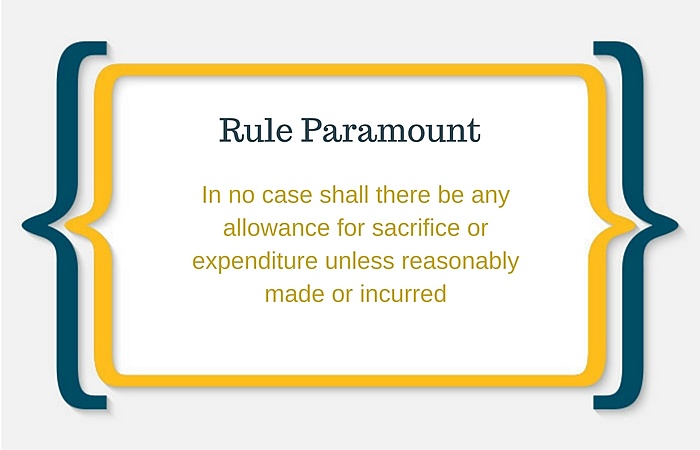
Sacrifices made by ship owners should be reasonable and they cannot over spend. For example let us say the vessel was towed even when the ship’s engine were working.
This would be considered as “not -reasonable” and this amount will not be included in the general average.
What is General average act (Rule A)
What expenditures will be shared by all parties ? When we talk about general average and York Antwerp rules, this is most important question.
If ship owner places armed guards on board, can this be considered as general average act ? Will these expenses be shared between ship owner and cargo owners ?
Rule A of the York Antwerp rules defines the limits of general average act. It says
There is a general average act, when and only when, any extraordinary sacrifice or expenditure is intentionally and reasonably made or incurred for the common safety for the purpose of preserving from peril the property involved in a common maritime adventure
So there are four essential requirements for an action to fall under General average.
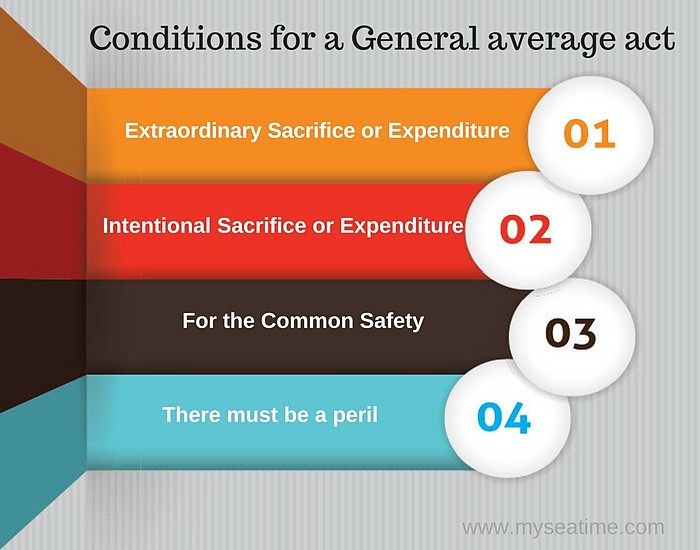
1. The expenditure or sacrifice need to be extraordinary
The ship owner is bound by his duty to deliver the cargo safely at the destination. There is nothing extraordinary in any actions that a ship owner performs to fulfill this duty.
This also answers my earlier question if placing the armed guards would come under general average act. It won’t. Ship owner is placing the armed guards to fulfill his duty of delivering the goods safely.
2. The act must be intentional
If the ship ran over a wreck and to release the ship a part of ship or the wreck need to be cut away. The expenditure involved in this will not come under general average because this was not intentional.
Jettisoning part of cargo to re-float the ship or flooding the water in a hold to extinguish the fire are intentional acts.
3. The Action must be for the common safety
Let us understand the term “Common safety: with an example.
Let us say a container ship has few of the refrigerated containers. The referigeration system of the ship failed and ship had to be diverted to a nearest port for repairing it to avoid damaging this cargo.
Will the expenditures incurred by the ship owner in this case come under general average ?
No, because the action is only for saving part cargo and not for the common safety of ship owners and for other cargoes loaded on ship.
For the general average, the action has to be for the common safety.
The action of Jettisoning some cargo to avoid sinking of entire ship is for common safety.
4. There must be a peril
If the master jettison a cargo to save the ship from sinking, it is a peril. But if the master jettison the cargo because he feels that the ship is overloaded, is not a peril.
Dictionary meaning of “peril” is “Grave danger”. If there is no grave danger, general average cannot apply.
But in the context of York Antwerp rules and General average, the interpretation of grave danger can be different.
In fact that is the difference between “a ship in distress” and “a ship in peril“.
For example take a ship that has broken engine in the mid sea with calm weather. The ship is not in distress but the ship is in peril.
General average Sacrifices
The sacrifices that can be made and are included in the general average fall under three categories.
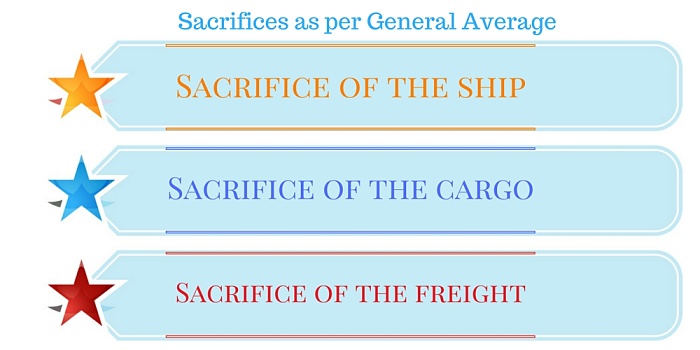
The numbered rules gives the examples of the sacrifices that can be included in the general average.
Jettison of cargo: Jettison of cargo will include in the general average if the cargo was carried as per customary trade. For example if the deck cargo was loaded on a ship that is not allowed to load on deck, sacrifice of such cargo will not include in the general average.
Extinguishing fire: General average will include the damages (to ship or the cargo) because of extinguishing fire on board.
Voluntary stranding: Damage and loss because of intentional stranding in “common safety” is allowed to be included in general average.
General Average Expenditures
Apart from the sacrifices, one party may spend lot of money in the common interest of saving the ship and the cargo. As per York Antwerp rules, these expenditures also can be included in the general average.
Some of these expenditures can be
- Salvage expenses
- Port of refuse expenses
- Wages of master and crew during the prolongation period because of port of refuse
- Fuel during the prolongation period because of port of refuse
No general average for environmental pollution (Rule C)
As per Rule C of the York Antwerp rules, the costs involved in handling environmental pollution cannot be included in the general average.
This is a logical rule as if the general average was to include the environment damage claims, it would have taken the domain of the general average too far.
It does not matter whose fault it is (Rule D)
Let us say a vessel ran aground. The vessel had to sacrifice (Jettison) some of the cargo to re-float it. As per rule D, the cargo owners cannot claim that the grounding was due to the fault of ship owners and they would not contribute to the general average.
Irrespective of the fault which led to the event (in this case grounding), all parties have to contribute to the general average.
But this will not be the case if the ship was unseaworthy. If the grounding resulted because the vessel was unseaworthy, then ship owner cannot benefit from the general average.
In spite of the rule D of the York Antwerp rule, US law does not allow the navigation fault of the ship owner to be neglected. As such most of the ship owners make sure to include “new Jason Clause” in the bill of lading and charter party agreement.
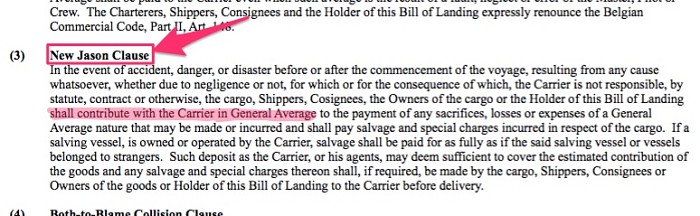
Application of York Antwerp rules and General average
In most countries these rules do not have any legal force in themselves. The York Antwerp rules and principle of general average have legal force only if these are included in the bill of lading or charter party agreement.
If you get to see an actual bill of lading, read the term, conditions and clauses on the back side. Most likely you will find a clause regarding York Antwerp and General average there.
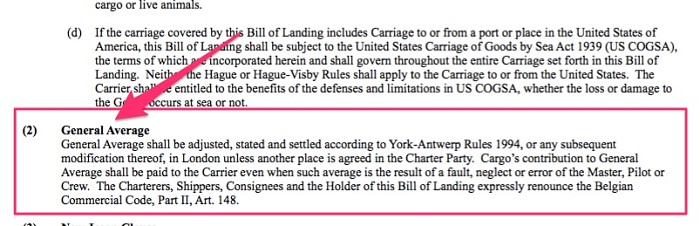
Recovery of general average contribution
In “taxi fare” example, if one person refuse to pay his share what options one can have to recover it.
May be we can let it go as the amount will not be that big.
In the perils at sea, in most of the situations it will be ship owner who would make sacrifices and expenditure to come out of these situations.
So how can a ship owner ensure that everyone will contribute to general average amount that ship owner should get.
In the maritime law a ship owner has the lien on the cargo for the general average contribution. So ship owner will only release the goods once he receives a guarantee that he will get his dues. This guarantee can be in form of
Role of Average adjuster
Don’t go by the name. Average adjuster are not average people. They are the expert in one field of marine insurance, that is general average.
During a general average situations, usually a average adjuster is appointed by one party. The role of the average adjuster is to
- Collect all the information following a general average action
- Make a statement of general average contribution of each party
- Collect general average security from each party
- Assist in effective settlement of the general average
Irrespective of which party has appointed average adjuster, it is the duty of the average adjuster to be impartial towards general average settlement.
Association of average adjusters sets the standards for the training of average adjusters.
Conclusion
General average allows sharing of loss in an unfortunate incident. General average is a good old maritime practice. Not only for ship owners and other parties involved but also for ship’s masters.
To some extent it allows the master of the ship to be a boss and take actions what he believes is the best for that situation.
Take an example where master need to beach the ship to save it from sinking. Because of general average, master would face lesser resistance from all the parties as the loss would be shared.
In the absence of general average, condition would be different. Master may have to convince all parties that beaching is the only option.
Another example where master has to jettison some cargo to save the ship. In the absence of general average, the cargo owner might object to why his cargo was jettisoned and not the other cargo ?
York Antwerp rules and General average has something good for everyone involved with a ship and carriage of cargo.
Fall of Hanjin Shipping and other Maritime stories: September issue
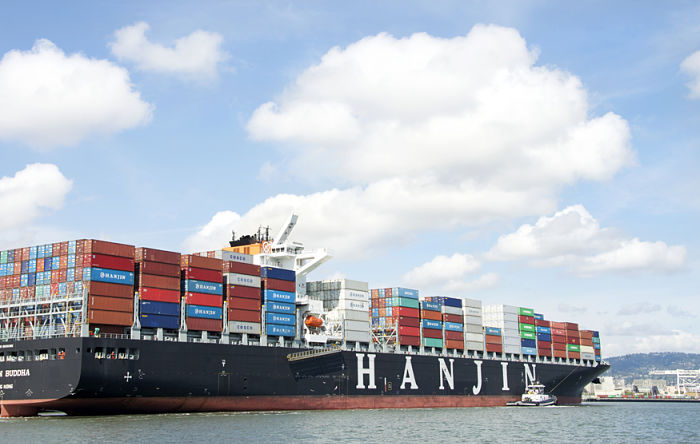
Each month we bring to you the important happening from the maritime and shipping industry. We only bring the news that are in some way relevant to seafarers.
We do not choose a news just to fill the space. Moreover we not only try to post the news but also do an analysis of that news.
Here are the main stories of September 2016.
Fall out of Hanjin Shipping : Main story
If you have been following social media or you have had the chance of reading any maritime magzine, you would know there was something serious about Hanjin that happened last month.
Hanjin was all over the internet. Some described it as “Lehman” moment for shipping.
What is the issue ?
The problem is not new and had started way back in 2011. Like many other companies, Hanjin has been posting loss from 2011 onwards. Companies cannot run with losses and they need cash to run the show.
This cash can only come either through profits or through people and companies investing in the company. Many creditor invested money in Hanjin hoping the conditions would improve and they will get their money back with a good profit.
Korean state bank, Korean development bank was the main creditor in this case.
On 30th August, Korean bank withdrew its support saying the funding plan by Hanjin’s parent’s company is not sufficient to tackle the shipper’s debt.
This withdrawl of support meant that
- Hanjin would have no money to pay for all the operating costs
- Creditor would be aiming for arresting the ships at various parts of the world for recovering its money
Considering the number of Hanjin ships that are at sea, this left everyone concerned in jittery. This would mean that
- Shippers need to find space on other ships for its consignments.
- Port operators were worried if they will get the port dues in time
Apart from this, port operators were also worried that if the ships are arrested in their ports, they would take some space in the port and port operations would suffer.
This left many Hanjin ships stranded outside the port as port did not allow these ships to enter their ports.
But someone’s loss is somebody’s gain. All other container companies saw this as an opportunity. They increased their freight rate as many shippers try to get space for goods on their ships in the forthcoming festive season.
Even though Korean court is trying to stop the fall out of Hanjin, industry experts believe that there is no coming back for Hanjin. This whole business works on the perception of customers and if customer find it risky to deal with a company, they won’t irrespective of the revival.
Here is the timeline of fall of Hanjin
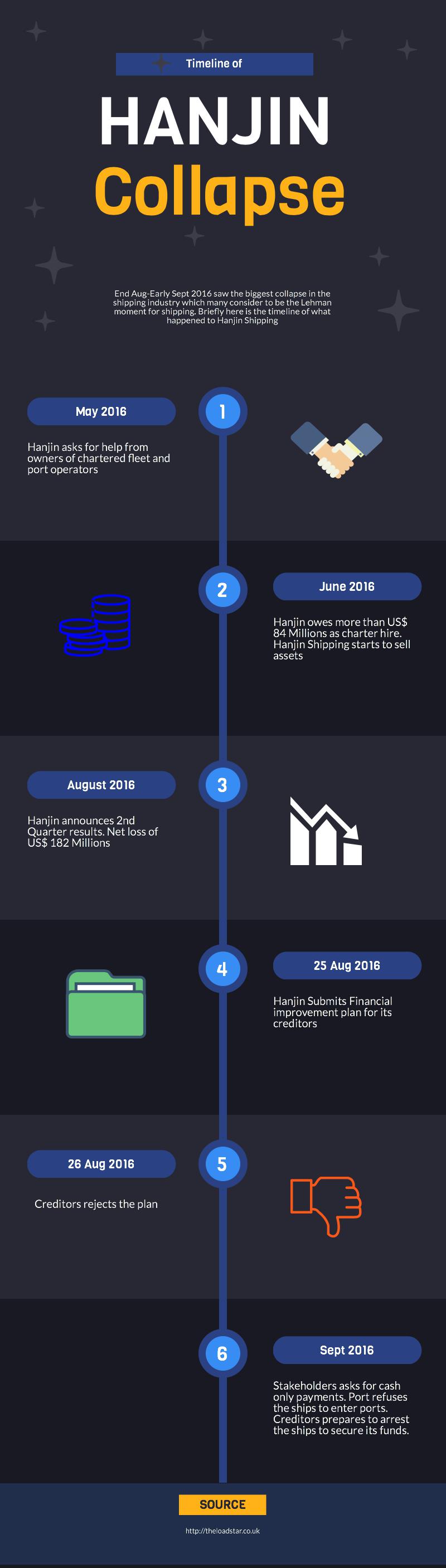
Refusal of shore leave to Hanjin crew
Apart from all the issues with Hanjin ships, crew on board few of the Hanjin ships were not allowed shore leave in USA. ITF described it as a denial of human rights.
2. Lifeboat Drill accident: One crew died and four injured
This month also witnessed tragic incident on board cruise ship “Harmony of the seas”. During routine lifeboat drill, the lifeboat was being lifted with few of the crew inside the lifeboat.
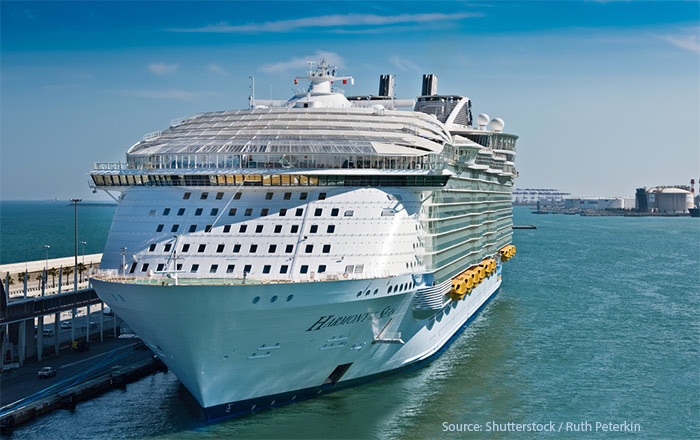
While lifting, the lifeboat detached from its hook and fell into water from around 10 meters height.
Because of this incident, one 44 years old crew member died and four others were injured.
The equipment that is supposed to save lives is responsible for a deaths on board.
This is a tragic incident which highlights the fact that lifeboats are still being lowered with crew inside the lifeboat.
This adds to the already alarming list of accidents and casualties during lifeboat drills.
This incident also highlights the fact that IMO, MSC and the lifeboat makers still has a lot of ground to cover to have a fail proof system. A system that can actually help in preventing the accidents involving lifeboats.
I mean how can a hook simply detach ? We can blame the training and the crew members but in my opinion the solution to it is to design a system that is fail proof and not confusing.
If you want to have an idea what happens when lifeboat hook is detached, watch this video.
3. Ballast water management ratified and to enter in force on 08th September 2017
Accession by Finland has triggered the entry into force of Ballast water management convention that aims to stop the spread of potentially invasive aquatic species in ships’ ballast water.
As this convention was to enter into force one year after it has been retified, this means that convention would enter in force on 08th September 2017.
What does this mean for ship staff and shipping companies ?
1. Ballast water management plan
Each ship need to have a ballast water management plan which will be approved by the flag or by class on behalf of flag.
2. Ballast water record book
Ship staff need to maintain a ballast water record book for all the activities related to the ballast water.
3. International Ballast Water Management Certificate
All ships that have been surveyed and found in compliance with this convention will be issued a certificate. This certificate will be “International ballast water management certificate.
4. Port state inspections
Ships will be subjected to the port state control inspections who will focus on ballast water and may check a sample of ballast water.
4. Alang to be developed into green ship breaking yard
The Indian government will be providing financial assistance to the tune of over Rs 404 crores for a host of maritime projects in Gujarat, including the delayed Ghogha-Dahej Ro-Ro project, two fishing harbour and sprucing up infrastructure at the Alang ship breaking yard.
A Rs 200 crore Workers Welfare Fund will also be used to build hostels and hospitals at Alang. Alang ship breaking yard is being developed into a “green” ship breaking yard to help it handle old Naval ships and even hazardous vessels.
5. World Maritime day 2016
World celebrated world maritime day on 29th of September each year. In a message on this day UN chief said “Maritime transport is the backbone of global trade and the global economy”.
The theme of this year’s world maritime day was Shipping: indispensable to the world.
To mark this occasion IMO secretary general said
“In today’s economy, people all over the world rely on ships to transport the commodities, fuel, foodstuffs, goods and products on which they depend. Maritime transport is the backbone of international trade and global markets.”
“Ships have never been so technically advanced, so sophisticated, never carried so much cargo, never been safer and never been so environment-friendly as they are today.
It is thanks to this global fleet and global workforce of over one million seafarers that the import and export of goods on the scale necessary to sustain the modern world can take place.
But, if the benefits of globalization are to be evenly spread, all countries must be able to play a full and active part in shipping,” he added.
Watch his message in this video.
6. Video of the month
For the video of the month, we chose this video that shows the time lapses video of traffic flow in port of Amsterdam.
The video shows what seafarers deal with these days with traffic density increasing each year around the globe.
Conclusion
Last month we heard the tragic news of fall of Hanjin. We hope that shipping and maritime industry will soon start to revive itself. We hope that the worst is over and only good things will happen here on.
This is the 2nd edition of the monthly newsletter and we shall work continuously to improve the content of the monthly newsletter each month.
Hope you liked this edition of the newsletter.
5 Confusing Terms of Ship Navigation and its Clarification

If it wasn’t about safe navigation, no ship would reach its destination safely. But safe navigation is not only about steering a ship. It is also about navigators being crystal clear about rule of the roads and all the terms used in it.
But not all the terms used in COLREGS are simple or easy to understand. For example while COLREGS has defined the responsibilities in a narrow channel, it fails to define narrow channel.
If navigators do not know what is a narrow channel, how can they apply the rule ?
There are many such confusing terms and I am here to discuss some of these.
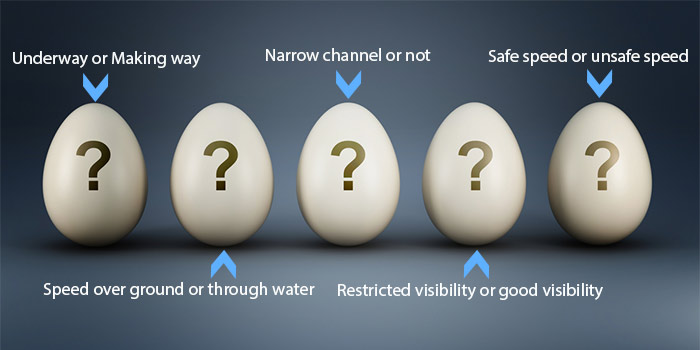
Let is break these eggs to know the answers.
1. Underway or Making way
These are simple terms but if we go in details of it, it might not look so simple. But what makes it important to differentiate between these two terms is the inclusion of these in COLREGS.
For example, a vessel not under command is supposed to display different lights when underway and when making way.
Also a vessel need to sound different sound signals when underway and when making way.
So what is the difference between a vessel that is underway and when it is making way.
As per COLREG
The word “underway” means a vessel is not at anchor, or made fast to the shore, or aground.
In simple words when a vessel is afloat and in no way is touching the ground or seabed, she would be underway.
Now COLREG does not give any definition for a ship making way. It is assumed that it is easy to understand when a ship would be making way through water.
So let us see if we understand the difference with these two situations.
- Situation 1: A vessel was at anchor and it just picked up its anchor.
- Situation 2: A vessel is moving in open sea
These two are easy. In situation 1, the vessel is underway while in situation 2 vessel is making way. Now let is see 3 more situations.
- Situation 3: A vessel is moving while approaching a port and it stopped its engine but it is still moving with a speed of 8 knots.
- Situation 4: A vessel is moving up river with 5 knots speed and with 5 knots against current. So in this situation even though vessel’s engine is running but the GPS speed would be showing zero.
- Situation 5: A vessel is heading downriver with 5 knots following current. The vessel has its engines stopped but would be moving with 5 knots GPS speed because of following current.
Now what do you think the vessel is doing in these three situations.
A vessel is “making way through water” or not is not defined by whether or not she is using engines. It is defined by whether or not ship has any speed through water.
There is another factor that we need to take into consideration while deciding if the vessel is underway or making way. We need to know if the vessel is controllable by helm or not.
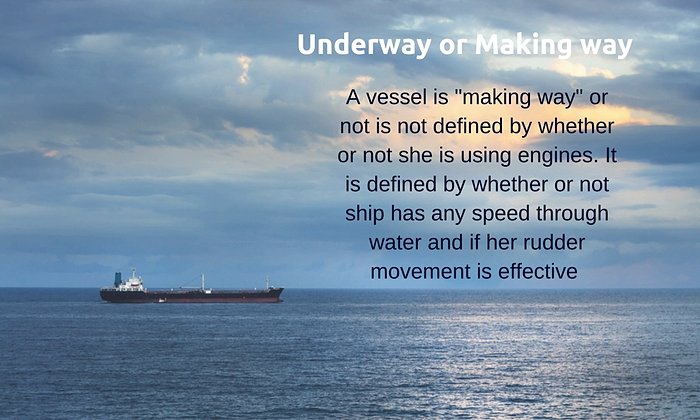
So in situation 3, vessel still has speed through water. Till the time vessel can alter her course with the rudder, the vessel is making way. But when the vessel’s speed is reduced below which the rudder is not effective and ship cannot alter her course, she would be underway.
In situation 4, vessel’s speed over ground is zero but she is still moving with respect to water. So in this case the vessel is making way through water.
In situation 5, even though vessel is moving with respect to ground, she is stopped with respect to water. Hence vessel is underway but not making way.
2. Speed over ground or speed through water
Speed over ground and speed though water are most misunderstood terms.
In simplest of terms, speed over ground is the speed of a ship with reference to ground. For example how fast a ship is moving with respect to an island, a vessel at anchor or with respect to seabed.
Speed through water is the speed of the ship with reference to a floating object.
Let us understand this with these examples
1. Calm weather with no current and wind
Let us say in calm conditions, a vessel is moving with GPS speed of 15 knots. There is one floating boat parallel to the ship at one point.
In one hour how much distance ship would cover with respect to boat and ground (island).
As there is no wind or current, boat would maintain its position. So the distance covered in one hour with respect to boat and island will be 15 NM. So in this case speed over ground and speed through water will be 15 knots.
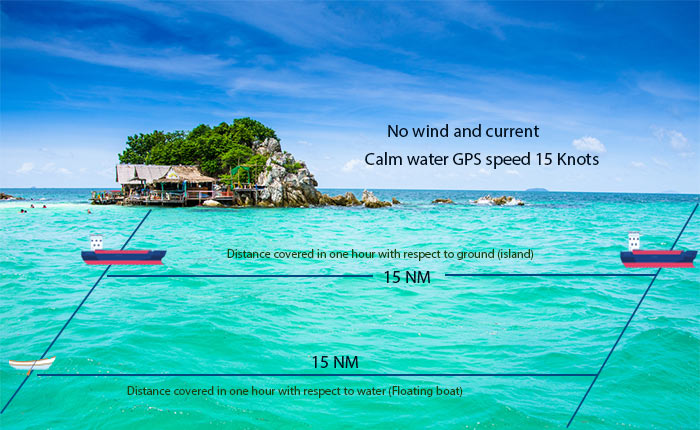
2. Same condition with 2 knots adverse current
Now consider the same situation but with 2 knots adverse current. The ship would move only 13 NM in one hour. But the floating boat would also move astern by 2 knots in one hour because of adverse current.
Now how much distance the ship has covered with respect to island (ground) and with respect to floating boat ?
Yes you got it right. In this case speed over ground would be 13 Knots and speed through water (with respect to floating boat) would again be 15 knots.
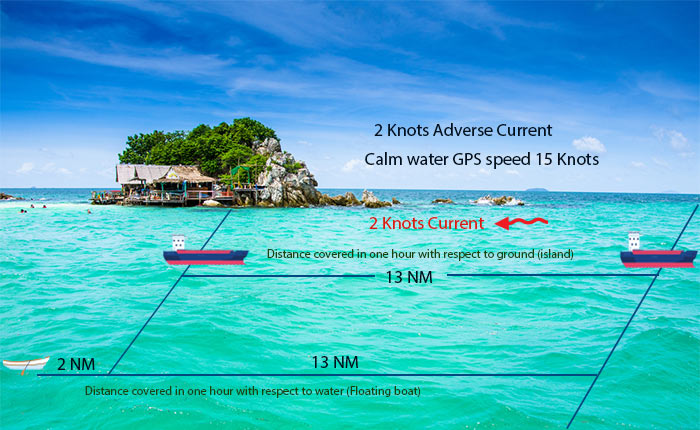
You can do same exercise with a situation with 2 knots favourable current and I am sure you will get your answers.
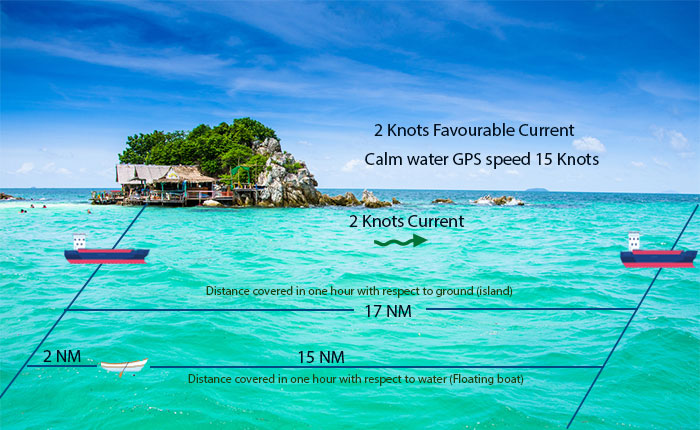
So any speed that is calculated with reference to something on the ground is speed over ground. And speed that is calculated with reference to floating object on the water is speed through water.
Let us work out one more situation. A vessel is made fast to a jetty in river which has 4 knots of head current. What will be the speed over ground and speed through water in this case.
I leave it up to you to calculate.
Hint: What do you think will be the speed of the ship with respect to jetty and with respect to a piece of paper floating in river.
3. Narrow Channel or Open sea
While COLREG 1972 was being drafted, Indonesia proposed to define “narrow channels”. Most of the other countries like Finland, US and Germany rejected the proposal and proposed to keep it undefined.
The people who drafted the rules must have either assumed that the meaning is too obvious or too difficult to give a concise definition.
But the navigational incidents because of unclear definition of narrow channel points out to the fact that the meaning of narrow channel is not too obvious.
On 22nd of March 2008, an Ukrainian flagged oil rig supply vessel NEGTEGAZ 67 collided with Chinese flagged panamax bulk carrier Yao Hi. The collision took place in the western approaches of Hong Kong harbour.
The supply vessel sank because of this collision and 18 of the 25 crew died.
Captain of the supply vessel was found to have breached rule 9 (Narrow channel) because he did not keep on the starboard side of the channel.
There were number of debates on the court’s finding which considered this to be a narrow channel. Many experts did not agree with the court’s decision that it was a narrow channel.
The experts argued that even outside this buoyed channel, there was sufficient sea room for the bulk carrier.
Now if in this incidents, so many experts could not agree on narrow channel, it would be unfair on seafarers to expect them to decide correctly on this.
Even COLREGS do not give any definition for Narrow channel. It is left up to the seafarers to decide if something is a narrow channel or not.
But still seafarer would need some base to decide on if they are in narrow channel or not.
The dictionary meaning of channel is
“A navigable passage in a stretch of water otherwise unsafe for vessels.”
Mariner’s handbook defines the channel as
A comparatively deep waterway, natural or dredged, through a river, harbour, strait, etc, or a navigable route through shoals…”
Now this is the definition of a channel, as in the English channel. But how narrow a channel need to be for it to be called narrow channel.
Some define the narrow channel as
- Channel of 2-3 miles navigable waters
- Channel limited by buoys
- Channel at the river bed
- Approach to a port
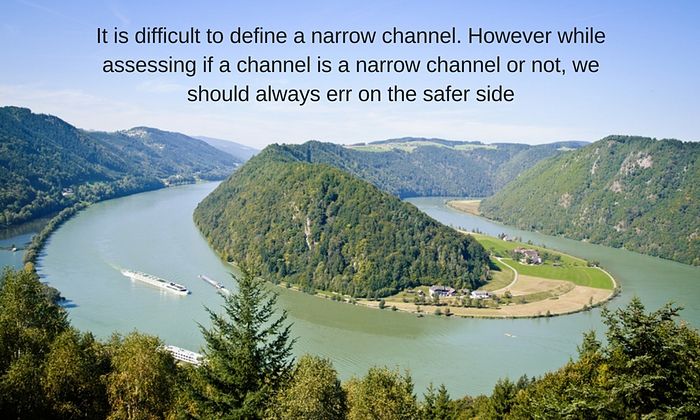
But if it was so easy to define, IMO would have included it in COLREGS. While we can consider above points for assessing if a channel is a narrow channel or not, while assessing we should alway err on the safer side.
4. Restricted visibility or good visibility
What visibility will you consider as a good visibility ? Or rather what visibility will you consider as restricted visibility ? I mean how many nautical miles ?

This is another term that colregs has not defined clearly and there is a reason for that. COLREG defines what restricted visibility is but navigators may get confused if they do not have a number.
So visibility of how many miles can be considered as restricted visibility ? To understand that we need to understand what is the purpose of COLREGS ? What do we want to achieve with so many rules ?
I am sure your answer would be “not to collide”. So at what minimum distance you can discover a target and still would have time to take action to avoid collision.
But before you think of a number, consider that you have same visibility all around. For example let us say you think you can alter to starboard for a target that you spotted head on at 2 NM to avoid collision.
In this situation you need to consider that on your starboard side too, you can only spot targets in 2 NM range. So would you be sure that if you have few ships at 2.5 NM on you starboard side which you cannot spot visually and if you take action for a vessel head on at 2NM, you would be safe ?
Now if I give you same situation in open sea with not much of traffic, you may consider 2NM as safe distance to take action. This is because you may not have much traffic to analyse in open sea. But in traffic dense areas, 2NM may not be enough to analyze the situation and take action.
Usually 3NM is considered to be safe distance to take action. For a distance lesser than 3NM specially in head on situation, there may not be enough time to take action.
So this is the visibility at which you should extra look out so that you can spot the target early.
Depending upon factors particular to your own ship, you may post the extra look out earlier than that.
But if we talk about action for collision avoidance, it does not matter so much if you take action as per restricted visibility or not.
Need to know why ? That is because if you take action as per “restricted visibility” or “in sight of one another”, your action would be same. Even if it is not exactly same, it would not contradict with each other.
See these examples.
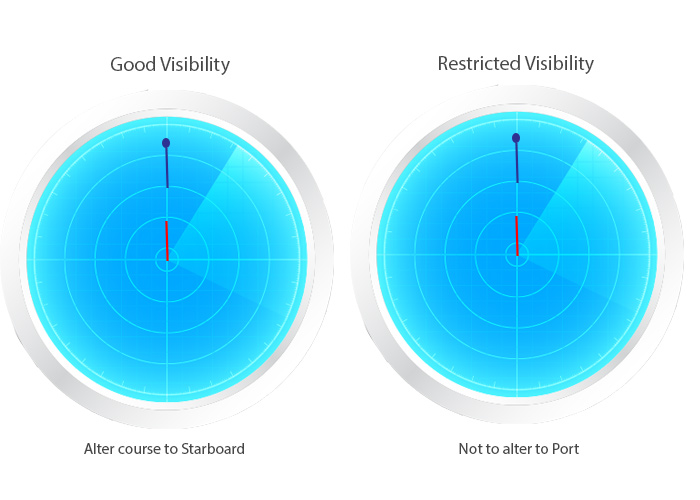
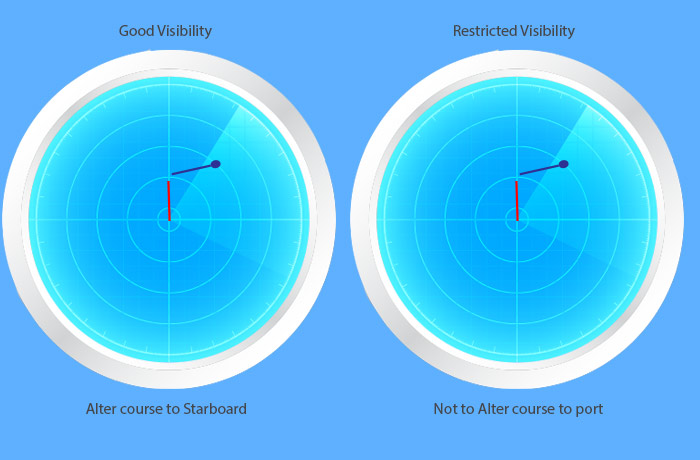
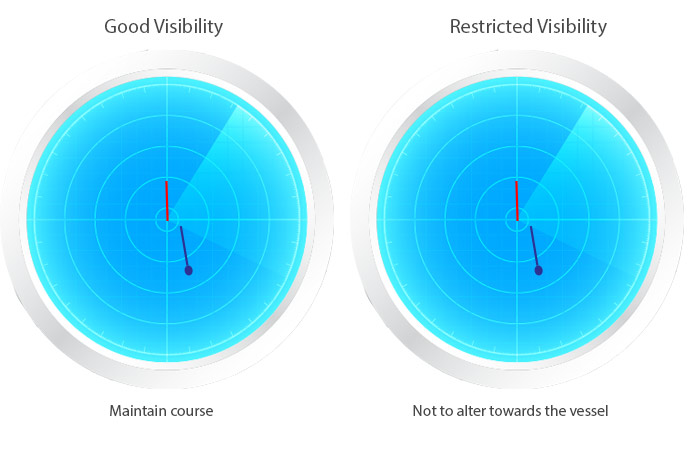
Conclusion: 3NM is usually considered to be safe distance for considering if it is restricted visibility or not. We need to consider ship’s local factors like speed and traffic density to assess the time when we should have extra look out.
For collision avoidance action it does not matter if the action is taken as per restricted visibility ot not as both does not contradict with each other.
5. Safe Speed or unsafe speed
Does safe speed always means slow speed ? Well not always. So what is safe speed ?
It is all in the name. Safe speed is the speed at which vessel will be safe. A vessel would be safe if it has the time to respond to an emergency situation.
Remember the collision of MSC Chitra in Mumbai ?
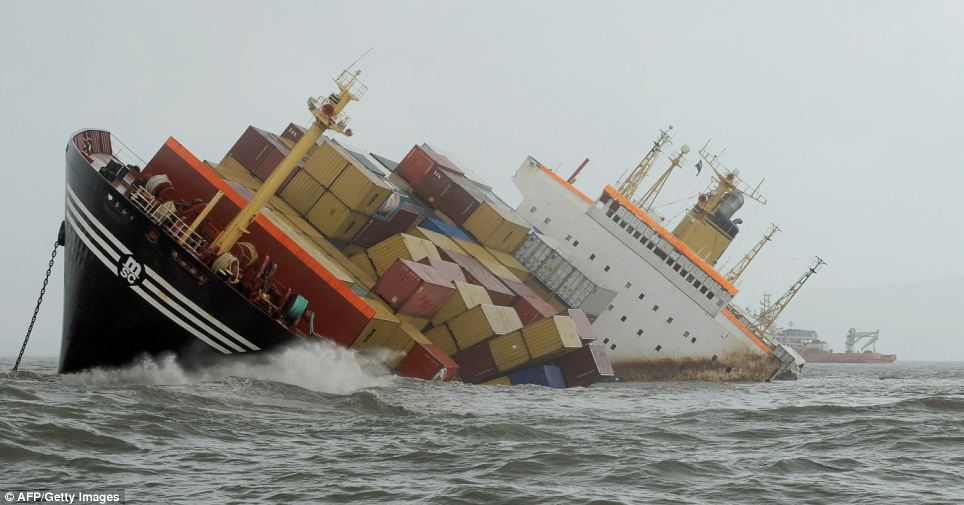
Here is the excerpt from the investigation of this incident. See what it say.
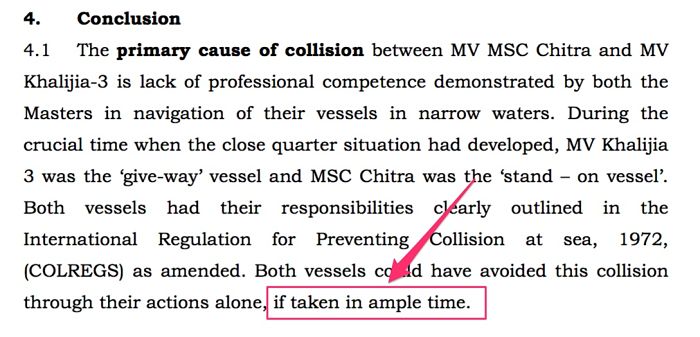
It is always about having ample time. If we have ample time, we can assess the situation and take action.
Have you seen the passenger ferries crossing the strait of Gibralter at a speed of 35 knots ? Do you think they are proceeding at unsafe speed ?
I do not think so. These passenger ferries can reduce their speed from 30 knots to 5 knots in no time.
Now imagine at same location, a ship moving at a speed of 15 knots. But to start reducing its speed, the engine room would need 30 minutes notice. That is what we call unsafe speed.
When we talk about safe speed, it is not how slow a ship is moving but how fast she can respond to a situation that require reduction of speed.
There are whole lot of other factors that need to be considered to assess what is the safe speed. These factors are outlined in the rule 6 of the COLREGS.
These factors mentioned in rule 6 basically ask us to consider two things to decide safe speed
- How early the target can be detected
- How effective the action of the vessel will be
If the target can be detected easily, for example in good visibility, we can proceed at more speed. But if the target cannot be detected easily then we should move at slower speed and have our engines ready.
There are lot of factors that can reduce the effectiveness of the target detection. Some of these are
- The visibility
- presence of background lights
We also need to consider how effective the avoiding action that we take would be. For example in an area of dense traffic, we cannot just alter our course for a developing situation. We need time to analyse the traffic.
If we are moving at higher speed, the time is what we would not have, specially for head on situation.
There is one theory that says that Titanic did not have the binoculars as the navigating officer could not find the key of the store in which these were kept.
Absence of the binoculars meant that targets could not be detected early. So the ship should be proceeding at slower speed. But the titanic was still proceeding at full speed and the result is the history.
Conclusion
There are many terms in ship navigation that are not clearly defined. This is either because the terms are too obvious or the scope of a term cannot be defined in few words.
Whatever the reason, navigators should be clear about these terms. While assessing their own definition, navigators should err on the safer side.
Infographic: How to Wear SCBA in Correct Way

SCBA (Self contained breathing apparatus) is an important equipment on board. We may not get to use it frequently but still it is an important equipment.
We need SCBA for fighting the fire as well as for enclosed space rescue. SCBA is required to be carried on board as per SOLAS Chapter II-2, Reg 10.
But any equipment on board is of no use if we do not know how to operate it. In case of SCBA, not only we need to know how to use it but we should be able to wear it in a flash.
During enclosed space rescue, we should be able to rescue the person quickly. A person can die because of lack of oxygen in less than 3 minutes. As such seconds matters and if we take more time to wear SCBA, we have lesser chance of successful rescue.
Drills on board have a huge impact on the timings of wearing SCBA provided we aim to improve the effectiveness of drills conducted.
So do you know how to wear SCBA correctly. This Infographic can be of some help.
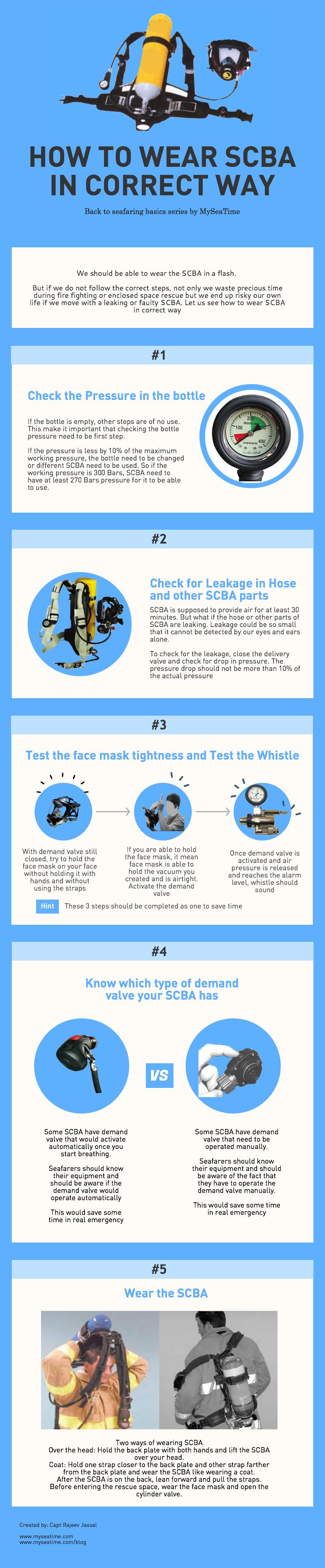
Conclusion
Different ships can have different makes of SCBA on board. But there are few thumb rules that are common with all the makes. It is important that we follow these thumb rules while using SCBA during fire fighting or enclosed space rescue.