
A Basic But Helpful Guide On Framo System

I recently met a 3rd officer. I had a conversation with him about less number of jobs these days for junior officers.
He told me how he got the job just after clearing his exams while his friends were still waiting.
You might ask what edge he had over his friends !!!
Well, he had worked on ships (tankers) with Framo pumps.
I was like.. what ?? Now Framo system helping to get the jobs on ships.
Few seconds later when I got my breath back, I realised how Framo has captured the tanker market.
Truth be told, Submersible pumps are the present and future of the tanker industry.
This makes the knowledge of Submersible pumps and Framo system so much important. This post is about the basics of the Framo pump so let’s start with that.
How a centrifugal pump works ?
Framo submersible pumps are centrifugal pumps. So before we discuss Framo pumps, we must know how a centrifugal pump works ?
And this video might help in understanding of how a centrifugal pump works.
I am not going in details of how a centrifugal pump works. But if you watch the above video, you would know that it has three main components
- Impeller
- Volute casing surrounding impeller, and
- A prime mover (source of energy) to move the impeller
Prime mover provides the energy for the impeller to rotate. Impeller rotates and pushes the liquid into the volute casing.
Volute casing has a spiral structure. It has narrow opening at the entry of liquid and the size of opening increases along the passage of liquid.
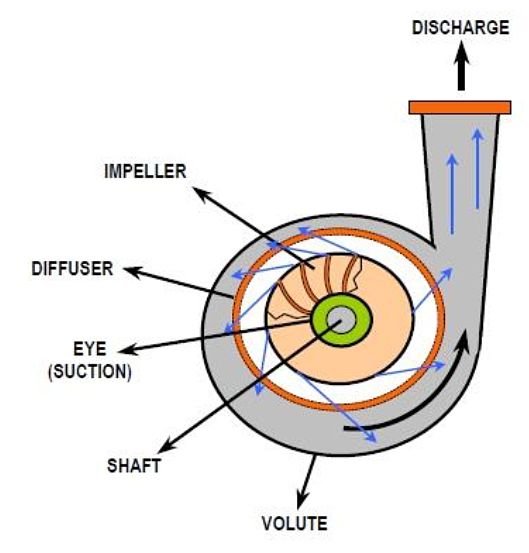
This means that as the liquid travels in the volute casing, velocity reduces and pressure increases. This is as per Bernoilli’s Theorum.
This is the most basic points we should know before we proceed with any kind of centrifugal pump.
Components of FRAMO system
As with all centrifugal pumps, Framo pump also have
- Impeller
- Volute casing
But apart from being a centrifugal pump, FRAMO is also a submersible pump. That is the pump is fitted inside the cargo tank and will be submerged in the liquid (cargo).
Keeping this in mind, let us discuss the components of FRAMO system to better understand this.
1. Hydraulic Motor
For the centrifugal pump to work, impeller need to rotate. But impeller would not rotate on its own. It need a source of energy (prime mover).
In steam turbine centrifugal pumps, this energy is provided by steam. For electric pumps, electric motor provides this energy for rotating the impeller.
In FRAMO system, this energy is provided by the Hydraulic motor using the pressurised hydraulic oil.
How ? Well we all have read the below law of conservation of energy. Haven’t we ?
“Energy can neither be created not destroyed. It can only be converted from one form to another”
Hydraulic motor converts pressure energy of high hydraulic oil pressure to rotational energy to rotate the impeller.
Below diagram is the most basic diagram that shows how a hydraulic motor works.
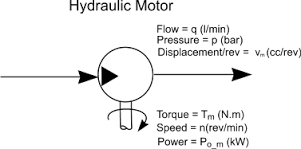
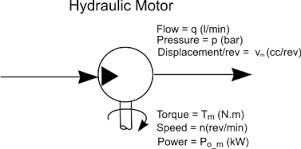
High pressure oil enters the motor. It rotates the shaft and low pressure oil leaves the motor.
In Framo system, you will not be able to see the hydraulic motor as it is placed in the outer casing.
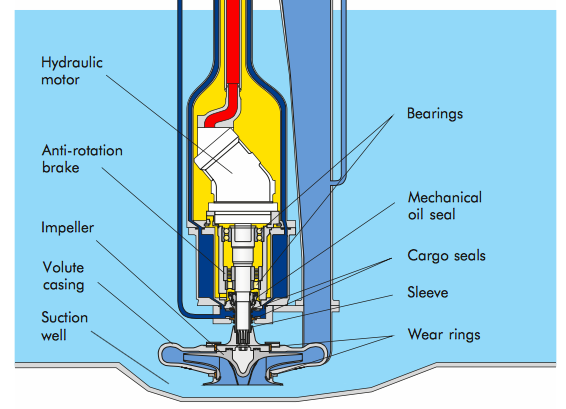
And there are no serviceable parts in a Framo hydraulic motor.
2. Power Packs
For the Hydraulic motor to rotate the impeller, there need to be high pressure of hydraulic oil.
Power packs supply this high pressure hydraulic oil to the Framo hydraulic motor.
Power packs are either installed in the forecastle store or in the engine room of the ship.
Power pack system consists of
- A hydraulic oil tank to draw the oil from
- High pressure pump to take suction from the Hydraulic tanks and pump this oil into the hydraulic pipeline on deck
- Electric motor to run the High pressure pump
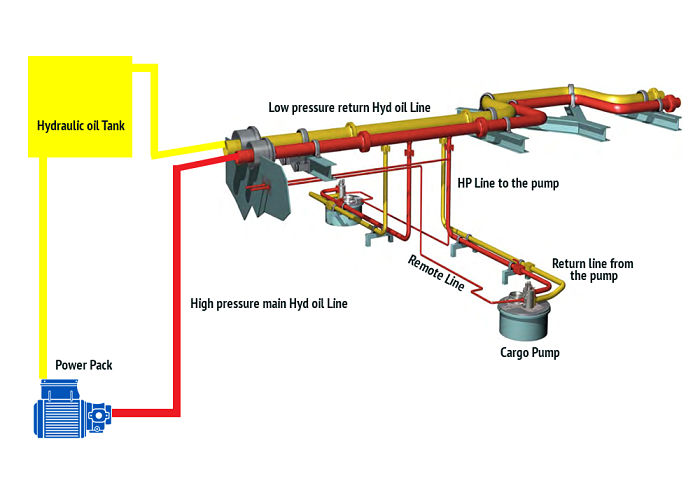
It is important that hydraulic oil tank always have sufficient oil for the high pressure pump. If it has less or no oil, the pump will get damaged.
Less or no oil can be because of two reasons.
- No oil in the tank
- Closed Suction valve to the power pack
There are two safe gaurds in the Framo system to ensure this.
- “Closed suction line” trip
- “Low oil level” trip
Closed suction valve trip
If the suction valve for the high pressure pump is closed, the power pack will trip. This ensures that the suction valve of the pump to take suction from hydraulic tank is not inadvertantly closed.
The alarm for the trip will display in cargo control room as well as Engine control room.
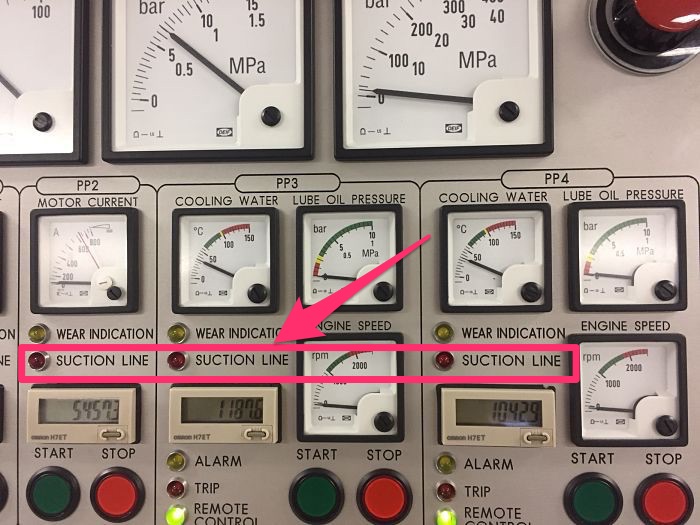
There is a sensor arrangement for the suction valve, which senses if the suction valve is fully open.
In old Framo system this could be a manual valve with its handle touching the sensor. If the suction valve is even slightly closed, its looses the touch of sensor and trip is activated.
In new systems, the valve is not a manual valves. In this case the a proximity sensor is fitted on top of the valve, that senses if the valve is fully open or not.
Low oil level trip
The power pack can loose suction if there isn’t sufficient oil in the hydraulic tank. For this reason when the oil level in the hydraulic tank goes below minimum level, the power pack will trip.
The oil level in the hydraulic tank is kept just above the alarm level. This ensures that any leakage in the line will be immediately detected without the loss of much of hydrualic oil.
There are two alarms for low level
- Low Level alarms, and
- Low Low level Alarm
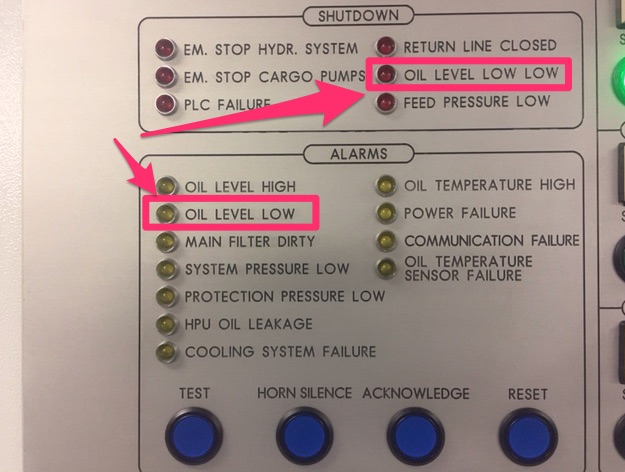
When the level is at Low level, an alarm will activate and will be displayed in CCR and ECR.
If the level of the oil further drops to “Low Low”, the hydraulic oil system (Power pack) will trip.
If the low oil level trip is activated, the reason for low level must be investigated. The oil can then be refilled either from the standby tank or spare drums whichever available.
It is important to fill only the correct grade of hydraulic oil.
3. Cofferdam and Purging routine
So far we have discussed that
- Framo pump is run by hydraulic motor and
- Hydraulic motor gets the pressurised hydraulic oil from the power packs
Now let us see the internal parts of the framo pump.
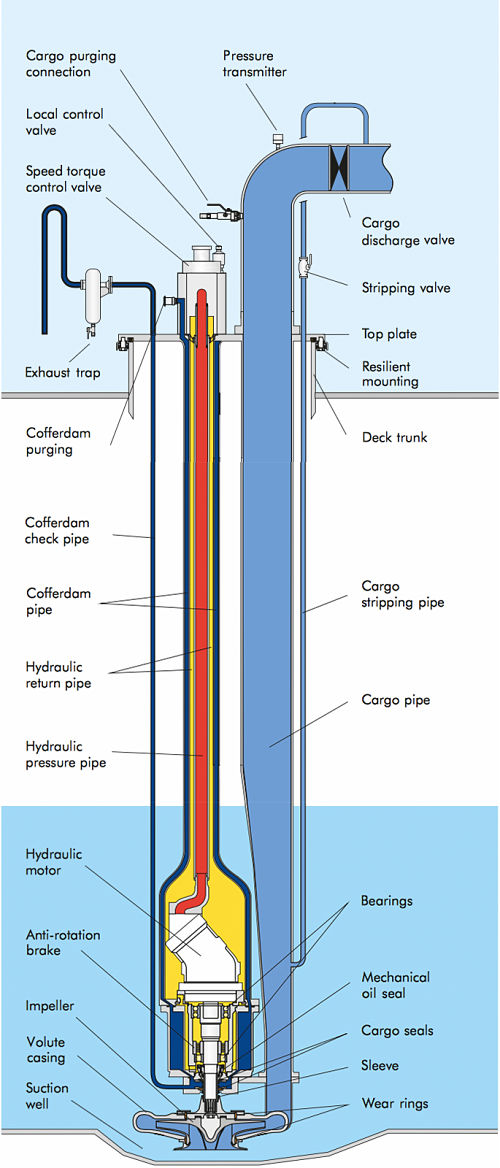
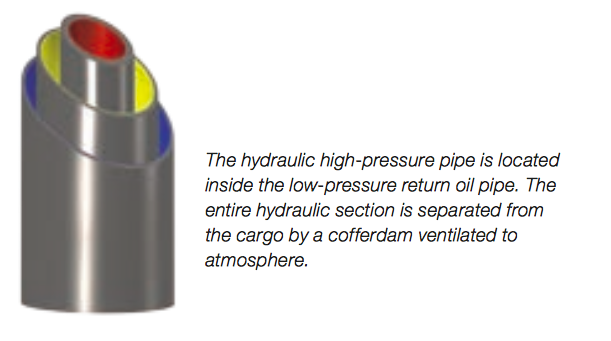
If you notice,
- the red section is the high pressure hydraulic oil going into the hydraulic motor.
- Yellow part is the hydraulic oil return.
Both these pipes are concentric to each other. Like in below picture.
This pump is inside the cargo tank and there are two liquids (hydraulic oil and cargo) that should not come in contact.
If the hydraulic oil leak into the cargo, cargo can damage. If cargo goes into the hydraulic oil, the hydraulic system will damage.
As you might have guessed, there is something in the Framo pump to prevent that. There is hydraulic seal that prevents hydraulic oil leakage to the cargo side. And there is cargo seal that prevents cargo leaking into the hydraulic side.
But seals can leak overtime, right ? so if any of these seals are leaking, how would we know ?
That is exactly the purpose of cofferdam.
You can think of cofferdam as a steel cup with cargo seal at the bottom. Any hydraulic oil or cargo leakage will collect in this cofferdam.
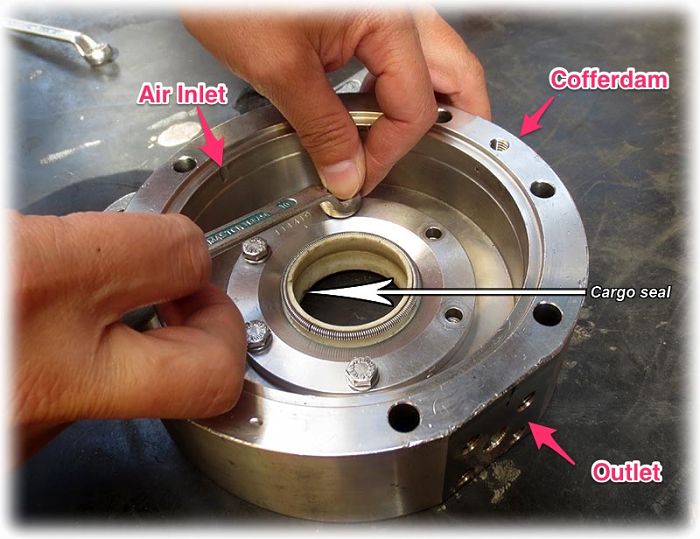
It is important to know if the cofferdam is empty or not. And this is done by purging the cofferdam.
We introduce air or nitrogen in the cofferdam and check the outlet of the purging line.
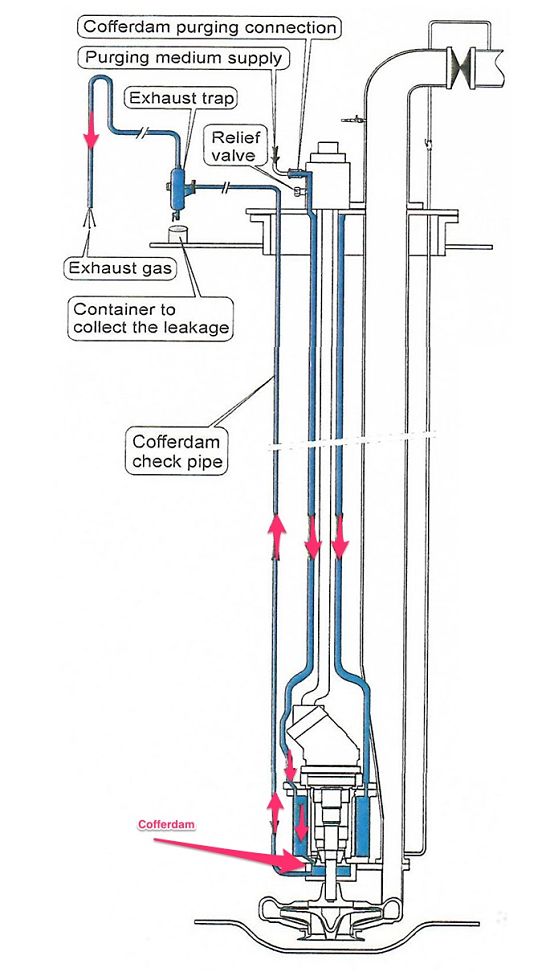
- If we just get the air in outlet of purging line, the cofferdam is empty. So no leakage of hydraulic oil or cargo and both the seals are intact.
- If we get cargo in the cofferdam, it indicates that the cargo seal of the Framo pump is leaking
- If we get Hydraulic oil in the cofferdam, it indicates that Hydraulic oil seal of the framo pump is leaking
- If we get mixture of Hydraulic oil and cargo, it indicates that both oil seal and cargo seal are leaking
If any of the seal is leaking, it need to be replaced with new seal after the discharging and tank cleaning of the tank.
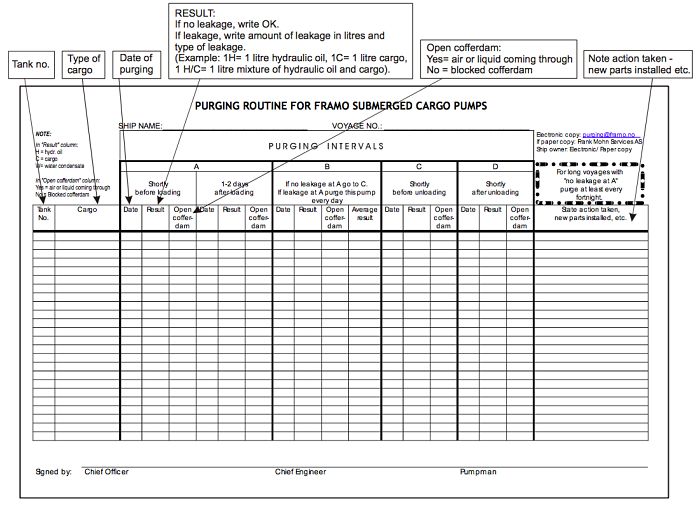
Framo has a purging routine which shows when the purging of the pump cofferdam need to be carried out.
![[Click here for larger view]](https://devv2.myseatime.com/wp-content/uploads/2017/03/purging.png)
We must keep history of purging records for all previous voyages.
For some cargoes, we are supposed to not do the cofferdam purging. These may be toxic cargoes such Toluene Diisocynate or solidifying cargoes such as Palm oil.
In these cases we need to fill the cofferdam with some liquid (DOP in case of loading TDI) so that cofferdam is not blocked with the cargo.
4. STC Valve (Before known as “Flow control valve)
Now we have the pump and the hydraulic system to run the pump.
But like any other type of cargo pump, Framo too would have an operational requirement.
To be able to run the pump at different speeds
To achieve this, we should be able to control the flow of the hydraulic oil to the hydraulic motor of the Framo pump. This is because more the flow of pressurised oil to the hydraulic motor, more speed the impeller will rotate.
This is exactly what Speed torque controller does. STC is fitted on top plate of the pump on main deck. The Hydraulic oil inlet pass through the STC.
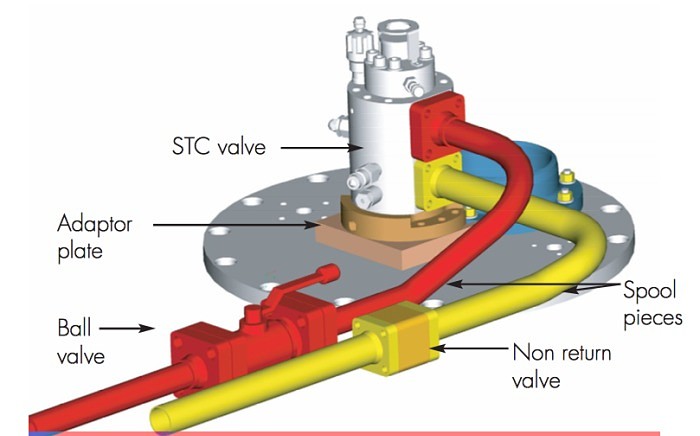
STC of the pump controls the speed of the pump by allowing only the required amount of hydraulic oil to pass through to the hydraulic motor.
STC also prevent the pump to overspeed by controlling the amount of oil to the hydraulic motor of the pump.
There are two ways to control the speed of the pump through STC.
- From the local control on the STC
- From the cargo control room
Local control valve on STC
With local control valve, we can control the speed of the pump locally from the pump itself. This becomes handy during stripping of the tanks or tank cleaning.
Local control valve is a kind of knob located on the STC. When we close the knob (by turning clockwise), the STC passes the oil to the pump.
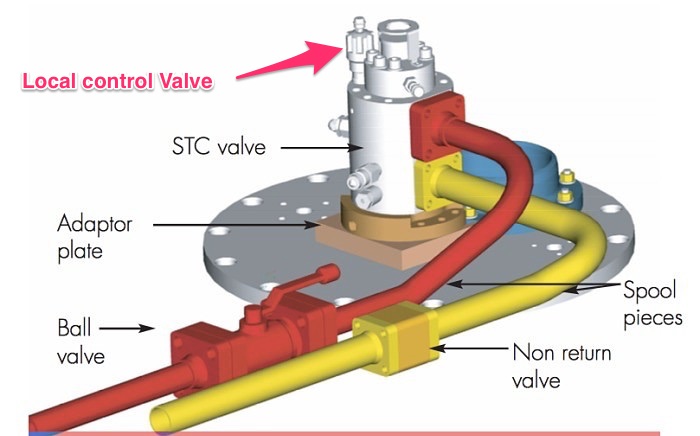
When we open the knob (by turning anti clockwise), the STC bypasses all the oil and nothing goes into the hydraulic motor. Pump stops or do not run in this case.
By partially closing the local control valve, we can adjust the speed of the pump.
Starting the pump from the cargo control room
Speed of the pump (or we can say operation of STC) can also be controlled from cargo control room.
We do this by a lever provided in the cargo control room. Each pump has a lever that connects with the STC of that pump by a hydraulic control line.
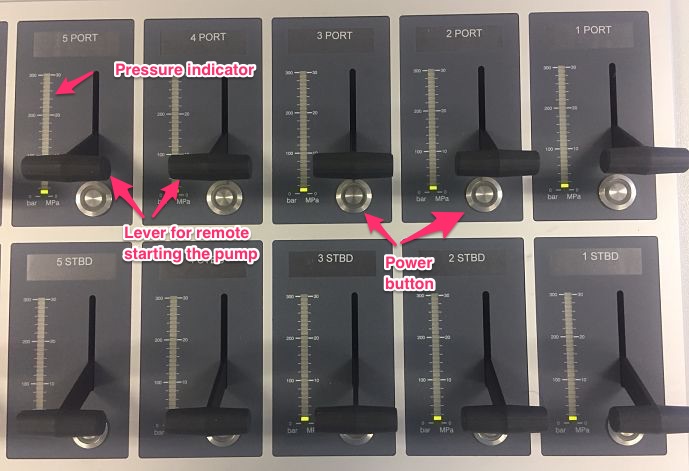
As we push the lever up to start the pump, a signal in form of hydraulic control line pressure goes to the STC.
STC then releases the amount of oil to the hydraulic motor which will be corresponding to the amount to lever lifted.
Here is the actual photo of the STC and pump stack on deck.
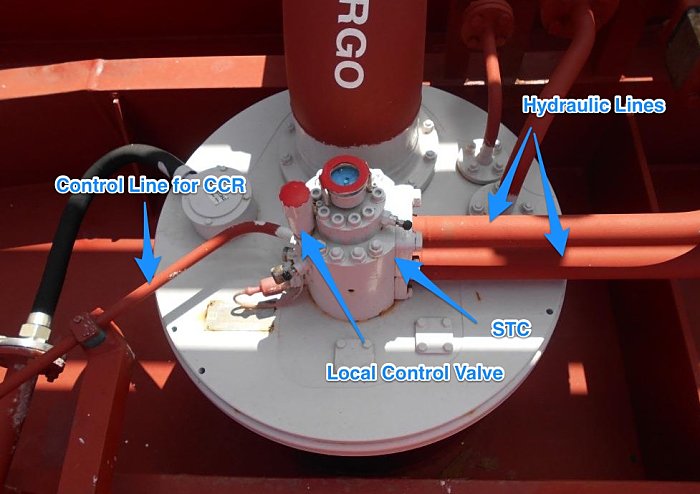
Remote start and Local start
Both, the remote start from CCR and local start from the pump location are interconnected.
We cannot start the pump from local control if the pump Lever is not pushed up from the CCR.
Same goes other way around.
If the local control knob is in open position, the pump will not work even when the pump lever is operated from CCR.
So for the pump to operate, STC need to have the signal from both from local control valve as well as remote lever in CCR.
If we need to start the pump from local control
- We open the local control valve by rotating it anti clockwise
- We push the lever up from the CCR
- We operate the pump locally by slowly closing the local control valve
If we have to start the pump from CCR
- We close the local control valve by rotating it clock wise
- From CCR , we push the lever up to start the pump
5. Feed Pumps
For the Framo system to work efficiently, the hydraulic oil used in the system need to be in absolute good condition.
There are few things that can degrade the hydraulic oil quality.
- Moisture ingress due to hydraulic lines being in vacuum due to temperature variation
- Air in the system that can cause vibrations, frothing of the oil etc.
- Small particles that can be inside the oil during filling of hydraulic oil tank or after a maintenance on the system
Feed pump takes care of all of these issues. Here is how.
Feed pump always keep on running, 365 days in a year, 24 hours a day. Feed pump maintains positive pressure in the lines and hydraulic system . It continuously recirculate the oil through entire hydraulic oil system
Usually pressure of more than 5 Bars is maintained in the system even when the system is not in use.
Now when the system is always under positive pressure, the chances of moisture ingress are minimum
Air if any is auto released to the Hydraulic tank while recirculation. Off course if air is still suspected in the system, there is air purging arrangements in the Framo.
And any particles in the system are filtered while feed pump runs the hydraulic oil in recirculation mode. This is because the recirculated oil is made to pass through the filter.
Recirculation of hydraulic oil through feed pump also avoids oil temperature variations at different parts of the hydraulic system.
There is another function that feed pump serves.
It helps in keeping the feed pressure on the suction side of the main hydraulic pump. This means that when high pressure power pack pumps are taking suction from the hydraulic tank, feed pump ensures that there is no negative pressure on the suction side.
Feed pump alarms
One of the feed pumps must always be running when the power packs are not in operation. If the feed pump stops, the “protection pressure Low” alarms will be initiated.
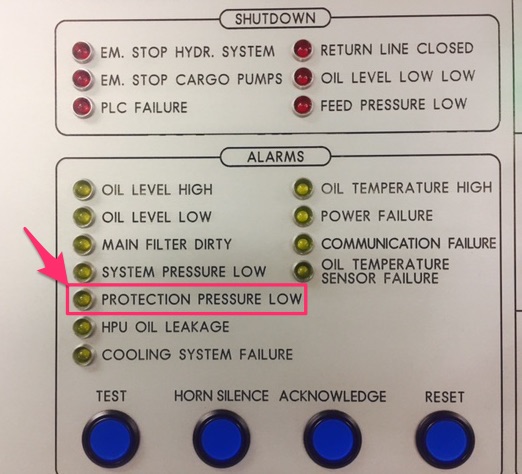
When starting the first main power pack, two feed pumps will automatically start before the power pack is started. This is called high capacity mode of feed system. This is to keep the feed pressure on the suction side of the main hydraulic pump.
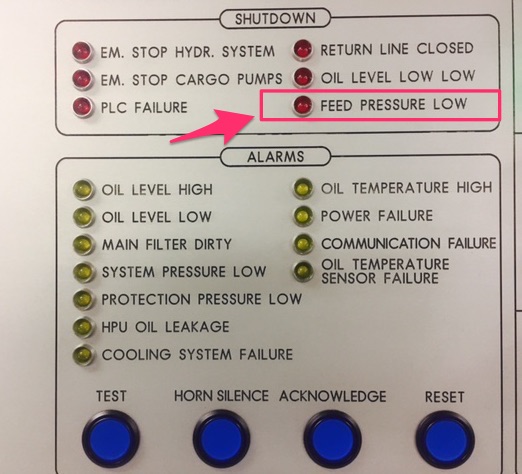
Now let us say that one of the feed pump stops while running in high capacity mode and the power packs are running. In this case the third feed pump will start automatically.
If running signal for the third feed pump is not obtained within 3 seconds, the “feed pressure low” alarm will be initiated and power packs will shut down.
6. Cooling and heating system
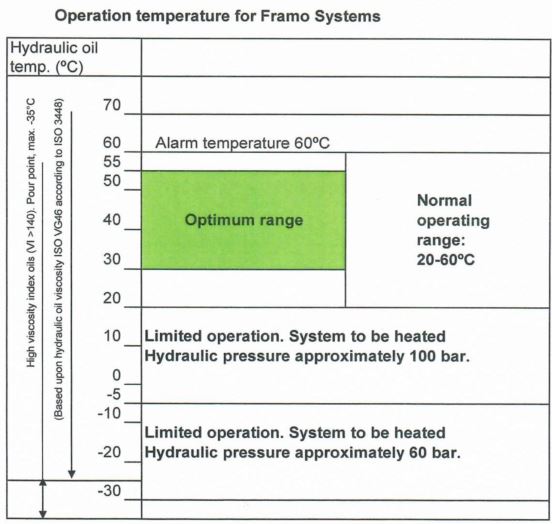
Hydraulic oil used in any hydraulic system has a optimum temperature range for use. This is because higher temperature can damage the seals and other components and also it accelerates the degradation of oil.
Hydraulic oil used in Framo system is no exception.
Depending upon the surrounding temperature, the hydraulic oil used in Framo may be below or above this temperature range.
If it is above the optimum range, the oil will need cooling. If it is below the optimum range, it would need heating.
Even if the surrounding tempertaure is within optimum range, the oil temperature will increase during operation.
If the surrounding temperature is below 20 C, we need to open the heating and venting valve for heating with one power pack running. When the oil temperature is well within operating range, other power packs can be started.
Same goes for when the surrounding temperature is higher. The hydraulic oil is made to pass through a oil cooler to cool the oil before delivery on deck.
The cooling water inlet valve is automatically controlled. It will open at hydraulic oil temperature above 50 C and will close when temperature decreases to below 30 C.
The “high oil temperature alarm will activate if the oil temperature is above 60 C.
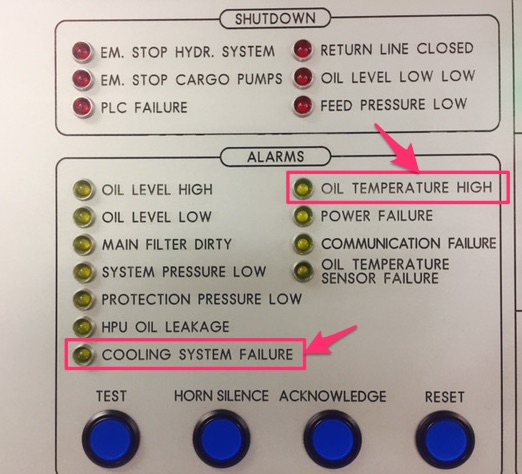
When oil temperature reaches 70 C, the power packs will trip.
7. Emergency Stops
One final thing (among many other) that the operator of the Framo pumps need to know is about “Emergency stops” for the pumps.
These are the push buttons installed at different locations. When pressed, the hydraulic system will trip immidiately.
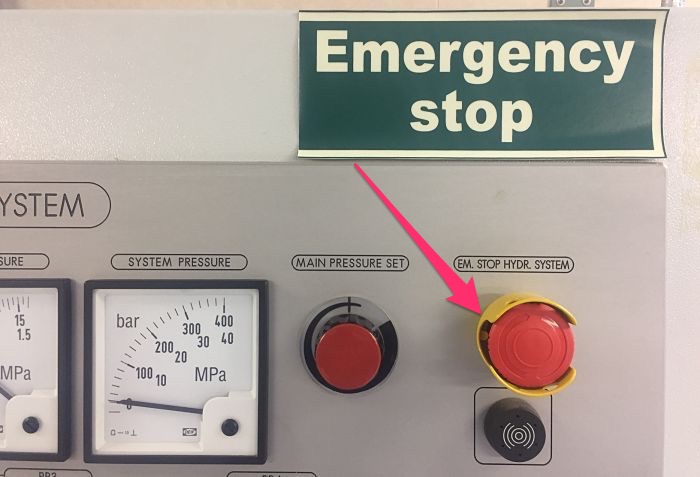
The common locations for these emergency stops are
- Cargo control room
- Manifold port side
- Manifold starboard side
- At the power pack location
On each ship, there could be few locations for emergency stop for Hydraulic system. We must know all of these locations.
Conclusion
Submersible pumps on board tankers is the first choice for the ship owners because of various advantages these offer.
This is particularly the case with chemical and product MR and LR tankers.
Framo is leader among the submersible pumps fitted on board tankers. For anyone working on tankers, this makes the thorough knowledge of the Framo system a necessity.
Here Is All You Wanted to Know About Draft Survey Calculations
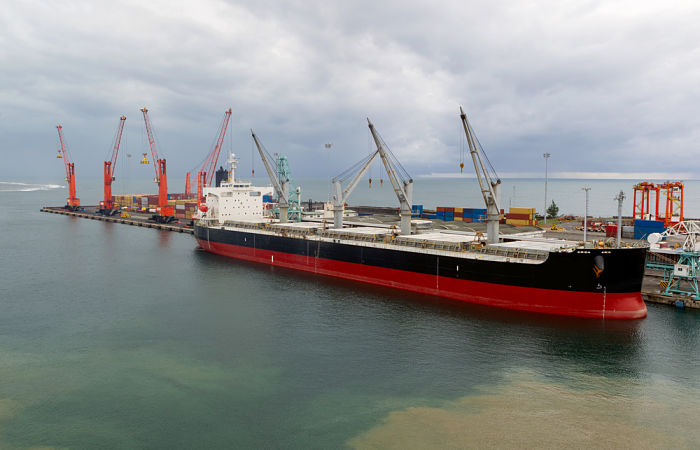
Have you seen a truck weighing bridge ? Do you know how it works ?
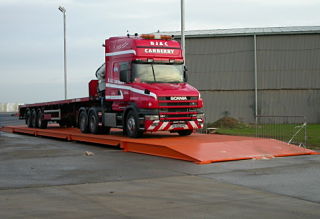
It weighs the empty weight of the truck and then the loaded weight. The difference is the weight of the cargo on that truck.
Well draft survey uses a similar principle to measure the cargo loaded on board ships.
With draft survey we measures the initial weight (displacement) of the ship and it measures the final weight (displacement) of the ship after loading. The difference plus all the weights that were taken out (like ballast) will be the cargo loaded.
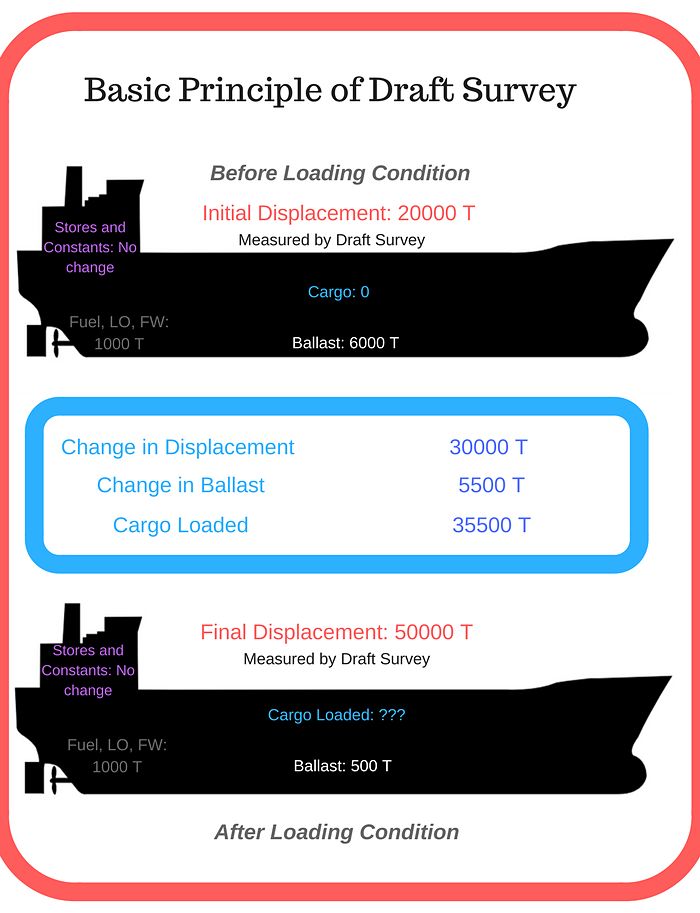
The only difference between weight measurement in case of truck and ship is that for later the calculation is not that simple.
So in this post I will discuss about how to go about measuring the cargo quantity with draft survey.
1. Why Draft survey ?
On tankers, the measurement of cargo quantity loaded is simple. We know the density of the cargo and we know the volume. It is easier to know the weight of the cargo loaded.
But with cargoes like coal, we cannot measure the weight by just measuring the the height of the hold to which cargo is loaded.
This is because unlike liquids, solid cargoes would not take the shape of the hold.
Calculating the cargo loaded with draft survey is the most appropriate way.
But it isn’t only with solid cargoes. Sometimes we have to measure the cargo quantity of liquids by draft survey. One such cargo is Mollasses loaded on chemical tankers.
This cargo has air in it and thus the density of this cargo is not uniform. Calculating the way we calculate the weights for other liquids will give wrong quantity. Draft survey is the answer in this case too.
So let us see how we need to go about draft survey.
2. Basics of Draft survey
With draft survey calculations, all we want to know is the difference in ship’s arrival weight (Displacement) and departure weight (displacement).
Let us say we have these figures
On Arrival
Displacement: 20000 T
Cargo: 0
Ballast: 6000 T
Other weights : 1000 T
On Departure
Displacement: 50000 T
Cargo: ???
Ballast: 500 T
Other weights : 1000 T
The difference in displacement is 30000 T. Out of this 5500 T of ballast was removed and some cargo was loaded at the port.
It is simple calculation to know the quantity of the cargo loaded which is 35500 T.
In this simple calculation, it is not difficult to know the ballast and fuel on board. What we need to know is the displacement of the ship on arrival and after completion of loading.
Once we know that, we can know the cargo quantity. The easiest way to calculate the ship’s displacement is by noting down the draft of the vessel and looking for the displacement for that draft in the trim and stability booklet.
That is the simplest way of saying it but then there are few corrections to this which we will discuss.
3. Draft of the vessel
There are two drafts for a vessel.
- Draft at forward and aft perpendiculars and at midship of these two. This is the draft that is listed in the ship’s trim and stability booklet.
- Drafts at actual draft marks painted on ship side.
So to get the displacement from the trim and stability booklet, we must get the drafts at the perpendiculars.
What we will get from the visual drafts will not be the drafts at perpendiculars in most of the cases.
Let us say we have the visual draft as follows. In draft survey calculation we call the visual drafts as “Apparent drafts”.
So let us say that the mean of both side of the apparent drafts is
Forward = 6.43 m
Aft = 8.53 m
Midship = 7.42 m
Apparent Trim = 2.1 m
As I said we need to bring these drafts to the perpendiculars.
The formula for correction to the visuals drafts to bring it to the perpendiculars is

You will find this distances in the Trim and stability book of the ship. Have a look at these corrections for one of the ship.
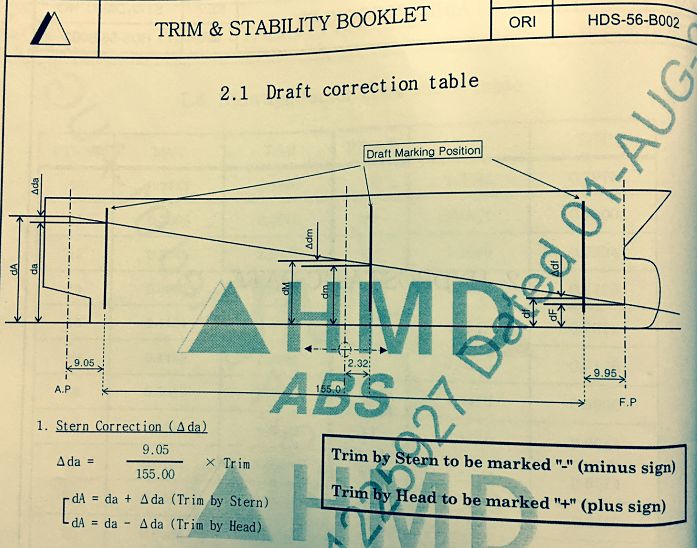
As we can see that the distance from forward perpendicular to the forward draft mark is 9.95 meters.
So the correction to the forward draft would be 9.95 x 2.10 / 155. This will be equal to 0.135 meters. As the forward perpendiculr is forward of the draft marks and we have stern trim, this correction will be negative.
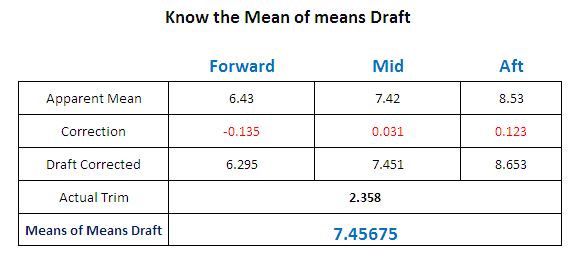
Same way for apparent trim of 2.10 meters, the corrections to the apparent drafts are
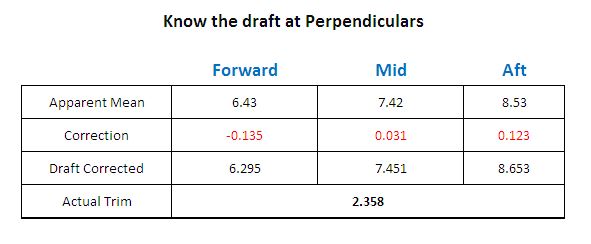
So the drafts at forward and aft perpendiculars and midship will be 6.295 m / 8.653 m / 7.451 m respectively.
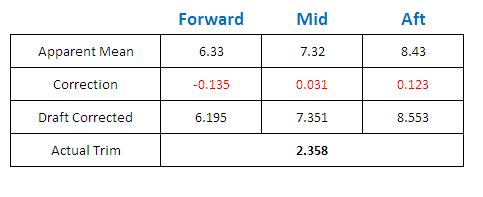
Ideally we should now take the midship draft (7.451 m in this case) and look for the displacement from the trim and stability booklet.
But there can be errors in this drafts and we have to make sure that draft is correct. These error could be
- Errors in reading few of the visual drafts
- Errors due to Hog or Sag of the vessel
To minimise these errors we finalise the draft of the vessel by having mean of means draft. This is also called Quarter mean draft.
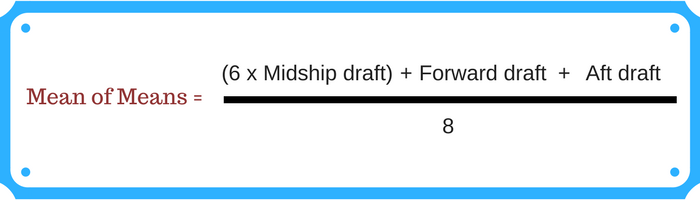
Mean of means is considered to be the accurate draft of the vessel at the midship. This is the draft we need to enter in the trim and stability booklet.
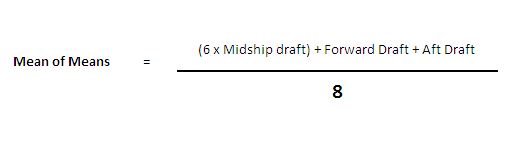
Below is the mean of means draft for our example.
4. Calculating displacement of the ship
Now that we know the draft of the ship, we can open the trim and stability booklet and check the displacement for this draft.
We may have to interpolate to get the exact displacement.
Here is the relevant page of Trim and stability booklet for this ship.
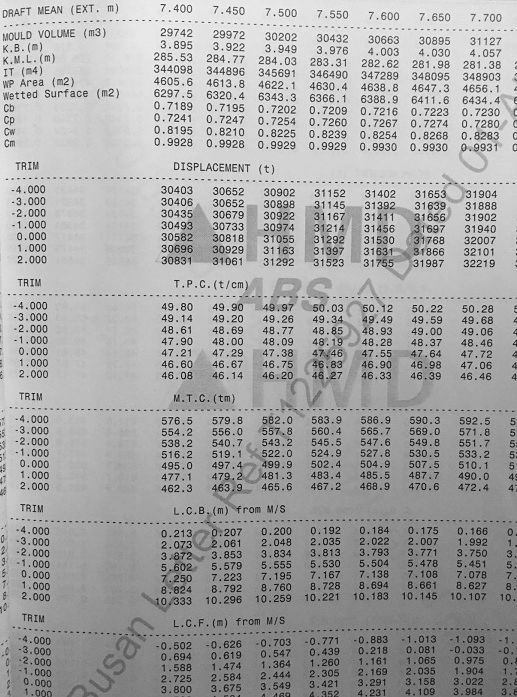 So the displacement for our draft of 7.45675 m will be 30702.28.
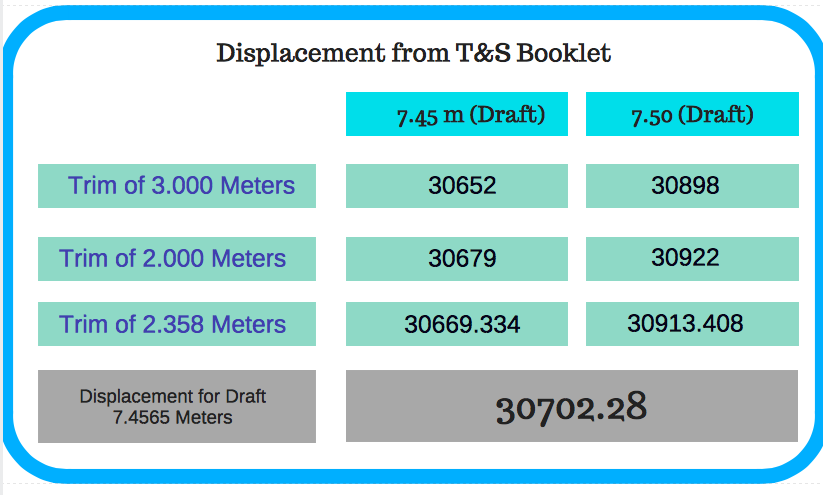
We have now got the displacement for the actual draft of th vessel. But there will be few corrections to this displacement. Let us see what these are.
5. 1st Trim correction
The draft and displacement we got so far is at the mean of aft and forward perpendicular.
As per Archimedes principle, a floating ship displaces the amount of water equal to its own weight. And the ship floats at the center of floatation. So the correct displacement is the displacement corresponding to the draft at the center of floatation and not at the mean draft.
The correction applied to the displacement at mean draft to bring it to the displacement at center of floatation is called the “1st Trim correction”.
The formula for 1st trim correction is
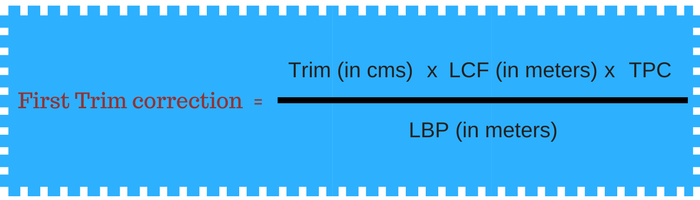
If you wish to know how this formula arrived, watch this video
As we need the values of TPC and LCF for calculating 1st trim correction, open the Trim & stability booklet and find these values for the vessel’s draft. Again we have to do the interpolation to get the exact values.
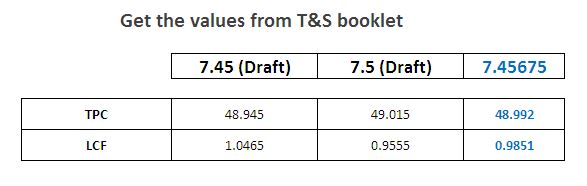
Now let us calculate the 1st Trim correction for our example.

In this case it comes out to be 65 T but it can have larger value in other situations. This 1st trim correction we need to add to the displacement we got earlier.
Sign of 1st trim correction
This is not so difficult to find. We have the draft at the Midship and we are applying the correction for change in draft because LCF is not at the midship.
Now let us say vessel has stern trim and LCF is aft of midship. Which draft will be more ? The one read at the LCG or at the midship ?
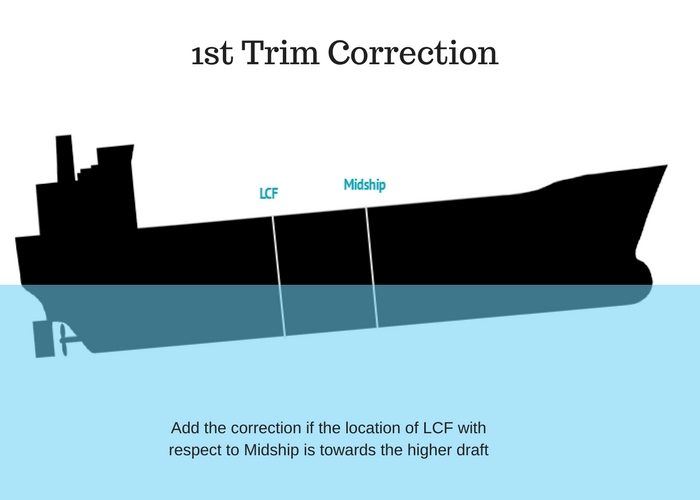
You are right !!! The draft at the LCF will be more. So in this case the correction need to be added to the midship displacement we have got.
So for sign of 1st trim correction, all we have to see is the location of LCF with respect to Midship.
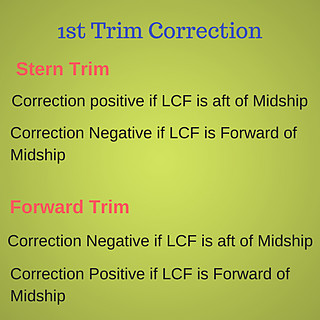
So for sign of 1st trim correction, all we have to see is the location of LCF with respect to Midship. Then by pure logic, we can find out if we need to add that correction or subtract.
6. 2nd Trim correction
Now there is this another correction. First trim correction was because LCF was not at the midship. If the LCF was at the midship, there would not be any 1st trim correction.
The distance of LCF from the midship is given in the trim and stability booklet. For hydrostatic ship particulars for some ships, the value of LCF is at zero trim condition. For example see below
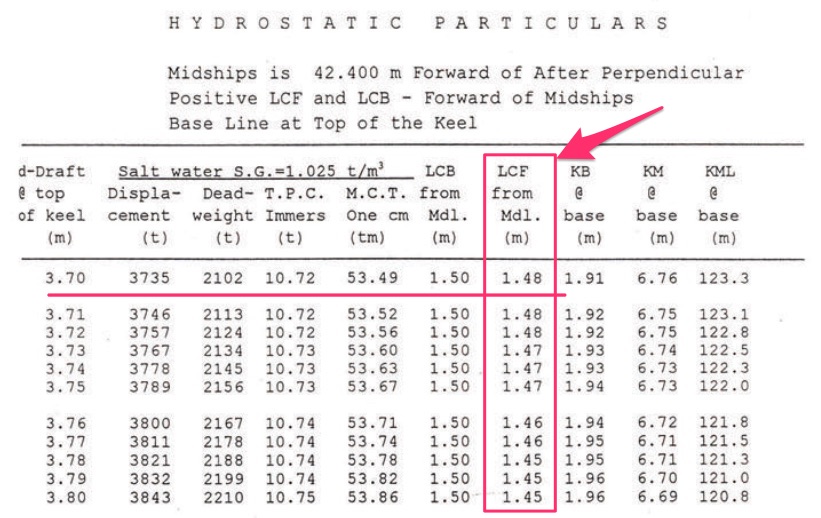
Now if the vessel is trimmed, the position of LCF will change slightly because of change in water plane of the ship.
2nd Trim correction takes care of this change of position of LCF because of trim of the vessel.
The formula for 2nd trim correction is
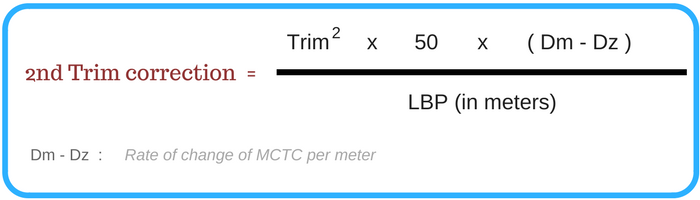
To get the value of Dm-Dz, get the value of MCTC for (mean draft +50 cms) and for (mean draft-50 cms). The difference between these two values of MCTC will be the value for Dm-Dz.
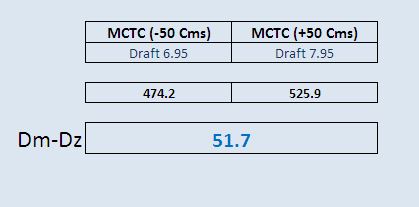
With this value of Dm-Dz, we will get 2nd Trim correction as 35 T.
The 2nd trim correction is always positive.
But see the hydrosatic particulars of the vessel that I took the data from. LCF values are given for different trims.
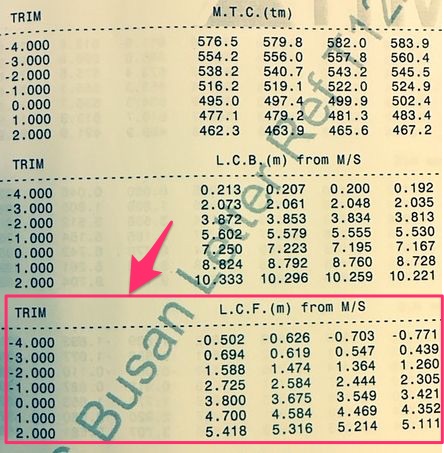
We can interpolate to get the LCF for actual trim of the vessel. In this case 2nd trim correction will not be applicable.
7. Final Displacement
Once we have 1st trim correction and 2nd trim correction, we need to apply these to the ship’s displacement.
So the actual displacement with respect to the draft at LCF will be
Displacement at Midship + 1st Trim correction + 2nd Trim correction
In our example this would be 30702.28 + 65 +0 = 30802.28 T
8. Density correction
We have now got the displacement for quarter mean draft. To this displacement we have applied 1st trim correction and 2nd trim correction.
We now have vessel’s actual displacement. But this displacement is in salt water density of 1.025 as most of the hydrostatic tables have the data for that density.
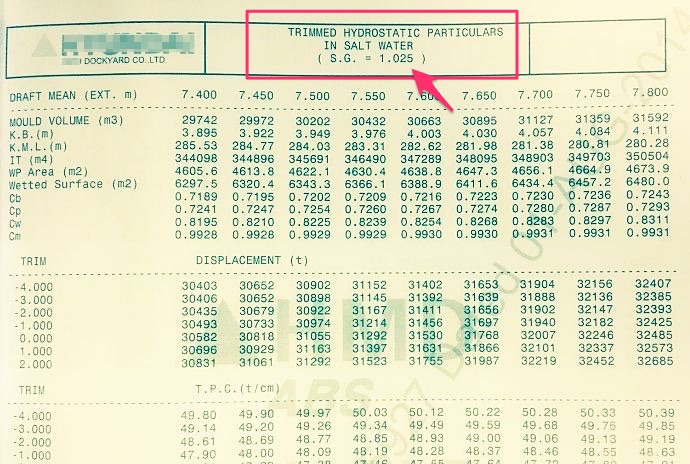
Now if the water density around the vessel is different than 1.025, the displacement of the vessel will change.
Why ? As per archimedes principle the ship displaces water equal to its own weight. If the density of the water is more, ship would displace less volume of water (less draft). And if density of the water is lesser, it would need to displace more volume of water (more draft) to have same weight as of the ship itself.
For draft survey, we need to measure the density of dock water just before or after reading the visual drafts. The density is measured by draft survey hydrometer with a sample of dock water drawn from around the vessel.
The density of dock water changes with depth. So it is important to know at what depth the sample is drawn. Many take the sample from a depth that is half the draft of the vessel. Others prefer to take the sample by running the emergency fire pump.
Now say we have measured the density and we have the dock water density as 1.01
So how to correct the displacement we calculated so far for density ?
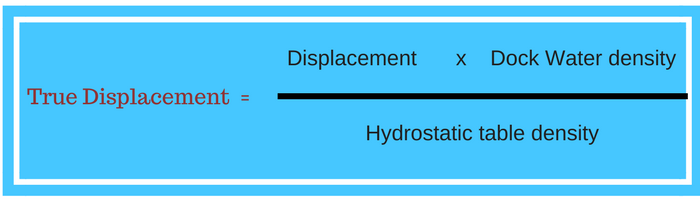
So in our example it will be 30802.28 x 1.01/1.025. That will be equal to 30351.51.
9. Cargo quantity from initial and final displacement
Apart from calculating the displacement, we need to to know the existing weights on vessel.
For example we need to know the exact weight of ballast, Fuel oil, Lube oil, fresh water etc on board on arrival. That is not a difficult thing to know. But there are some best practices.
First it is easier to measure the quantity if a tank is either completely full or completely empty. This also removes the ambiguity and measurement error.
Second, the vessel must not be down by head (negative trim). This is because it brings ambiguity to the actual quantity of ballast in a tank.
Third, since we need to know the weight of the ballast, we must know the density of the water in the ballast. We will know the volume from the sounding table and multiplying with the density will give the weight in each ballast tank.
Fourth, we need to measure and sound each space on ship and not assume that it is empty. For example if there is any void spaces, we must sound these spaces as well.
So now we will know what contributes to the the arrival displacement of the ship.
Arrival displacement = Lightweight of ship + Ballast + Fuel + Fresh water + Lube oil + Constants
And among these things we know the quantity of ballast, fuel, lube oil, and fresh water.
We need to repeat this calculation and measurement of all spaces after completion of loading.
Departure Displacement = Cargo + Lightweight of ship + Ballast + Fuel + Fresh water + Lube oil + Constants
Lightweight of the ship and constants will remain same and so these does not matter. We would know the arrival and departure displacement from draft survey. All other weights we know by sounding and measurement. The only known is the cargo loaded. It is simple mathematics then to know the cargo quantity.
10. Calculating constants on arrival
Calculating constants is not really required if our aim is only to know the weight of the cargo loaded. This is because the the quantity of constants will not change.
But calculating the constants on arrival is a good practice. This gives a fair idea of the correctness of calculation. For example, let us say we know that constants will be in the range of 200 to 300 tons.
If initial calculations give too high or too low constants, we know something is wrong somewhere.
We can sometimes get negative constants. This would mean that we have done some mistake and we must find it and correct it. It may be that we have wrong drafts, wrong soundings etc. Whatever it is, we must correct it before loading starts.
Conclusion
Draft survey is widely used for cargo measurement. It is acceptable way of measuring the cargo quantity.
The calculation however requires practice. It may sometimes be confusing to seafarers using the draft survey for the first time. This can lead to the errors in calculations and cargo claims.
We must know the basics of the draft survey. Once we know that draft survey would not look that difficult.
Treaty and Convention, How These Two Are Different ?

Treaty and convention are two words that looks to have same meaning.
Too often I hear the question about difference between these two terms . And each time I read or hear an answer to this question, it becomes even more confusing.
Do you feel the same way about these terms ? So lets simplify these terms once for all.
What is a treaty ?
We will come to the difference part. But first let us understand what exactly a treaty is. And what more better way to understand this than with a story.
The story is about “peace process”.
Let us say there are 2 friends. Off late, they fight a lot with each other. But now they want to have a peaceful environment. So they made a set of rules for each one to follow. Both of them signed these rules and agreed to follow this in the future.
You know what ? They have just signed a treaty.
Since this treaty is about having peace and harmony, it may be called “Peace treaty” between two friends. And since it involves two parties, it will be called “Bilateral treaty”.
Now you can co-relate this to the real treaties.
For example, Indus water treaty is a bi-party treaty between India and Pakistan for distribution of water from rivers flowing from India to Pakistan.
Same way, Cuban-American treaty is the bi-party treaty between Cuba and United states of America for the betterment of relations between these two countries.
When does a treaty come in force ?
Usually a treaty will enter into force when all the parties have signed the treaty. A Bilateral treaty will enter in force when both the parties have agreed to the conditions set in he treaty.
What is a Convention ?
Now that we know about treaties, let us move to what a convention is.
Let us take a similar story in different situation. There are 10 friends who nowadays are fighting with each other. Because of this the peaceful environment of the town is in question.
The head of the town drafts a policy for conduct of people in the town. This policy will be a convention. Let’s call it “Peace convention”.
A Convention has Articles, annexes and regulations.
In our story, before this convention is brought up, head of the town (in discussion with the head of families) may decide upon various rules about how to go about in bringing this convention. Rules such as
- How many families need to accept the convention for it to come in force ?
- Who among the family members can give their vote
- How a family can cast its vote. That is by verbal, written, typed. And by which method, That is by email, fax, hand delivered etc
These set of rules forms “Articles of the convention”.
The details of the convention is drawn up into annexes and each annex will have many regulations.
How a convention enters into force ?
As I said, a convention has articles and Annexes. It can have different structure but at least the IMO conventions are structured this way.
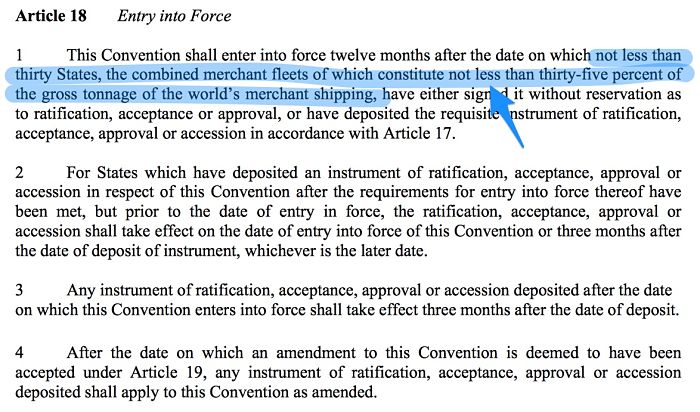
One of the Article of the convention will have the details of how the convention will come in force.
For example, Article 18 of the Ballast water convention states that for this convention to enter into force, At least 30 states with combined gross tonnage of 35 percentage need to ratify the convention.
Difference between Treaty and Convention
Now you see, both of these examples are for a peace process. One is “peace treaty” and second one is “peace convention”.
As you might have already noted, there are few differences. That is exactly what differentiates a treaty and a convention. Let us discuss the differences.
Number of Parties involved
The treaty is between a limited number of parties. Mostly two (Bi-party treaty), sometime three (tri-party treaty) and rarely more than that.
But convention is usually for larger number of parties. For example SOLAS convention has been ratified and adopted by 172 countries.
Drafted and executed by
A treaty is drafted and signed by the parties involved. For example if two countries are at war, they may sign a “peace treaty” to end the war. This treaty may cover the rule of conduct of each nation to avoid such wars in the future.
In this treaty only two countries are involved and no one else. The process may proceed under some international body but it is the parties involved that decides and agree on the structure of the treaty.
But the convention is drafted and executed under an international body such as United Nations for the issues that affects multiple countries (or parties) .
Extent of coverage
Treaty is drafted, agreed and signed to solve a local issue. For example,
- A issue of tensed environment between two countries
- Issue of flow of river water between two countries
whereas a convention is drafted, agreed and signed to solve a issue that affects larger section of the world.
So much in common
Having said all that, you would have noticed that there are so many similarities between a treaty and a convention.
For example, look at the two stories of friends, one of which led to a treaty and other to a convention.
At the end, both are a kind of “peace process agreements”.
This is the reason that the word “treaty” and “convention” are many times used interchangeably.
Treaties and conventions in Maritime context
Shipping and maritime industry is international in nature. All the rules and regulations in maritime context affects almost all countries.
Rules and regulations for the international shipping are governed by IMO which is a body of united nations.
As we can understand by now that all the rules drafted by IMO would fall under the category of “Convention” and not “treaty”.
So we can say that IMO drafts conventions for the world shipping to adopt and follow.
Few of these conventions that we all know are
- SOLAS convention (For safety of life at sea)
- MARPOL convention (For pollution prevention at sea)
- CLC convention (For civil liability during oil pollutions)
- FUND convention (Supplementary fund for oil pollution incidents)
- SUA convention (Suppression of unlawful acts)
- Load line convention (For ship’s load line)
All these conventions were drafted, approved and were brought in force to solve a larger issue that affects the world’s shipping.
Conclusion
Treaty and convention are confusing. In maritime context, we have conventions as these are executed by an international body and these aims for the world shipping at large.
Though all these conventions are sometimes referred as “International treaties” but so far we know what each one of these mean, it is OK to use these interchangeably.
Continuous Synopsis Record (CSR) : What It Is And How To Ensure Compliance ?

If I ask you, who is the registered owner of your ship, will you be able to get this information ? I am sure you will !!
You can get this information from the “Certificate of Registry” of the ship.
Now if I ask about the detail of the ship owner from whom the present ship owner bought the ship, will you know it ?
We as a seafarers may not require this information but it is a necessary information for security purposes.
As with all the security concerns related to shipping, this too was talking point during development of ISPS code.
This information along with few others is now required to be in continuous synopsis record.
Let us discuss this in detail.
What is continuous synopsis record (CSR) ?
In short and plain language, the CSR is a record of ship’s history. It is a record that remains with the ship for its entire service.
When chapter XI-2 (special measures to enhance maritime security) was introduced in SOLAS, a new regulation (regulation 5) concerning CSR was introduced in chapter XI-1 of the SOLAS.
The purpose of the CSR was to avoid the annonimity to the ship’s history and thus enhance the security at sea.
Even if the ownership of the vessel has changed many hands over the years, with CSR it will not be difficult to find who was the owner at what time ?
Same goes with flag of the ship, classification societies and ISM company of the ship. Each change need to reflect on the CSR.
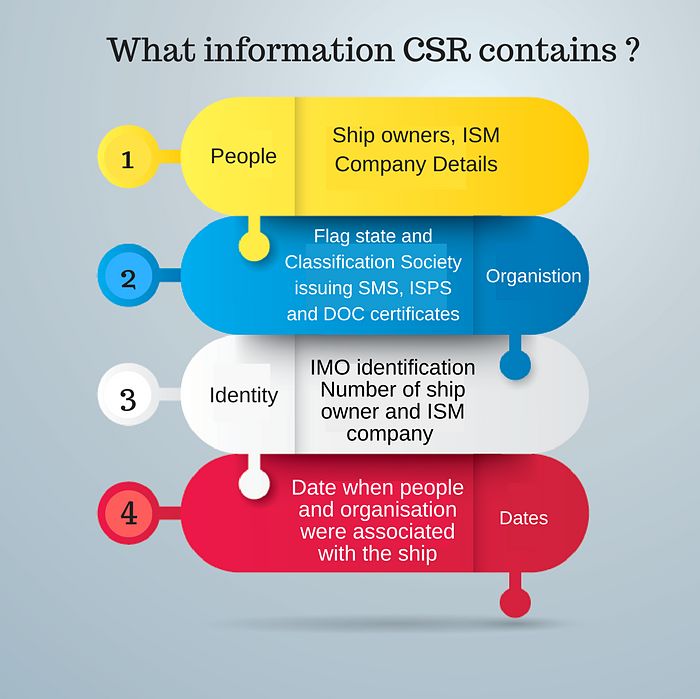
CSR is issued by the vessel’s flag and it must contain at least these 15 point information.
- Name of the flag state
- Date on which the ship was registered with the flag
- The ship’s identification number
- The name of the ship
- Port of registry
- Name of registered owner and their registered address
- Registered owner’s identification number
- Name of registered bareboat charterer and their registered address, if applicable
- Name of company responsible as per ISM code
- Company identification number
- Name of vessel’s classification society
- Name of the organisation that has issued Document of compliance to the company
- Name of the organisation that has issued SMS certificate to the ship
- Name of the organisation that has issued ISPS certificate to the ship
- Date on which the ship ceased to be registered with that state
Company identification number
IMO vide MSC resolution 160 (78) adopted a resolution that requires each ship owner and ISM companies to have a unique identification number.
This number need to be in the appropriate CSR column for the details of Ship owner and ship management company.
These IMO numbers are issued by IHS fairplay on behalf of IMO.
To apply for IMO number for a company, the company need to register with the email on IHS fairplay website.
Once registered, the company then need to fill the online application form for applying to get IMO number.
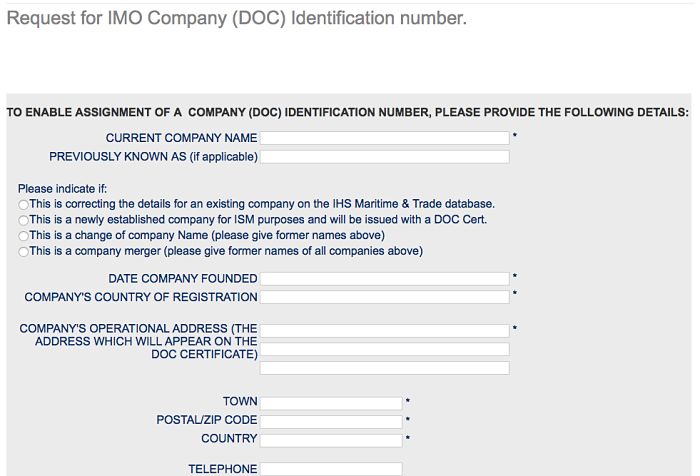
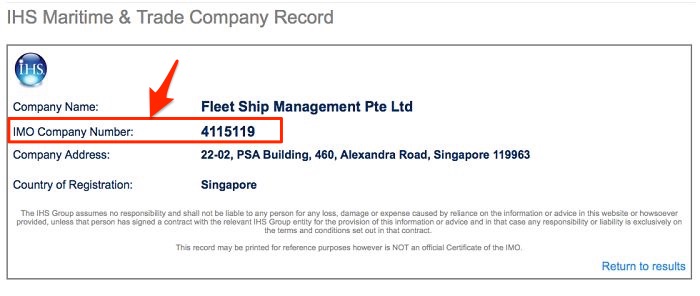
From this website, it is even possible to check the IMO number of any company. For this after login, we can enter initial few words of the company and then press search.
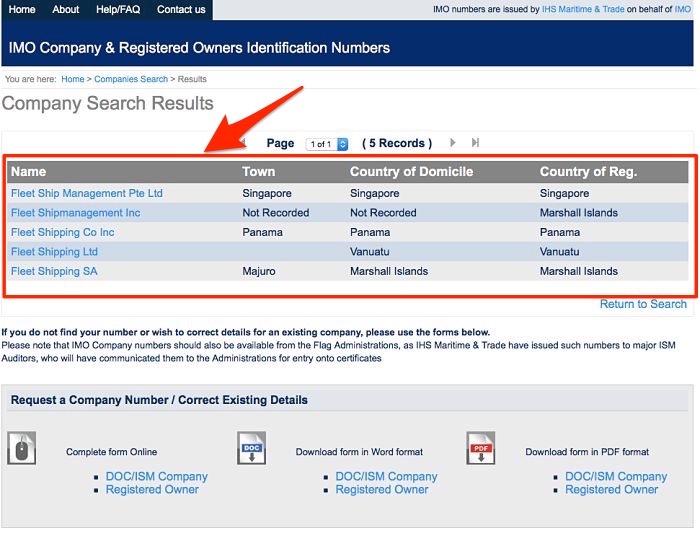
This will give all the matching results. Click on the company for which you are looking for th information.
This will give the information about that company and their IMO number.
Process of changing information in CSR
Now when a ship is newly built and handed over to the ship owner, the ship will have only one CSR document.
This CSR document will have all the 15 point information filled.
Now say, after two years, the ship was bought by a ship owner. This ship owner prefers different classification society than the vessel currently has.
The ship owner need to change the owner’s detail in the ship’s registry certificate. He would then change the classification society of the ship.
I am not going into details of process of changing the classification society of the ship as this would make us divert from our topic.
Now after this has been done, The owner need to apply for these changes to the flag state of the ship to issue a new CSR.
Different flag state can have different procedure of application for correction to the CSR. Some may require the documents to be emailed to them and they will issue a new CSR based upon that.
Others may require physical copy of the application to be sent to them. But most of the flags have moved to the digital way.
These procedure are usually available on the website of the flag states.
These procedures involve sending following to the flag state
- index page of the Continuous synopsis record and
- the amendment page highlighting the amendments required
Let us see how the amendments of change of owners and change of classification society need to be entered in the amendment page.
Amendments to CSR
The amendment page contains all the information that CSR has. When applying for the amendment to the current CSR, company need to fill the amendment page.
Only the columns that are changed need to filled with new information. The columns that are not affected need to be marked as N/C (not changed).
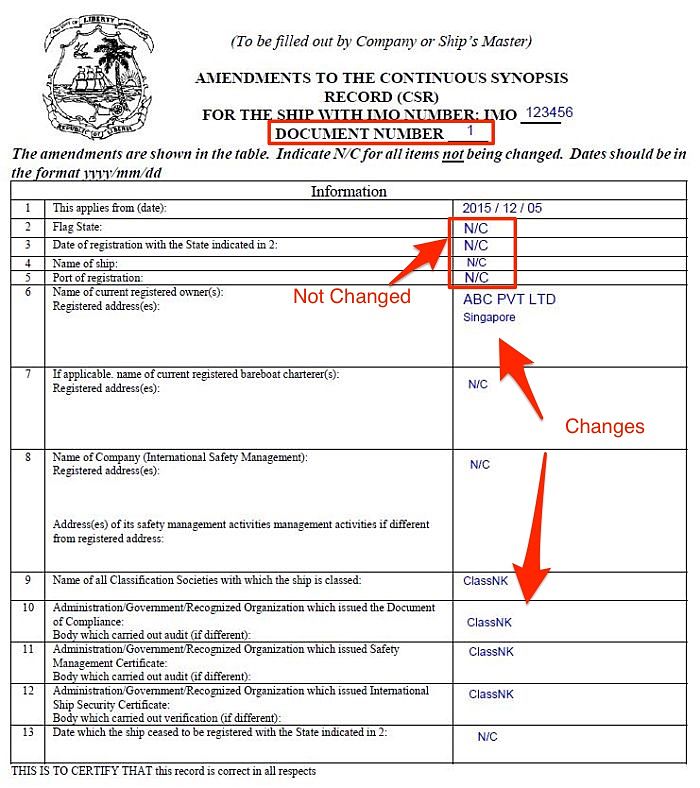
The document number marked on the amendment page shows to which CSR number these amendments are applied.
Amendment from is sometimes also referred as Form 2 of the CSR.
Index page of the amendments
Whenever amendment page is filled for any CSR, the index page need to be filled as well.
For the sample amendment page that I filled, this is how index page will look like.
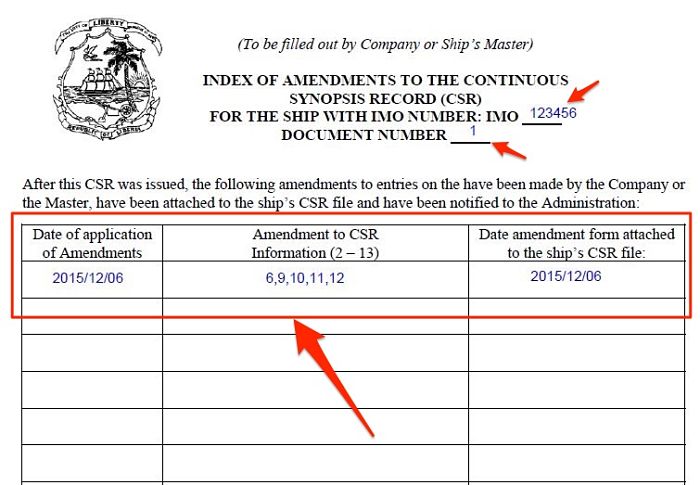
It shows the index of the columns that were affected by the amendment of the CSR document.
So now we have CSR document number 1, which was issued by the flag of the ship when the ship was built.
This CSR had some changes. The changes are shown in the amendment page and index page.
On the basis of this application and the “amendment and Index” page attached to the CSR document 1, flag of the vessel will issue a new CSR which will be marked as CSR document no 2.
Now each time there is any change in the information contained in the Current CSR document, a new CSR document will be issued by the flag state of the vessel.
Index page of a CSR document is sometimes also referred as Form 3 of the CSR.
Click here for a sample blank CSR document with Form 2 and form 3
What Master need to check on CSR documents file ?
Upon joining a ship, master need to check the correctness of the CSR document file. Here is what master need to check
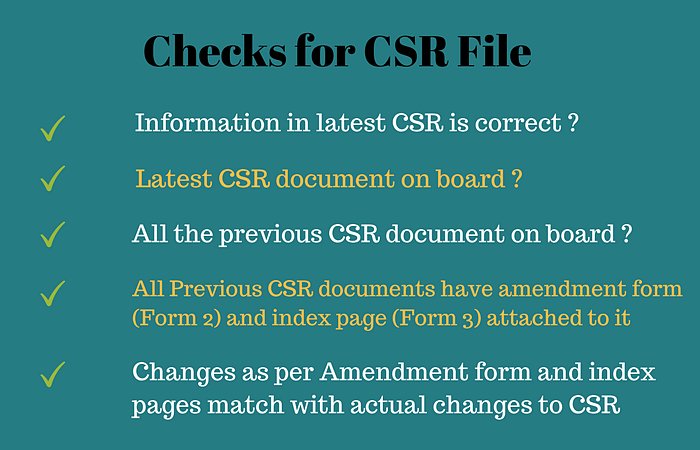
1. Information in the current CSR is correct
First thing that master need to check is if all the information in the Current CSR document is correct. For example, if it mentions the owner’s details, classification society, ISM company name and all other information correctly.
Master need to compare the Owner’s details entered in the current CSR with the ship’s certificate of registry. These two details must match.
2. Current CSR document is on board
If any of the information in the latest CSR document is not current, it may be that there is one more CSR document that is not on board.
In this case, master must ask the company about the document number of latest CSR.
If this CSR is actually the latest CSR document and has some wrong information in it, Master much inform this fact to the company.
Company will then apply for the changes in CSR document.
It may also be the case that the latest CSR document is not yet received from the Flag state of the vessel.
As per IMO circular A.959 (23), Flag is required to issue the updated CSR document within 3 months from the application date. If the latest CSR document is not onboard, Master much check if it is still under 3 months window period and Liaise with the company for receiving this onboard.
During a PSC inspections, 3 months issuance time for the CSR document can be highlighted to avoid deficiencies related to CSR.
3. All the previous CSR documents are on board
Now if the latest CSR document is number 8, all the previous 7 CSR document must be on board. All these CSR documents should be arranged in sequence order.
Master must check if the CSR document numbers 1 to 7 are in the file
4. All Previous CSR documents have amendment page and index page attached
We have already discussed about the amendment page and index page. Each CSR document that was amended must have amendment page and Index page attached to it.
So If there are total 8 CSR documents, 8 being the latest. Then
- Document number 8 will be the latest CSR document with no amendment page (Form 2) and Index page (Form 3) attached to it
- Document number 7 will have the amendment page (Form 2) and index page (Form 3) attached to it. These amendments will be the difference between information in document number 7 and document number 8.
- Same will be the case with other 6 CSR documents
5. Changes as per amendment form and Index pages match with actual changes to the CSR
Amendment form attached to a CSR document reflects the changes made to that CSR document. So for example, let us say as per amendment form attached to CSR document no 6, there is only one change which is change of vessel’s classification society.
This change in classification society must reflect in CSR document no 7.
It is rare to have a mistake from the flag in this case but it may be the case that a wrong amendment form is attached to the CSR document.
Master should detect these errors if any and correct these.
Conclusion
The requirement of “continuous synopsis record” was introduced in SOLAS chapter XI-1 because of the security concerns. The core purpose of the CSR was to be able to get the basic information of people and companies involved with the ship through out its service period.
Not having a CSR or a missing old CSR document can be cause of concern during onboard inspection.
We must ensure that all the CSR documents of the ship are available on board.
Where Does NBDP Fit in GMDSS and How to Use It ?
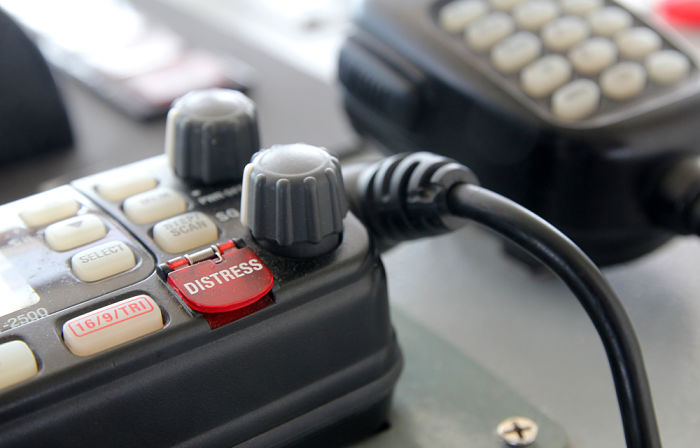
Raise your hand if you think NBDP is more ignored equipment of GMDSS system.
If I was with a group of deck officers right now, I am sure I would see many hands raised. NBDP is surely an ignored equipment.
But it is ignored because NBDP is a dead horse, hardly used and gathering dust at one corner of the bridge.
Even only few coast stations these days have the NBDP facility.
All agreed but if we have this equipment on board, we must know about it. That remains the logic for all the equipments on board.
So in this post, I will go through all that one may have to know about NBDP.
Let’s start.
What is NBDP ?
In simple terms, NBDP (Narrow Band Direct Printing) is a telex. A way to communicate with text rather than by voice.
It is said that NBDP was introduced in the GMDSS to help seafarers whose first language was not English. They did not have to speak to broadcast their distress message, instead they could type and send.
If we go by the literal meaning of the NBDP, then we can understand that
- It uses narrow band width for transmitting the message and
- When a message is received, it prints the message on the screen and on the printer connected with NBDP
So what can NBDP do..
- NBDP can send and receive text messages with to and from a single station
- NBDP can transmit text message stored in the equipment (SD card or floppy)
- NBDP can broadcast a message to all the stations that have their NBDP tuned in to the frequency on which message is transmitted
You can easily draw an analogy between NBDP and whatsapp or viber.
Is NBDP really required on board ?
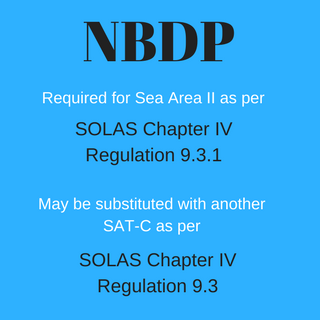
NBDP is required for sea area A2 as per SOLAS chapter IV, regulation 9.3.1
But if you had noticed, on some ships you will find that there is no NBDP.
This is because as per SOLAS chapter IV, regulation 9.3, the requirement of having NBDP can be fulfilled by providing an additional Inmarsat ship earth station.
So on the ships with no NBDP, you may find additional Sat-C terminal.
What is ARQ and FEC mode ?
If you wish to know about NBDP, you must know about ARQ and FEC.
These are two modes of transmission for NBDP.
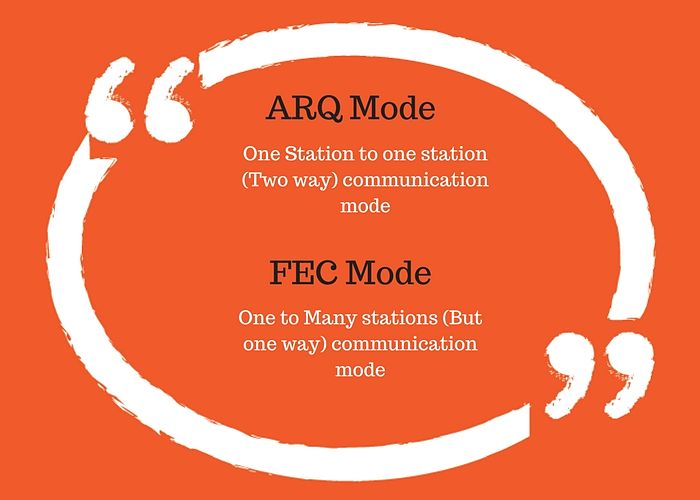
ARQ Mode
ARQ mode is used for one to one communication. For example when our ship wish to communicate with a specific ship or coast station.
With ARQ,
- you send an information (text) when you are transmitting station
- You press Over key (F9) and you become receiving station. You now can read the message what other station is sending
- When other station presses “Over”, you again become the transmitting station and this process goes on.
FEC Mode
FEC (Forward error correction) mode is for one station to one or many stations type of communication. This mode is used for broadcasting the message. For example if a ship need to broadcast a distress telex message, FEC mode should be used.
Unlike ARQ mode, FEC is only one way. That is, with FEC we can transmit our message and then end the communication.
With FEC mode
- You send the information you wish to send
- Once the information is sent, you disconnect the connection
- You cannot switch between transmission and receiving mode
So if you want to communicate with other station, you need to choose ARQ mode. But if you just want to transmit your message, you can choose FEC mode.
So when transmitting a distress message to all station through NBDP, you must use FEC mode
Options on NBDP screen and what these mean ?
A NBDP screen typically looks like this.
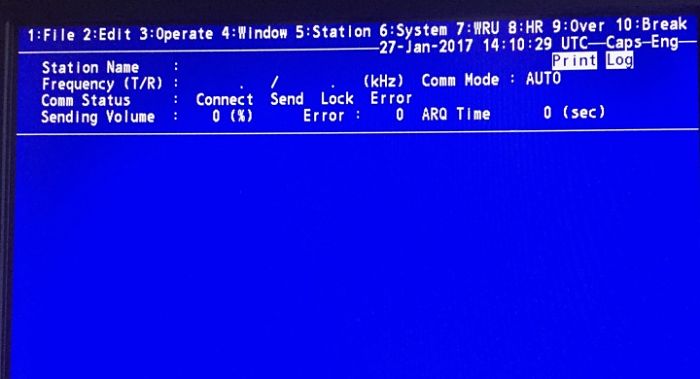
The options you see on top of the screen are accessed by function keys. I see sometimes the keyboard functions keys marked with these options for ease of use. Even if it is not there, we can always mark it like this.
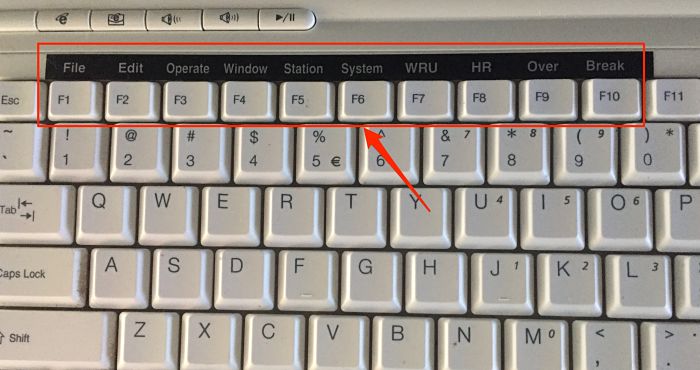
Lets see what each of these functions are for
WRU, HR and OVER keys
The literal meaning of the first two terms is
WRU (Function Key F7): who are you ?
HR (Function Key F8): Here is…
This is the way identity is exchanged between the stations interacting with each other.
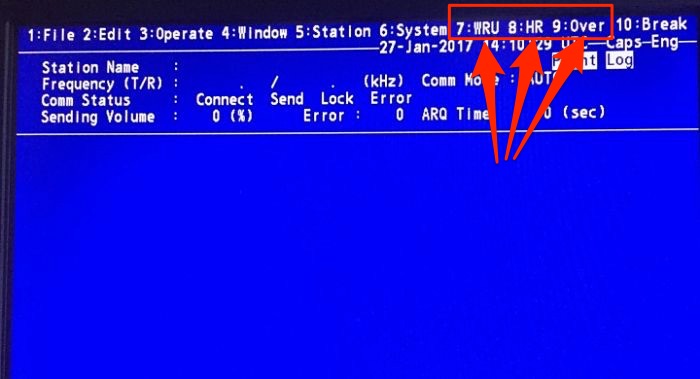
When you are connected with a station and before you start transmitting any telex message, you need to press these two keys.
This will send your identity and ask for the identity of another station.
Logically this is similar to how we start any communication. For example, during R/T communication we pronounce the ships name and call sign.
The Over (Function key F9) is used to switch the direction of traffic. The information sending station becomes the information receiving station and vice versa. As two way communication is only possible in ARQ mode, Over key is used when communicating in ARQ mode.
One station finishes his message, presses “over” and then waits for receiving the message of other station.
The function of this key is similar to saying “over” over walkie talkie after we finish our message.
GA+?
This is the code that you will see when communicating through NBDP. The meaning of this code is “Go ahead”.
When you see this code on you screen, this means that now you are the transmission station and you are ready to send your message. Again this code will appear in ARQ mode.
Methods of sending message
On NBDP, we can either
- Send a message file stored in floppy or SD card of the NBDP or
- Manually type the message on the keyboard.
In ARQ mode, when you are the transmitting station, you can just start to type the message and it will be received by other station as you type.
Or you can choose the file to send and it will be transmitted to the receiving station.
To choose the file on Furuno NBDP, after exchanging the answer back (WRU, HR)
- Press the function key F3 then 3 key to open the [File to Send] window
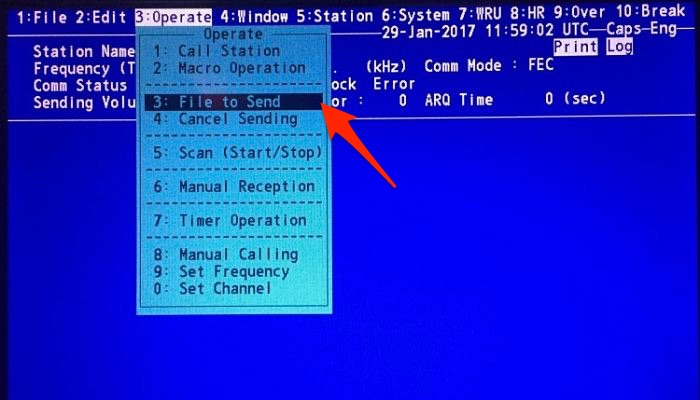
- Choose the file to send from the list by pressing up/down arrow
- Press enter to send the file
How to send / Receive a routine message on NBDP ?
Now that we know something about NBDP, let us discuss how we can send a routine message to another ship on NBDP.
I will show this on Furuno GMDSS station.
First thing is to know the MMSI number of the other ship and agree on the working frequency.
To communicate with another ship, both your station and station of other ship need to be on same frequency and NBDP station should be active.
To make the connection with other ship station (on Furuno equipment).
Press the function key F3 to open operate menu and set the working frequency by choosing option 9.
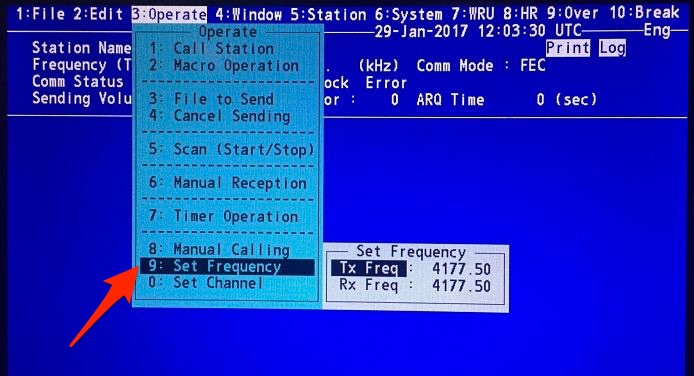
After operating frequency is set, press function key F3 (Operate) and choose “manual calling” option
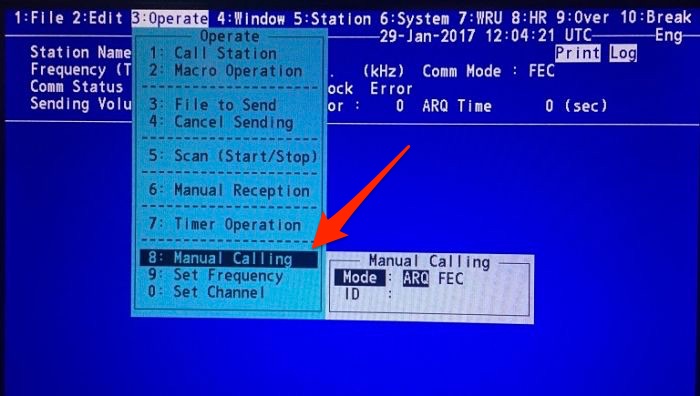
Select the ARQ mode (remember for one to one communication we have to use ARQ mode) and then input the ship’s MMSI number in the ID.
Press enter. After you hit “Enter” one of these two message will appear. It will either show
- Channel busy check, if the frequency is busy. or
- Connect Send Lock, if the frequency is open for communication
Now if “Connect send Lock” is highlighted on screen, you are all done to communicate with the other ship.
When you are connected with the other station, it will show the station’s ID and frequency you are communicating on.
Exchange answer back by pressing F7 (WRU) and then F8 (HR) keys and start communicating.
As I said earlier, when you are done with sending your message, press F9 (over) key to switch the transmission to other ship.
When you see GA+? on your screen, it mean that the other station has switched the transmission to you and you can again start to transmit your message.
To end the conversation
- Exchange the answer back by pressing F7(WRU) and F8 (HR) keys
- After exchange of answer back, press F10 (End) key to disconnect the line.
How to transmit a distress message on NBDP ?
Usual way of GMDSS distress communication is
- Send the DSC alert to all ships and coast station on an appropriate distress DSC frequency
- Switch to corresponding Radio Telephony (RT) frequency and broadcast your distress message starting with Mayday Mayday Mayday
Now when we have transmitted the DSC alert, how a ship receiving it know where they can listen to your distress call ?
This information is right there in the DSC alert message. In the DSC alert message that a ship sends, it need to mention
First is the Mode of communication it will broadcast its message. That is if the message will be broadcasted on RT or NBDP. J3E is the code for RT communication and F1B is for NBDP.
Second, the frequency on which the receivers need to switch on. The frequency will be the corresponding frequency on which DSC alert is received.
So now if you want to communicate the distress message on NBDP, first step will be to let that know to ships and coast stations who would receive your DSC alert by choosing the Telecommand as “F1B”
After you have sent the DSC alert, switch to NBDP corresponding frequency.
To transmit your Mayday message,
- You can either type and save the Mayday message in floppy drive or SD card of NBDP, or
- You can type directly while transmitting your message
Either way, you have to follow these steps.
Press Function key F3 and select manual call.
Choose the FEC option. Remember for broadcasting to all the parties we cannot use ARQ mode which is for one to one communication.
Leave the station ID as blank. This is to be entered only if we are sending the message to a particular station.
Press enter. If the frequency is clear, you will see Connect Send as highlighted.
Now you are ready to either send your message by input to the keyboard or by choosing a pre-typed file.
To Send the stored message, press function key F3 and then select “File to send” option.
Press enter and your file will be transmitted.
How to receive a distress communication on NBDP ?
When you receive a distress DSC alert. Check if the telecommand is J3E or F1B. If it is F1B, you need to be on NBDP to receive the distress message.
To receive the distress message on NBDP, switch to NBDP frequency corresponding to the frequency on which DSC alert was received.
Press the function key F3 and choose “Manual Reception”.
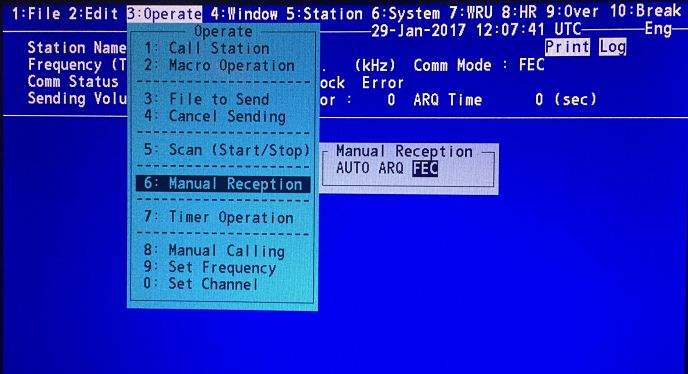
Select FEC mode and press enter key. When a call is detected, Lock will get highlighted.
When the line is connected, [Connect] is highlighted.
When the receiving the message is complete, the NBDP connection will automatically cancel.
The received message will be stored in the Floppy (or SD card) of the NBDP.
NBDP Test procedures
Now that we know how to operate NBDP, testing of NBDP should not be an issue.
Actually NBDP does not require much of the testing. There is a self test in the equipment that should be done as per the maker guidelines.
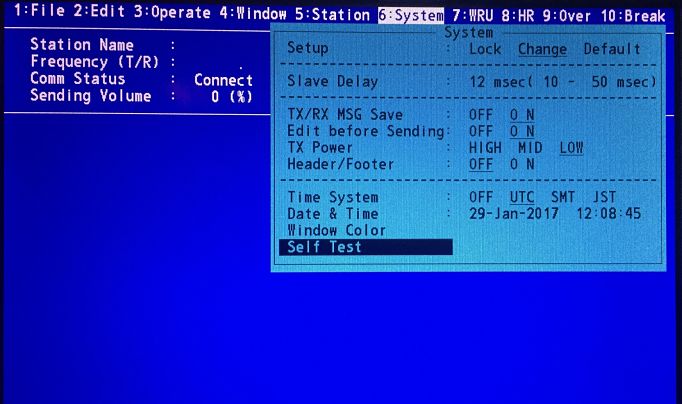
Apart from that, it is a good practice to communicate with another ship at least monthly and keep the records.
Conclusion
NBDP is hardly put in use onboard ships. Many ship owners are now preferring to have another set of Sat-C on board rather than having NBDP fitted on board.
In spite of all that, if we have NBDP on board, we must know about how to operate it. After all if it is on board, it is very much a part of GMDSS station.
This is How QHSE Department Can Contribute to the Success of Company

If your company is doing well, a larger part of its credit has to go to QHSE department of the company. After all they draft the policies that everyone on board follow.
QHSE department plays a big role in the success of a shipping company.
But that is also applicable when the company isn’t doing well. QHSE department should be willing to take the responsibility and correct the things.
There are many right things that QHSE department of shipping companies do. But there are few that they completely neglect.
We are so entangled in this web of policies that we neglect the simple things.
In this post I will discuss 8 areas of improvement for QHSE department of a shipping company for achieving a far bigger success of the company.
1. HSE Policies
The first task of the QHSE department is to draft policies for everyone to follow. This is important and continuous task.
Though it is not an easy task, I must say that HSE policies of most of the shipping companies are robust.
But the task of the QHSE department is not only to make policies but also to ensure that everyone follows it.
When it comes to HSE policies, we have two inter-related issues
- More policies
- Less compliance
In fact, it would not be wrong to say that the number of policies is inversely proportional to the compliance rate.
QHSE department must be absolutely sure if a policy that they are planning to roll out is necessary.
For example, I know a company which rolled out a strange policy after an anchor related accident. The policy required all masters to call their marine superintendent over phone just before dropping anchor.
Nobody followed the policy and the company never bothered if anyone is following it or not but the policy stayed there for years.
The key point is that there is no fun in having more policies specially the one with no logic.
The second issue is of the compliance.
We might say that we cannot force compliance, specially when we are sitting thousands of miles away from the work area.
May be, yes !! But we can always influence compliance on board, even while sitting far away from the ships.
How can we ? I could see this question coming !!!
And the answer is “by having the company run by policies and not by people”. So,
Who runs your company: People or policy ?
Do not know the answer to this question ? Then these direct questions can be of some help
- Do each department of the company has a bad inter-personal relations ?
- Do the expected shipboard standards vary with the age and condition of the ship ?
- Do the expected shipboard standards vary with the hectic schedule of the ship ?
- Do each ship superintendent discuss his appraisal report about master and chief engineer with them without fail ?
If the answers to any of these questions is NO, your company is being run by “People” and not by “Policy”.
For example, we may have a policy of open appraisal system. But if it is only expected to be followed by few people and not across all the departments, company is being run by people.
I see this quite often. A superintendent is suppose to share and discuss his appraisal report about master and chief engineer as per the company policy. But the compliance is left to the individual superintendent.
Another example of “company being run by people” is when expected on board standard changes according to the age and run of the ship.
If we read the HSE policy of any company, it would say that “we aim to have highest standards”. But if the definition of highest standards changes with the age of the ship and other external factors, this policy is just a piece of paper. Again in this case, the company is run by people and not by policy.
No matter how hard we try, we cannot achieve high compliance in companies that are run by people and not by its policies.
Take away point: QHSE department must ensure that company is running as per the policies and not as per the people.
2. Internal Audits
Let me narrate a story. Many of us would relate to this story.
Annual internal audit was conducted on a tanker which resulted in zero Non conformities and zero observations. Few days after, a PSC inspector boards the ship and detains the ship for deficiencies.
How come a best ship with no observation became a worst ship ?
In most of these cases, master and ship staff would be crucified. But QHSE department of a good company would blame it on ineffective internal audit conducted few days back.
I always believed that effective internal audits is the key of success for a shipping company.
There are few things QHSE department can do to ensure an effective internal audit is conducted. And one of the thing is the person conducting the internal audit.
As per ISM code,
Personnel carrying out audits should be independent of the areas being audited unless this is impracticable due to the size and the nature of the Company
This means that internal audit cannot be conducted by superintendent of the ship. This is logical as superintendent of the ship would not want to list out his own deficiencies.
For example if a critical equipment is not on board, the superintendent would not like to highlight this.
Superintendent of a different fleets conducting the internal audit of ships that are not in their fleet is also not a good idea.
This can give rise to “I scratch your back, you scratch mine” culture and effective internal audit will still not be a reality.
I am strong advocate of the idea that internal audits must be conducted by QHSE department of the company. And the QHSE superintendents must be willing to do a good job in that.
There are companies that hide behind the second line of the ISM code requirement (…unless this is impracticable due to the size and the nature of the Company). More often than not, these companies do not do a good job with the internal audits.
Internal audits should be a reset point of the on board SMS system. Any errors, faults in the the system must be identified and corrected after the internal audit.
If we allow these to develop over the years, we are inviting accidents.
Take away point: QHSE department must conduct the internal audits seriously and use it as a reset point for avoiding latent failures.
3. Training
Maritime industry spends enough money on training. But how much of that training is effective ?
It may not be completely ineffective but it does not justify the money spent.
Training of the employees is a integral part of successful implementation of company’s policies, provided the training is effective.
Let us say QHSE department just drafted a policy where it encourages “work safety on board”and wants its crew to follow “take 5” before any work.
Most companies that I researched on implement it this way
- Send a poster of “take 5” on board and ask the ship staff to paste it in alleways.
- Include the work safety on board and take 5 section in HSE manual and a QHSE assistant will send a message to the ships informing about the changes in the HSE manual.
This isn’t effective implementation. How should then QHSE department go about it ?
Well let me answer that by narrating my experience from another industry.
When we travel by air, not many of us are interested in watching the safety video played before take off and that includes me.
But then recently when I was on a Qatar airways flight, I watched the entire safety video. Want to know why ?
Watch it yourself.
A training video has more than 11 millions views on you tube, the audience for which this video is not even directly intended.
It simply proves that whoever watched it while it was playing on board the aircraft was actually grooved into it.
I am not saying to engage Messi or Kohli in training videos. But we must invest in effective training program using effective training techniques.
 Good training material is no longer the only important thing. How we serve the training material to the consumer (Trainees) is also important.
For example the content of the aircraft safety video is always same but Qatar airways safety video is consumed more widely.
QHSE department need to draw an effective training program for it to be of some use.
Take away point: QHSE department must invest in effective training of the ship staff
4. Safety Campaigns
Most seafarers hate safety campaigns. This is a broad statement but it is true.

Not that seafarers do not like safety campaigns at all but most of the safety campaigns that come on board are badly framed.
I say this after analysing at least 15 safety campaigns from 4 companies.
For example, in one of the MARPOL campaign,
- The questionnaire contained around 100 questions
- Master was supposed to take print out and distribute to each crew
- Each crew will answer these questions on the paper
- Master will collect it and calculate the score of each crew member and send the department wise (crew, deck officers, engineers) collective score of the ship to the office
Now this for one was a badly framed safety campaign.
QHSE department need to invest its time in research before they roll out a safety campaign.
A badly framed safety campaign wastes the time of both shore as well as ship management.
Take away point: Any safety campaign must be well thought out, researched and well framed. It must be framed by a team and not a single person.
5. SMS Reviews
ISM code requires master of the ship to review the elements of ship management system and report these to the shore management.
Masters, like any other rank on board and ashore are over occupied in their work. In this situation, it is so easy for them to just send the SMS review with all columns marked as “Checked and found satisfactory“.
Percentage of well thought out SMS review reports that a company gets is less.
An effective QHSE department of a good company always deal with these reviews appropriately as these are rare source of improvements.
There are 2 things that must be done to these reviews and suggestions
1) Acceptance or rejection of the points in review must be well thought out process.
2) If a point or suggestion made in the review is rejected, give detailed explanation in the response to the review. The responses such as “the point was discussed and it was decided that it is not necessary at this moment” does not work.
It is important that the person whose suggestion is rejected must be convinced about the reason for rejection. This will ensure that he continues to send good SMS reviews in the future.
Take away point: Encourage ship’s staff to send good SMS reviews. Make sure the person whose suggestion is rejected is convinced about the reason for doing so.
6. Incentives
Do rewards and incentives bring out better performance from people ? There are mixed reactions to this question. Some say “Yes”, some “no”.
As per “Alfie Kohn” from Harvard, rewards and incentives only brings out temporary compliance and cannot act as a motivator.
So then are incentives and rewards bad ?
Depend how we use it.
QHSE department should use the incentives to draw out something that is not in routine job for the shipboard staff.
For example, Mideast ship management uses the incentives really well. They urge the ship staff of all the ships to send any safety idea that they might have.
They analyse all the ideas received during the quarter and if any idea is worth implementing, they reward that idea with USD 500.

It is not about this scheme but about how they execute it. They send a detailed email to all ships giving detailed explanation about why the particular safety idea was selected as the winner.
They then put all the efforts to implement this idea on board all ships. Many times this implementation involves spending money on each ship.
But I know of incentive schemes in some companies where an incentive is given to one crew member from each ship each quater.
The crew member is chosen by the master. Masters as they want to maintain the harmony on the ship, nominate one crew member on rotational basis.
This is wastage of huge amount of money and does not solve any purpose.
Take away point: Use the Incentives and rewards for improving the system or to push for something that is not routine.
7. Technology on board
If a company is not investing in technology, soon they will be left behind.
QHSE department should use the technology to bring out the best from the ship staff and this improving their performance.
How ? By using the technology to make the people work only for the things technology cannot.
For example, lets take simple task of updating the SMS e-manuals on board.
Earlier this is how it was done (many companies are doing it this way)
- Ship receives a data packet via email
- Master will download it, open the e-manual software and import the file
- If any error, he will make countless efforts in discussion with the IT department
Companies using the latest technology has made this whole process automated and online. Ship staff do not need to click a button.
Any IT related issues, IT department takes control of the ship’s server through “Team Viewer” and corrects the error.
This is just one example. We must invest in technology so that ship staff are doing what they are supposed to do. And that is running the ship.
Take away point: Use the technology to increase the effectiveness of on board staff.
8. Crew Perception
No matter how good policies a company has. Or even how well these are implemented. Crew member’s perception about the commitment of the company is an important factor for the success of a policy.
When it comes to crew behavior, it does not matter how committed management is. All it matters is what perception about the company crew is holding.
Crew member’s perception is one of the factor that determines his attitude towards on-job safety. People’s behaviour is based upon their perception of the reality than the reality itself.

The problem is that good perception about the management takes years to build but only few months to loose.
So how can QHSE department help in building a good perception or changing a negative one ? It is a long process but their are few dos and donts
1) Do management’s actions are in line with the policies ?
For example you will not find a single company that would say they are not serious about Marpol violations. But the time to show the commitment is when there is a reported Marpol violation. If the company doesn’t take any action for reported marpol violations, then it would contribute to the negetive perception.
If there is no suitable port for garbage disposal in near future, do the company spends extra money to arrange for barge ? This will too be a contributing factor.
2) How do shore personnel talk about the company to the ship’s crew or officers ?
3) Do shore staff follow policies when they come on board ?
For that matter when a company handles all the seven elements previously discussed in a better way, it contributes toward a good perception about the company.
Take away point: It is not enough to have a committed management. How shipboard staff perceives the management is equally important. After all that is what drives the crew behavious on board ships.
Conclusion
QHSE department handles the the quality of operations and quality of everything a company does. But QHSE department has to work beyond the usual work of drafting and updating the policies if they need to see the real change towards the success of a shipping company.
ISPS Code: 9 Important and Must Know Elements
11th Sept 2001. Do you remember this date?
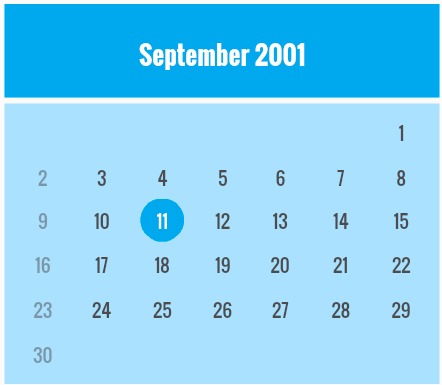 This, my friend, is the date that had great influence on the way we operate our ships. This is the date that led to the ISPS code.
I bet when you hear about ISPS code, you think about places like Somalia and Nigeria. But security has been the concern for shipping far longer than that.
IMO has developed many codes, regulations, and conventions since its inception in 1948.
If not all, most of these conventions were triggered by some major incident. For example, ISM code came into existence because of the incident of “Herald of free enterprise”. MARPOL was the result of the incident of Torrey Canyon. And as everyone knows, SOLAS was developed because of infamous incid the nt of sinking of Titanic.
ISPS code is probably the only code that was developed because of a non-marine incident. It was considered and developed after the 9/11 terror attack in the USA.
So what exactly ISPS code requires us to do. Let us discuss 10 elements of ISPS code we need to know about.
1. Ship security plan
Ship security plan has all the security-related instructions for the ship’s crew.
ISPS code part A/9.4 gives the minimum points that must be included in the ship security plan.
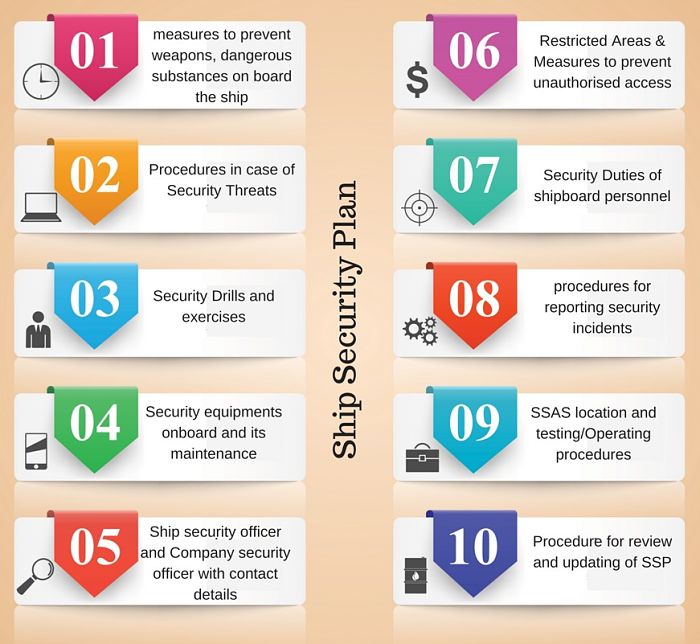
Ship security plan need to be approved by flag state of the vessel or by Recognised security organisation (RSO) on behalf of flag state. RSO is usually the classification society of the vessel.
Handling Ship security plan on board
Ship security plan is to be kept in a locker. If it is at an open location, it may lead to a non-conformity during PSC inspection or ISPS audit.
Master and SSO must not give access of SSP to any external party. Only Company security officer and person conducting security audit can be given access.
If any PSC inspector seeks access to SSP, this request should be politely rejected.
There may be situations where PSC inspector believes that there exists a security related non-conformance and only way to prove to him that this non-conformance does not exist is by showing him the SSP.
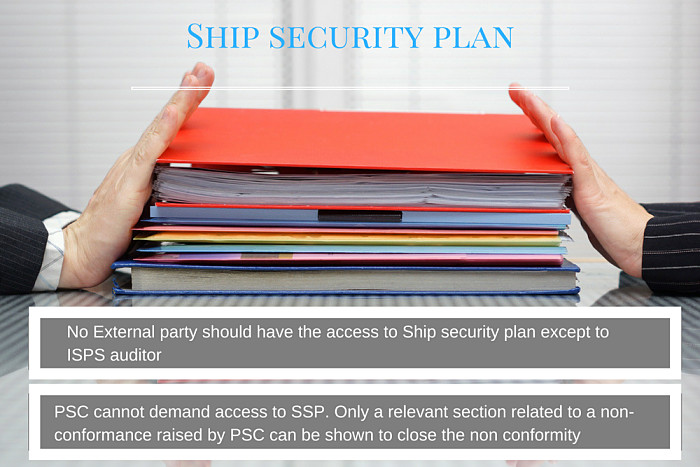
In these cases, Master / SSO can show only the SSP section that is required to prove the non-conformance as invalid.
2. Ship Security Assessment
Ship security assessment is the first step toward developing a security plan.
Let us say you have the responsibility to develop a ship security plan. There are many aspects you would like to explore.
You would like to ensure that your ship is not attacked. You have responsibility to ensure that unauthorised persons are not able to board your ship. how will you go about to achieve all this ?
You would probably want to identify all the access point of the ship. You may want to brainstorm and identify the possible ways your ship can be attacked. You may even want to assume yourself as an attacker and think of how you can gain access to the ship.
That is what ship security assessment is all about.
 It is about identifying the applicable security scenarios for the ship. For example, will there be any security concern during cargo operation ? Are there any weaknesses in the ship security ?
Ship security assessment is a kind of risk assessment about the security of the ship.
Ship security assessment aims to answer these five questions.
- Is there any motive to attack the ship?
- Which are the key shipboard operations and areas that are prone to security incident
- Are there any existing security measures, procedures in place?
- What are ways ship can be attacked?
- What are the likelihood and consequences of such attack?
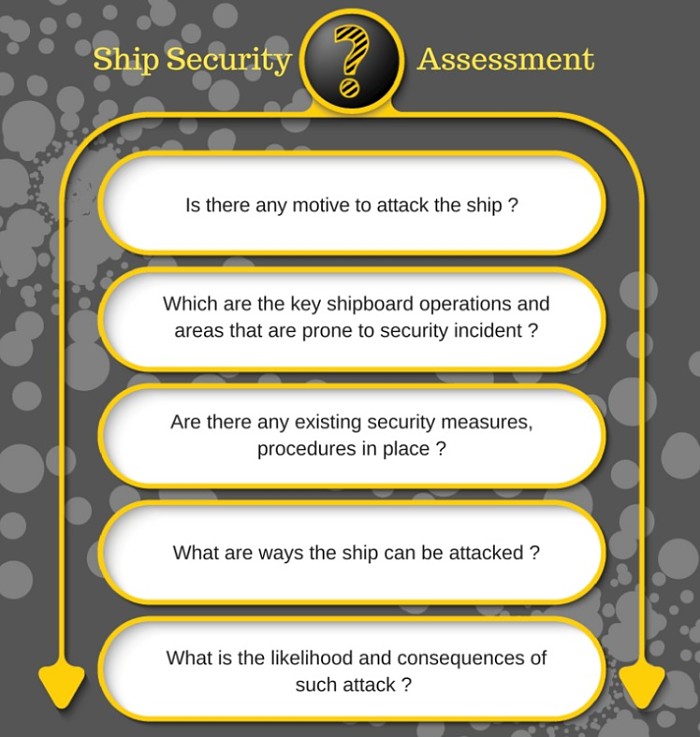
Ship security assessment forms the basis for development of ship security plan. It is the responsibility of the company security officer to conduct initial ship security assessment.
Here is an example of ship security assessment.
3. Ship security officer
ISPS code requires company to appoint a ship security officer. The crew member appointed as SSO must have done the security training required as per STCW.
The main duties of ship security officer is
- to implement and maintain all the elements of ship security plan and
- to liase with the company security officer and port facility security officer (PFSO) for all security related activities
It is quite obvious that to implement SSP on board, SSO must himself know about what SSP requires from SSO and ship’s crew.
For this reason, SSO must read the SSP thoroughly and preferably make notes of key points specific to SSP of the ship he must know at all times.
For example SSO must know
- percentage of baggage gangway watch need to check at each security level
- Procedure to follow if any unaccompanied baggage is found on board
- Restricted areas as per SSP
- Security equipments on board and what maintenance is required for these
- Procedure and required interval for testing of ship security alert system
One of the important duty of SSO is to review the ship security plan. The idea for review is to make the SSP robust over the time. SSO has to look for shortcomings in the SSP and point these out in the SSP review.
Some companies may have a quick checklist for review of ship security plan. Even if there is no checklist, SSO can review the SSP to best of his capacity.
For example, SSO may find that an access which should be a restricted area is not designated as restricted area in the SSP.
He may find that there are no clear instructions if the port security personnel with weapons can be allowed on board or not.
Whatever the SSO feel should include in the SSP which isn’t included, he can mention that in his SSP review.
4. Company Security Officer
ISPS code also requires company to appoint a company security officer. The main duties of the company security officer is to
- Carry out ship security assessment
- Develop ship security plan and submit it for approval
- ensure efficient implementation of SSP on board
One of the important duty of CSO is to share regular security information to the SSO and ship.
5. Security levels
ISPS code has set three security levels.
- Security Level 1
- Security Level 2
- Security Level 3
Security level 1 requires minimum security measures and is the normal security level all ships and ports are supposed to operate.
security level 3 requires most stringent security measures.
Security level 3 is set only in exceptional circumstances when there is a credible information about a probable or imminent security incident.
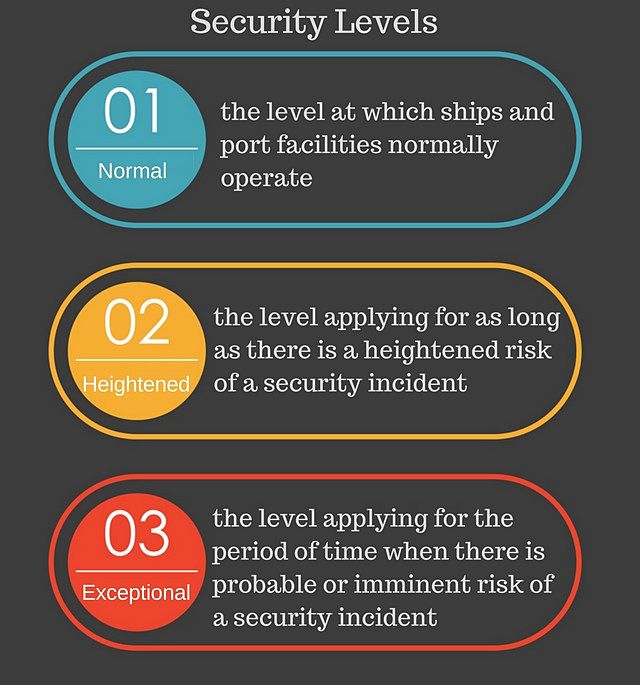
There is this one frequently asked question related to security levels. The question is “Who decides the security level on board” ?
Who decides the security levels on board?
When the ship is at sea, Security level is set by the flag state of the vessel. Flag state may not instruct the ship directly but may do so through CSO.
CSO will forward the message from the flag state to the applicable ships to change the security level. SSO need to acknowledge the mail for instructions to change the security level and confirm to CSO when the security level is changed.
At port, vessel need to have same security level as the port. Before arrival, agent gives all the security details of the port and also advises the security level of the ship.
If the security level of the port is higher than the ship, the ship must increase the security level to same as the port.
Now there may be instances where security level of ship is higher than the port it is calling. In this case, SSO should consult CSO. CSO may advise to decrease the level of the ship without downgrading the security measures.
This means that in this case, the ship will have lower security level but will have same security measures that are required as per higher security level in SSP.
CSO after consultation with flag may advise to keep the higher security level. In this case, vessel must inform the port of its higher security level.
6. Declaration of security
As the name suggests, declaration of security is security related declaration between two parties. One of the party is own ship and other party can either be a port or another ship.
The question is when do we need Declaration of security and why do we need Declaration of security?
Let us answer the “when” part first.
The DoS is intended to be used in exceptional cases usually related to higher risk. These are the times when there is a need to reach an agreement between the port facility and the ship as to the security measures to be applied.
ISPS code requires each flag state to establish the requirements of the declaration of security.
But in general DOS need to be filled when
- Ship is operating at higher security level than the port it is calling
- Ship is operating at higher security level than the other ship it is doing operations with
- Ship is calling a port which do not have port facility security plan. This will be the case when port is in a country that has not ratified ISPS code
- Ship is doing operations with a ship the flag of which has not ratified the ISPS code and thus do not have an approved ship security plan
Another question is why do we need to fill DOS. As you would notice in above situations that the ship is either at higher security level or is dealing with port or ship that does not comply with ISPS code.
In first case, we need to make sure that ship’s higher security level is efficiently conveyed to the port or ship it is dealing with. Also as the port or other ship is at lower level, we would want to know what security duties the port and ship will be performing.
For example we need to get the declaration from other ship that they will monitor the areas around their ship and restrict the access to their ship.
In the second case where port or ship is not ISPS compliant, we need to make joint declaration that the port or other ship will perform some of the security duties as per declaration of security.
Many ships or companies requires DOS to be completed at every port & ship operation. This is not required and in doing so we are just wasting paper and energy on something that is grossly unnecessary.
7. Security drills and exercises
Company is required to devise a security drill planner which should cover all the security situations.
These drills may include situations like
- Bomb threat at port / at sea
- change in security level
- Stowaway or Bomb search
The whole idea of these drills and exercises is to test the effectiveness of ISPS code implementation. These drills should aim to identify the gaps between expected outcomes and actual performance.
SSO should maintain the records of all the security drill carried out on board.
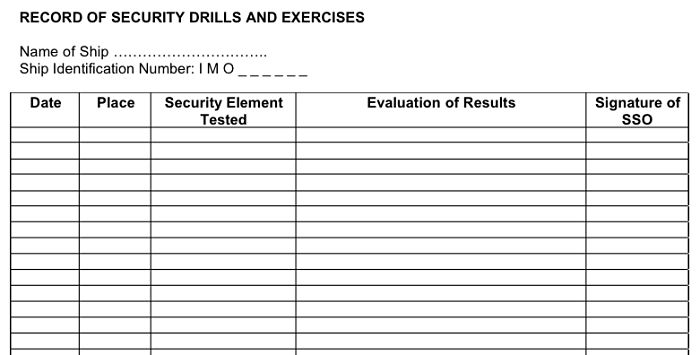
8. International ship security certificate
International ship security certificate is a statutory certificate. ISPS code applies to all ships over 500 GRT. ISPS code requires these ships to have a valid “International ship security certificate”.
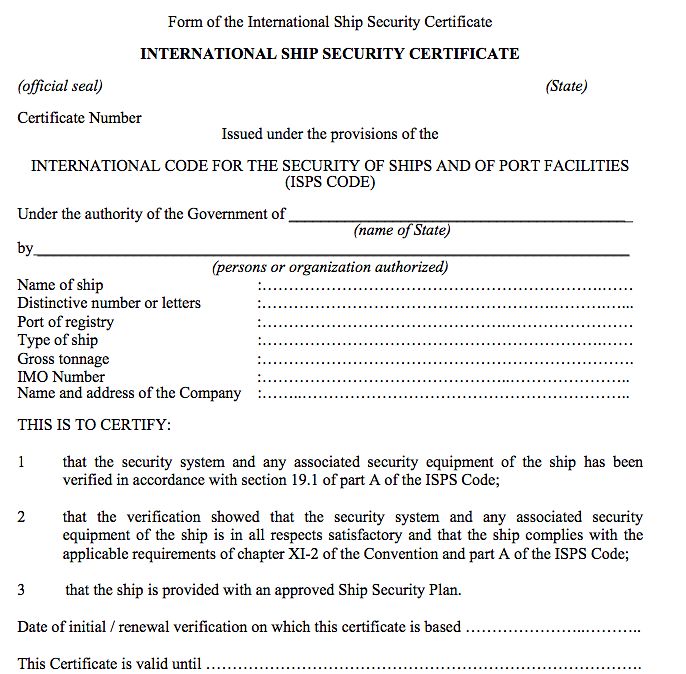
But how can a ship get “International ship security certificate (ISSC)?
A new building ship or the ship that changes flag or class will get an interim ISSC. The interim ISSC will be issued after verification by flag state or RSO (usually class) that all the elements of SSP are implemented on board.
The interim ISSC is valid for six months.
A full term ISSC is issued
- after SSP has been implemented for at least 30 day
- A successful ISPS audit has been conducted by the flag or RSO on behalf of flag
The full term ISSC is valid for 5 years subject to intermediate verification and endorsement by flag or RSO on behalf of flag.
9. Ship Security Alert system
One of the main security equipment on board required by ISPS code is ship security alert system.
There needs to be a minimum of two security buttons that can initiate SSAS. One of these buttons should be on the wheel house of the ship.
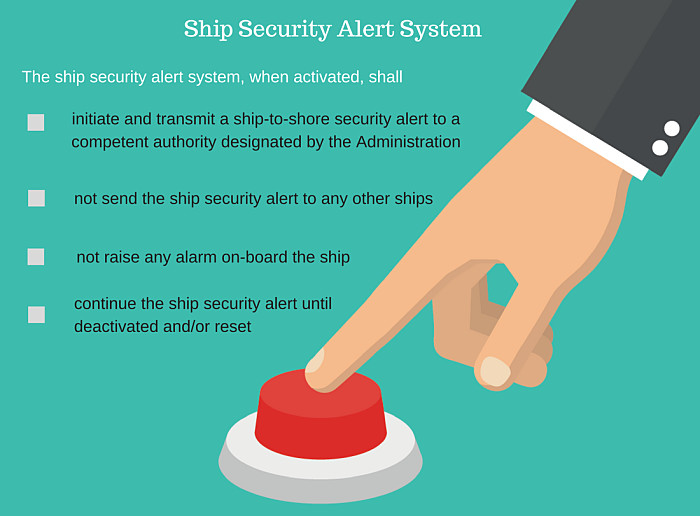
Generally, when a SSAS button is pressed, the alert goes to the Flag state and the CSO. But some flag state may require that alert is only received by the CSO.
Ship security alert system (SSAS) must be tested at least annually.
The test procedure is given in the SSP. SSO must know this procedure of testing.
Conclusion
ISPS code may not have been able to put an end to the security incidents around the world. But it has surely given a framework for deterrence in the security issues around the world.
This deterrence will only be effective if we know and implement all the elements of ISPS code effectively.
A comprehensive guide of fixed fire fighting foam system
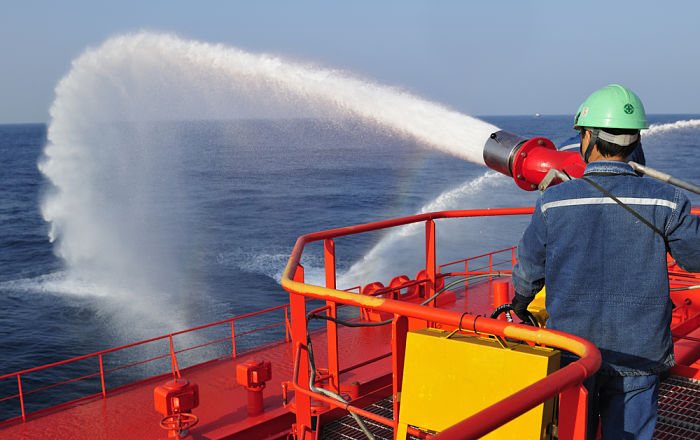
Let me narrate you a real story.
A ship was to arrive in a US port after a long sailing. Foam sample for fixed foam system was sent for testing at last port. Three days before arrival, the results of the foam sample analysis were received.
The test had failed. USCG did not allow the vessel to berth. The foam sample was redrawn and sent for analysis. Even though the sample passed, more than one day was lost in this process.
Question is, why did USCG not allow the ship to berth? They must have felt that it is really dangerous to allow the tanker to berth with an ineffective foam system.
Do we take our firefighting equipments and system this seriously? Let us admit it, we don’t !!!
The first step of showing the seriousness is knowing everything about our equipments.
In this article, I will discuss fixed fire fighting foam system on board ships.
Let us fire it out !!!
How foam extinguishes the fire
Fire fighting foam used on ships has three elements.
- Foam concentrate
- water
- air
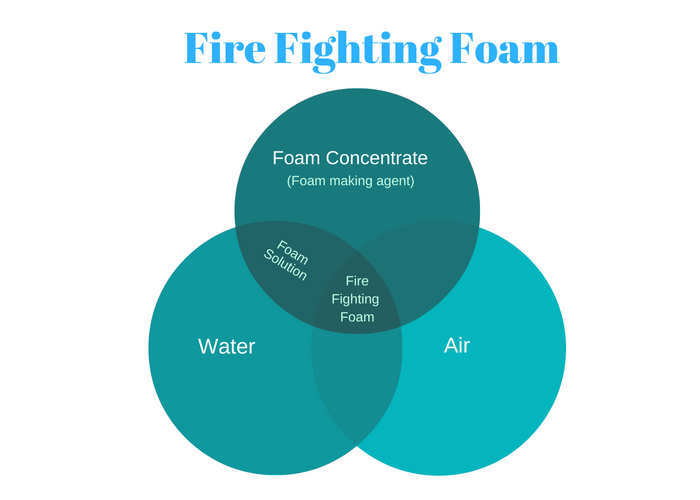
Foam concentrate is mixed with water in a correct proportion to form a foam solution. This foam solution when agitated with air produces foam.
Foam extinguishes the fire in three ways
- It forms a blanket and thus removing the supply of oxygen to the fuel, the effect called smothering.
- The foam blanket does not allow the fuel vapors to generate, thus cutting the fuel supply to the fire
- Since foam has water, it cools the fuel surface
Main terms used in defining the foam
Now let us get to know few of the terms associated with foam.
Expansion ratio
We all understand how a foam solution is formed. The form concentrate is mixed with the sea water and air at the foam monitor causes this foam solution to generate foam.
In other words, foam concentrate that we have in foam room tank expands to generate foam. Different foam concentrate has different capacity of how much foam these can generate from a fixed quantity of foam concentrate.
The ratio of the volume of foam generated (finished foam) to the foam concentrate used in that is called expansion ratio of the foam.
The foam with expansion ratio between 1:2 and 1:20 is called low expansion foam.
Foam with expansion ratio between 1:20 and 1:200 is called medium expansion foam.
Foam with expansion ratio above 1:200 is called high expansion foam.
Drainage time
Drainage time is the measure of how quickly a foam solution can move over a surface. Foam solution that has lesser drainage time move faster over a surface.
Drainage time is measured for 25% solution and 50% solution. This is called 25% drainage time and 50% drainage time.
Proportioning rate
Foam is generated by mixing foam concentrate with water. For the effective generation of foam that can be effective in firefighting, a correct amount of water need to be mixed with foam concentrate.
This ratio is called proportioning rate. It is also called mixing ratio or dilution rate.
So 6% foam concentrate means that the ideal foam solution from this foam needs to have 6 parts of the foam concentrate and 94 parts of water.
Knockdown speed and flow
Knockdown speed and flow is the ability of the foam to flow on the fuel and around the obstacles.
Good knockdown speed would mean that the foam is able to flow past the obstacles on the fuel surface.
Type of Foam solutions used on board ships
Broadly all foams fall under one of these two categories
- Chemical foam
- Mechanical foam
Chemical foam produces the foam by chemical reaction of two chemicals, one being alkali and second an acid.
Mechanical foam uses physical agitation of the foam concentrate to produce foam.
On board ships, the mechanical foam is mostly used. There are different types of mechanical foams used on board depending upon the expected source of the fire.
Let us discuss few of these.
Aqueous film forming foam concentrate (AFFF)
This is the very common type of foam used on board ship specially on tankers.
As the name suggests, apart from the foam bubbles, this foam makes an aqueous film over the surface that spreads across the surface of hydrocarbon to extinguish the fire.
These type of foam works on the fires generated from burning of hydrocarbons as it has a mixture of hydrocarbon and fluorinated surface active agents.
Alcohol resistant Aqueous film forming foam concentrate (AR-AFFF)
As I said foam has water in it. All the solvents like alcohols are miscible in water. So if we use normal foam on alcohol fires, alcohol will dissolve the water and foam will break up easily.
So for extinguishing the fires involving solvents like alcohol, normal foam concentrate will not do.
For fighting the fires involving alcohols and other solvents, Alcohol resistant foam is required.
On chemical tankers, that have foam as fixed fire fighting system for cargo fires, alcohol resistant foam is a must. This is because these ships carry alcohols (like Methanol, ethanol) as cargo.
So next time we check the foam certificate on a chemical tanker, we must look for the information mentioning the foam to be alcohol resistant.
Foams based upon the expansion ratio
We discussed that there are three types of foams based on the expansion ratio.
- High expansion foams
- Medium expansion foams
- Low expansion foams
But which foam will be used where ?
Would’t it be the fact that high expansion foams will generate more foam from less foam concentrate and thus be more effective ?
So the high expansion foam is very light and low expansion foam is comparatively heavier.
If we use high expansion foam for deck fires, the foam will fly with the wind and will not be able to extinguish the fire.
For this reason, for deck fires low expansion foam is used. On tankers, it will always be low expansion foam for fires of the cargo area.
High expansion foams are used for compartments such as holds and even machinery spaces where the space need to be filled with foam for fire fighting.
Functioning of Fixed foam system
Below is the basic line diagram of a typical fixed foam system on ships.
The foam pump takes the foam concentrate from foam tank and injects it in desired ratio into the water. The proportioner controls the quantity of foam solution to inject.
The common type of proportioner is of ejector type. The more the fire line pressure, more foam it will inject. Ship staff are not supposed to touch the proportioner.
When the foam solution reaches foam nozzle on deck, the air is injected into the foam solution to create the fire fighting foam.
The foam so generated creates a layer over the fire and cuts the oxygen supply, the process called smothering to extinguish the fire.
Maintenance required on fixed foam system
There are many components of the fixed foam system such as
- Foam line
- Foam monitor
- Foam isolation valves
- Fire pumps
- foam concentrate (foam solution)
- Foam pump
- Foam proportioner
Each one of these need to work as desired. We, the ship staff need to make sure that each one of these are in perfect condition. The only way to ensure that is by testing of all the elements of the foam system.
i) Testing of foam line, foam monitor and foam isolation valves
If the foam line is leaking, or the foam monitors cannot be turn around to aim the foam at the fire, we would not be able to use the foam system.
Every year the foam line need to be pressure tested at least to the maximum working pressure. We must check the SMS manuals of the ship for any special testing requirements from the company.
The testing procedure would be
- Close all the valves of the fire line and foam line
- Open the foam monitor on the forward most part of the ship
- Start the fire pump at maximum pressure
- Slowly close the foam-monitor that was kept open
- Check for any leakage
Apart from checking the foam line leakage, we also need to check if any foam monitor valve is leaking. For this we just need to check that no foam monitor is leaking when the foam line is pressurised.
If we spot a leaking foam monitor, we must first check if the foam valve is tightly shut. If it is still leaking, we should overhaul the foam valve.
Remember, foam system is a critical equipment. And if we plan to remove the valve for overhaul, we must carry out risk assessment as for the period of the overhaul, the foam system would not be available for use. The company may also require the ship to take their approval before proceeding with this work.
We also need to test if the foam isolation valves are holding.
To test the foam isolation valves
- Keep the forward most foam monitor open
- Close the foam isolation valve one by one and check if the water from the foam monitor stops completely.
ii) Foam pump
We test the foam pump during the fire drill involving fire on deck. The foam pump is run on recirculation. We must make sure that the part of the foam line involved during re-circulation is effectively drained and empty after testing.
iii) Fire pump
Fire pump is an important part of the foam system. It delivers the foam solution to the foam monitors. While testing the fire pumps for foam system, we run the fire pump at full pressure.
We then open the two foam monitors and directs the jets overboard. The jets from these two should be able to cross each other.
iv) Foam concentrate
The main element from which the foam is generated is Foam concentrate stored in the foam tank. We have to check two things for foam concentrate
- Quantity of the foam concentrate
- Quality of the foam concentrate
For the vessels fitted with inert gas system, there need to sufficient foam concentrate for running for 20 minutes at maximum flow rate.
For vessels not fitted with inert gas system, there should be sufficent quanitity of foam concentrate for running for 30 minutes at maximum flow rate of the fire system.
The required quantity is usually marked on the foam tank gauge. We must ensure that this quantity is never below the mark.
With regard to quality of the foam, there is only one way we can know. By analysis of a sample of the foam.
Sample analysis of foam concentrate
SOLAS requires the foam sample to be tested after 3 years from the date it was placed onboard and there after every year.
Various tests are carried out on the foam sample to ensure that the foam is fit for the purpose it is supposed to do. The tests include
Sedimentation Test: Sediments should be less than 0.25%
pH value test: The pH of the foam concentrate should not be less than 6 and not more than 9.5 at 20 Deg C
Drainage time test
Chemical stability test for Alcohol resistant foam:
The alcohol resistant foams are different from other type of foams. Water content from normal foam will dissolve in the solvent and so these forms are not suitable for solvents. Additives in the alcohol resistant foam form a membrane that separates the solvent and foam which avoids the breaking up of the foam blanket.
Small fire test:
In 2009, IMO revised the foam testing requirements on discovering that for protein based alcohol resistant Foam concentrate, even after all satisfactory test, with age it may not extinguish the fire as desired.
Following this discovery, a test called “Small scale fire test” is required for protein based foam concentrates.
In simple words this test is performed by actually extinguishing a sample of a small fire with the foam being tested.
The test is based upon testing or measuring of two parameters
- Extinction time
- Burn back time
Extinction time is the time taken for extinguishing the sample fire with the foam being tested. The extinction time should not be more than 5 minutes
Burn back time is the time in which the fire reignites if a sample of fire is place in the center of the foam.
Allowed Burn back time to cover 25% of the sample is 15 minutes.
v) Foam proportioner
Proportioner injects right quantity of the foam into the fire water to form foam solution. If the the proportioner is not set correctly, it either will inject more foam or less foam. In both cases, the system will be less effective.
If it injects more foam concentrate, the foam will not run for the time it is supposed to run. If it injects less foam concentrate, the foam generated may not be effective in extinguishing the fire.
SOLAS requires that foam proportioner must be tested by external agency once every five years.
The test is carried out to confirm that the proportioners are able to inject the foam concentrate in correct proportion.
The allowed variation from the designed value is +30% to -10%.
We should have the certificate for 5 yearly testing of Foam system on board.
Conclusion
Foam system is one of the main fire fighting system on board specially for deck fire on tankers.
It is important that the foam system is kept in a state of readiness at all times. For doing so, we must know how we are supposed to maintain these equipment and what tests we must perform.
7 important elements of ISM Code every seafarer must know about
ISM code has been the most controversial among all the chapters of SOLAS. There are plenty of seafarers and shore staff who feel that ISM code has only brought more paper work and nothing else.
But a detailed report on the impact and effectiveness of the ISM code suggests that “where the ISM Code had been embraced as a positive step toward efficiency through a safety culture”, tangible positive benefits were evident.
But as you would note that the report has a caveat which is “Where the ISM code had been embraced as a positive step“.
How do we embrace ISM code as a positive step? The first step would be to know about the ISM code and its elements.
In this post, we will discuss the 7 important elements of the ISM code.
Let’s get started.
1. Who is the Company as per ISM code
The first thing we need to know is who is the company. As per ISM code
Company means the owner of the ship or any other organization or person such as the manager, or the bareboat charterer, who has assumed the responsibility for operation of the ship from the shipowner and who, on assuming such responsibility, has agreed to take over all duties and responsibility imposed by the Code.
So the company can be
- Owner of the ship
- Any other organisation
- Bareboat Charterer
But most importantly, the company is the organisation that has agreed to take over all the duties and responsibilities as per the ISM code.
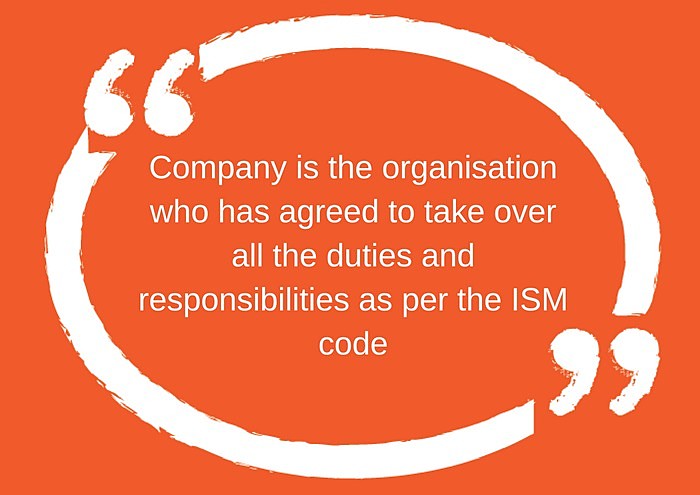
Now take it this way. If you board a ship as a PSC inspector, how can you find the details for the ‘Company” of the ship?
No ship can sail with an invalid or a missing statutory certificate. One such certificate is “Safety Management certificate”.
The details of the “company” are required to be entered into this certificate. This certificate will have the
- Name of the Company
- Address of the Company and
- Company identification number
A permanent and Unique Number is required to be assigned to all Companies and Registered Owners managing any ship of 100 gross tonnes and above engaged on international voyages.
The company identification number is issued by IHS Maritime and trade on behalf of IMO.
Most of the flags also require the company to fill a form called “Declaration of the company“. Which is a self declaration by the company stating they are the “company” for the listed ships as required by the ISM code.
2. Company’s responsibilities
ISM code is all about the company.
If you read the ISM code, all the lines of the code starts with “Company Should” or “Company is responsible”.
Even for the master’s responsibilities, it is not directed to the Master but to the company.
ISM code has not just made the company responsible for shipboard operations but it also its implications in the shipping business.
Take for example the Hague-Visby rules. These rules has one major rule in favour of ship owners.
It says that ship owner will not be responsible for any delays or damages resulting because of faults of master and crew of the ship.
While this rule still stays, its meaning has changed post ISM code.
Now even in the clear case of neglect on part of crew, in many cases the court has given the verdict against the ship owner.
Why ? Court asked what has the company done to avoid crew negligence ?
So ISM code is all about company’s responsibilities. Broadly there are two main responsibilities.
- To define and document the responsibilities and authority of the persons involved in work relating to and affecting safety and pollution prevention
- provide support and resources to the persons to carry out their functions effectively
The first point means that company need to provide the instructions to the ship in form of SMS manual.
Second, the company need to provide all the support a ship may need for running the ship safely.
3. Internal Audits
An effective Internal audits is the main dividing line between a good ship management company and a bad one.
ISM code requires that internal audit of each vessel should be conducted at least every 12 months.
Who is the right person to conduct internal audit ? Well, ISM code has the answer. As per ISM code
Personnel carrying out audits should be independent of the areas being audited unless this is impracticable due to the size and the nature of the Company
This means that the superintendents of the vessel cannot carry out the internal audit of the vessels they are managing.
This is because of obvious reason that they will tend to not highlight any shortcoming in the system for which they themselves has to blame for.
In most effective systems, it is always someone from the QHSE department that conducts the internal audits.
Some companies even have a “Shipboard Audit department”, whose only responsibility is to look after the internal audits of the ships.
Apart from this, there is a formal requirement for the auditor to be trained for carrying out the internal audits.
4. Certificates as per ISM Code
There are two statutory certificates that are required as per ISM code.
Document of compliance
DOC is issued to the company by the flag state or by the classification society on behalf of the flag state. The certificate is valid for five years and it requires to be endorsed annually.
DOC is issued to the company after a successful audit to verify that company complies with the requirements of ISM code.
A company may have multiple document of compliance from different flags and from different classification societies.
For example, company may be managing ships of Singapore as well as Hong Kong flag. Some of these ships may have DNV class and other have Class NK. Now the company will have following DOCs
- DOC from DNV on behalf of Singapore flag
- DOC from DNV on behalf of Hong Kong flag
- DOC from Class NK on behalf of Singapore flag
- DOC from Class NK on behalf of Hong Kong flag
From the ship’s point of view, we must ensure that we have correct DOC on board.
So if you are on a chemical tanker which has DNV as the classification society and Hong Kong flag, you know what you need to check in the DOC.
Yes, you got it right !!! In this case the DOC should be issued by the DNV on behalf of Hong Kong flag.
We also need to check that the ship type appears on the DOC.
Safety Management Certificate
Safety management certificate is issued to the ship. The certificate is issued after verifying two elements required as per ISM code
- That the safety management system is in place and complies with the ISM code requirements
- That the safety management system is being implemented and followed on board
This verification process is called “external audit” of the SMS and is usually done by the class on behalf of the flag of the ship.
Safety management certificate is also issued by the flag of the ship or by its classification society on behalf of the flag. The certificate is valid for five years and require intermediate (between 2-3 years from date of issue) verification.
Safety management certificate co-exists with the DOC
We must understand that the issuance of safety management certificate is conditional to the validity of the DOC.
If for some reason the DOC is revoked or if it becomes invalid, the safety management certificate will also be invalid.
5. Designated person ashore
ISM code requires the company to nominate a Designated person who will be a link between ship and shore.
A Designated person ashore
- should have access to the highest level of management
- is responsible for monitoring the safety and pollution prevention aspects of the operation of each ship
- is responsible for ensuring that adequate resources and shore-based support are applied, as required
Some companies designate a junior shore personnel (for example a Deputy marine superintendent) as DPA.
While he may have gone through all the trainings required for the DPA as per MSC circ 6, he will be ineffective in carrying out his duties because of lack of authority in the organisation.
In an effective system, DPA will be a senior person in the company who has some authority and control over the company’s activities.
6. Observations, Non-conformity and Major Non-conformity
So far we have discussed that two audits are carried out on ships to fulfill the requirements of the ISM code.
- External audit by the Class on behalf of flag of the ship
- Internal audit by the company
During these audits, the auditor may find some deficiencies and shortcomings. ISM code categorises these shortcomings as
- Observation
- Minor Non-conformity
- Major Non-conformity
Let us see what is the difference between these findings.
Observation
As per ISM code
Observation means a statement of fact made during a safety management audit and substantiated by objective evidence
What does this means ? It shows an area of concern that is conforming with the ISM code now but if it is not improved it may lead to the non-conformance with the ISM code.
Need examples ??
Ship’s SMS requires that certain critical spares need to be on board all the time. Ship’s SMS also require that charts and publications need to be kept update and maintained in good condition.
The observation on this can be
- Two A/E critical spare parts were not on board as these were recently consumed. The requisition for same was in place.
- One of the chart was torn at the end and was found with a tape
Both of these are observations because the ship is complying with the requirement of SMS. But if these situations are not corrected, it may lead to a non-conformity.
Minor non-conformity
As per ISM code
Non-conformity means an observed situation where objective evidence indicates the non-fulfilment of a specified requirement.
This is different from an observation because in this case a specific requirement of the ISM code was not met.
In the example we discussed under “Observation”, “non-conformity” will be
- Two A/E critical spare parts were not on board as these were recently consumed. The requisition for same was not in place.
- On random checking, one permanent correction on one of the voyage chart was missing.
The SMS requires that minimum inventory of the critical spares need to be maintained at all times. In this case as the requirement under Section 10 of the ISM code (maintenance of ship and equipments) were not met.
Major non-conformity
As per ISM code
Major non-conformity means an identifiable deviation that poses a serious threat to the safety of personnel or the ship or a serious risk to the environment that requires immediate corrective action and includes the lack of effective and systematic implementation of a requirement of this Code.
If we dissect the definition, we have few elements of a major non-conformity. These are
- Deviation that pose a serious threat
- Require immediate corrective action
- Lack of effective and systematic implementation of ISM code
One point that a major non-conformity highlights is that there is a systematic failure of one or more parts of the SMS.
A major non-conformity can be because of one single major deficiency or incident. Or it can be because of number of small deficiencies from one area.
For example, a single deficiency on Marpol equipments or Life saving appliances can be a major non conformity.
Also a number of small deficiencies on record keeping can be considered as a major non conformity.
If I have to differentiate between a Minor Non conformity and a major non conformity, I will do that with one point.
A minor non conformity may be an error, something someone forgot to do or a non-compliance on a single instance.
A major non compliance is a system failure. It just indicates that the SMS is not effectively implemented.
Actions in case a major non conformity is issued
IMO in its MSC circ 1059 and MEPC circ 401 has given the detailed guidelines on the procedure to handle major non-conformities identified during ISM audits.
Few quick points about handling major conformities
- Ship’s cannot sail with a major non-conformity. Ship can only sail once it has been downgraded to a minor non conformity
- A major non conformity will be downgraded once flag is satisfied that the effective corrective actions are being taken
- Corrective actions to close this non conformity need to be completed in less than three months
- If the nature of major non conformity is very serious, the Safety management certificate of the ship may be withdrawn. In this case even the interim Safety management certificate will not be issued. Ship need to go through the initial process of obtaining the SMC which would include initial verification of the SMS.
7. Master’s review
One of the responsibility of the master as per ISM code is to review the effectiveness of the SMS on board. ISM code has not mentioned any time frame for this review but as per the understanding of industry experts, it should be done at least annually.
Master is required to report any noted deficiencies in the SMS. While reviewing SMS, Master need to
- review SMS manuals and suggest any edits or corrections. Also if any requirement mentioned in the SMS manuals is against the industry practice or requirements.
- Make suggestions to improve the safety management system on board ships
- Review and comment on the shore based support and how this can be improved
- Review and comment on the ship’s performance on safety and pollution prevention related matters
Conclusion
ISM code has been critisized for bringing too much of paper work without comparatively lesser gains. But fact is more often than not, it is the implementation, in general that has been poor.
If implemented with all the seriousness it deserves, it has many benefits to offer.
New Indian MS bill, DG shipping starts issuing SID and other stories of November 2016
Each month we bring only the main stories of the maritime field. These stories are carefully chosen to have only the stories that directly related to the seafarers.
This is the 4th edition of this newsletter and these are the major maritime happening of the November 2016.
1. News from IMO
Capt Radhika Menon receives 2016 IMO Award for Exceptional Bravery at Sea
The Master of an oil tanker who says she was “just doing her job” has received the highest IMO bravery recognition for saving the lives of seven fishermen from a sinking fishing boat during a storm in the Bay of Bengal in June 2015.
“It is every seafarer’s and Master’s solemn duty and obligation to save souls in distress at sea. I just did what a seafarer should do for a fellow soul in distress at sea. Yes, it was an instant decision, but not without assessing the risks involved. I just did my duty,” said Captain Radhika Menon, Master of the oil products tanker Sampurna Swarajya.
She was speaking after IMO Secretary-General Kitack Lim presented her with the 2016 IMO Award for Exceptional Bravery at Sea on Monday (21 November), during an emotional ceremony.
Captain Menon is the first female captain in the Indian Merchant Navy and the first female to receive the IMO Award for Exceptional Bravery at Sea.
Watch this Video.
This annual award was established by the IMO to provide international recognition for those who, at the risk of losing their own life, perform acts of exceptional bravery, displaying outstanding courage in attempting to save life at sea or in attempting to prevent or mitigate damage to the marine environment.
The recipient of the Award is invited to a special ceremony at IMO to receive a medal and a certificate citing the act of exceptional bravery performed.
There are three categories of honour. First, the Award itself, for the nominee judged to have performed the most outstanding act of bravery from among those described. Second, certificates of commendation are awarded to nominees who have committed acts of extraordinary bravery.
And, third, letters of commendation are sent to those nominees who are judged to deserve some special recognition for meritorious actions.
MSC 97th session held between 21st-25th Nov 2016
97th session of maritime safety committee was held between 21st to 25th Nov 2015 at IMO headquarters at London.
The main agenda was to
- draft amendments to include the minimum STCW training requirements for masters and deck officers sailing in Polar region.
- Approve the amendments to the Navtex manual
- approve draft amendments to paragraphs 4.5.1 and 4.5.2 of the International Maritime Solid Bulk Cargoes Code (IMSBC Code) to emphasise the responsibility of the shipper for ensuring that a test to determine the transportable moisture limit (TML) of a solid bulk cargo as well as sampling and testing for moisture content are conducted.
2. News from Indian Shipping
Indian Government approves Merchant Shipping bill 2016
India has approved Merchant shipping bill 2016. This revamped bill is expected to simplify the laws governing merchant shipping in India.
Main highlights of the new bill are
A. Augmentation of Indian tonnage promotion/development of coastal shipping in India by:-
- allowing substantially-owned vessels and vessels on Bare Boat-cum-Demise (BBCD); charter by Indians to be registered as Indian flag vessels;
- recognising Indian controlled tonnage as a separate category;
- dispensing with the requirement for issuing of licences to Indian flag vessels for coastal operation and for port clearance by the Customs authorities; and
- making separate rules for coastal vessels to develop & promote coastal shipping.
B. Introduction of welfare measures for seafarers, such as:-
- seafarers held in hostage captivity of pirates will receive wages till they are released and reach home back safely;
- owners of vessels to compulsorily take insurance of crew engaged on vessels including fishing, sailing without mechanical means of propulsion and whose net tonnage is less than 15; and
- the requirement of signing of articles of agreement by the crew before the Shipping Master will no longer be necessary.
C. Registration of certain residuary category of vessels not covered under any statute and lo make provisions for security-related aspects.
Besides, the provisions for survey, inspection and certification of vessels which were scattered in various Parts of the existing Act are placed together to provide for a simplified regime for convenience of Indian shipping industry.
Issuance of Seafarers Identity Document commenced by DG Shipping
DG shipping India has started issuing the seafarer’s Identity document to the seafarers.
International labour Organization (ILO) had brought the ILO Convention C-108 on seafarers Identity Document. India has ratified this convention and issuing a Continuous Discharge Certificate cum Seafarers Identity Document to its seafarers in the form of a booklet.
The world maritime community had felt the need for a more uniform and robust Identification system for the seafarers consequent to the discussions.
The ILO had adopted another Convention C.185 on Biometric Seafarers Identity Document to be given to all seafarers.
The new biometric SID has the provisions for the bar coding of the biometrics based identity of seafarers and a centralized data base maintained in the issuing country, which can be accessed globally through an interoperable & standard biometric template.
3. News from Shipping business
i) Maersk buys Hamburg Sud
Mergers and acquisitions in the shipping does not seem to stop. In a new development, Container Giant Maersk is buying their German rival Hamburg Sud.
These mergers and acquisitions are aimed to ease the competition and improve stability in the container market.
ii) BWM regulations will trigger scrapping of old tanker tonnage
Weakness in freight rates will increase tanker shipping demolitions over the next two years, with the trend accelerating in later years as a result of the IMO regulation on ballast water, according to the latest edition of the Tanker Forecaster, published by global shipping consultancy Drewry.
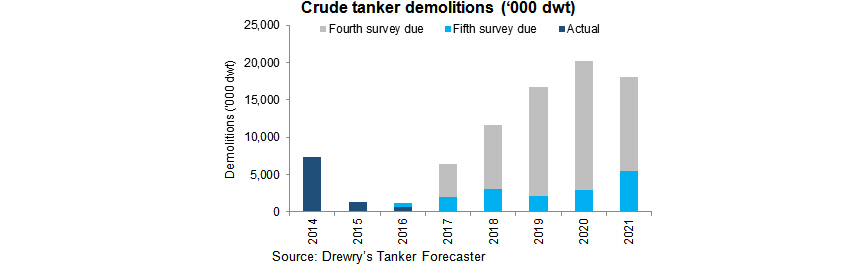
Despite the recent decline in tanker freight rates, demolitions have not yet picked up. Scrapping is expected to increase in the next two years, once owners start feeling the heat of persistent, low freight rates. But as the fleet is relatively young, demolitions will be moderate.
4. Incidents during the month
Attack on Teekay gas carrier off Yemen
Unknown attackers attacked a Teekley gas tanker off the coast of Yemen close to the Bab al-Mandab.
The incident had already raised risks for merchant shipping.
Shipping group Teekay said its LNG (liquefied natural gas) tanker Galicia Spirit “experienced a suspected piracy attack whilst off the coast of Yemen” on Oct. 25.
Teekey in a statement said that
While the intentions of the attackers and the use of the explosives is unknown, the investigation findings indicate that the explosives would have been sufficient to have caused significant damage to the vessel.
It further said that
It appears, that when the skiff was approximately 20m (meters) from the vessel, the explosives detonated, destroying the skiff and ending the attack.
No details have emerged of how many attackers there were, or what happened to them, but maritime sources said the information to date indicated this was probably not piracy.
“If the circumstances are as described, it was an ambitious attempt carried out by people who didn’t expect to survive,” said one source with detailed knowledge of the area.
Increased attacks in the Sulu Sea off Philippines
Sulu Sea off the Philippines is making the latest headlines.
In the latest incident, the Japanese bulk carrier Kumiai Shagang was “attacked by pirates or militants”” on November 20 in this area. The vessel was able to escape the attack following the anti-pirate maneuver.
Since March 2016, there has been 11 incidents with nine actual incidents and two attempted incidents occurred in the area. Most of the incidents are claimed by the terrorist group of the Philippines Abu Sayyaf Group (ASG). 44 crew were abducted and 11 crew among them are still in captive.
First attack in Somalia region since 2014
On 22nd October 2016, six armed pirates in a skiff attacked chemical tanker CPO Korea. Number of shots were exchanged between the pirates and armed gaurds on board the chemical tanker.
There were no casualties reported. This attack again re-iterates the point of not being complacent while transiting Gulf of Aden area.
Explosion at Pakistani ship breaking yard
At least 20 people died after a number of explosions on a beached oil tanker at a ship breaking yard in Gaddani, Pakistan on 01st of Nov 2016.
The first of these series of blast occurred while welding work was going on in the tanker.
Apart from the 17 persons that dies, another at least 58 persons were reported as injured.
5. Video of the month
Watch how a boat helped a truck stuck in the mud.
6. Conclusion
This is all from this edition of the newsletter for the month of November 2016. Share your views on this letter and how we can improve your reading experience.