
Understanding IMO Conventions, resolutions and Circulars
We all come across so many IMO resolution, conventions and circulars while being in shipping industry.
So many that we may get confused sometimes as to what purpose each of these serve. we now take a look at each one of these, starting with IMO resolutions.
1. Resolution
At IMO, Maritime resolutions are issued by the Assembly, The council and by each of the committee.
Each committee brings resolutions to amend part of International convention that they are associated with.
Like Maritime safety committee handles conventions related to safety. The most popular being “International convention for safety of life at Sea (SOLAS)” and STCW convention.
So MSC brings resolutions to amend any part of these conventions. Similarly MEPC’s resolutions amends MARPOL convention and Facilitation Committee’s resolutions amends FAL convention.
Each resolution of IMO looks something like this
XYZ.123(34)
Where the initial letter(s) shows who has passed this resolution.
The letter can be A (for Assembly), C (for Council), MSC (For Maritime safety committee), MEPC (for Maritime environment pollution committee), FAL (Facilitation committee) or LEG (legal Committee).
The next number shows the resolution number and it is in chronological order.
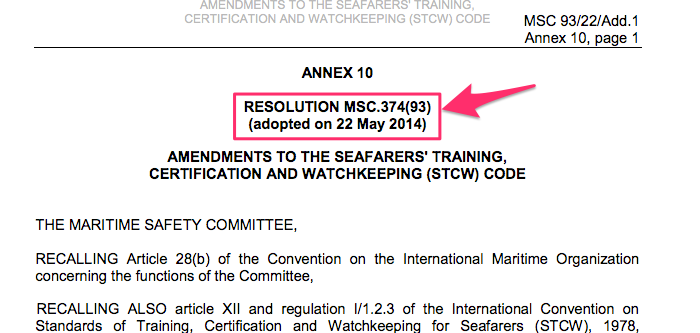
The number in the bracket shows the sessions in which this resolution was adopted. So the resolution MSC.374(93) refers to the MSC resolution number 374 which was adopted in the 93rd session of the MSC.
Why to amend a convention
The only permanent thing in this world is Change. And the way we move our cargoes through sea and the way ships are operating at sea is changing every single day.
A convention passed 30 years back may have many elements which are not applicable today. Same way, We might discover new strengths, weaknesses, opportunities and threats, which were not the part of original convention.
Take an example of Security. Post year 2001, suddenly the world realised a new threat to the shipping which was security. And to address that, we could either bring a security convention or amend an existing convention to include security.
Drafting, ratification, approving, acceptance and implementing a new convention is a tedious and time consuming process.
So unless the new identified threats are too unique to be included in the existing conventions, it is always better to amemd the existing convention.
Take another example of Convention of pollution prevention at sea (MARPOL). Pollution was totally different from safety and so instead of including MARPOL in SOLAS convention, we got new convention called MARPOL.
Also take an example of Ballast water convention. The topic of ballast water was much debatable. The debate was on its inclusion in the MARPOL as another annex or as a stand alone convention.
Even though ballast water was considered to be a kind of pollution but at the end it was agreed that the ballast water is a unique area from other pollutions and hence instead of including it in MARPOL, a new convention was adopted.
See the results, ballast water convention was adopted in 2004 and as of 1st Jan 2016, ballast water convention is still not ratified.
How resolutions are proposed, adopted and passed
For a resolution to come into effect, there are 5 main steps
- A contracting government need to propose a resolution.
- IMO or its respective committee need to review the resolution proposal
- Resolution need to be adopted in the IMO and finally
- Resolution need to be accepted by the contracting governments
- After a fixed time from acceptance, a resolution enters into force.
Proposal of the resolution
There are two ways an amendment to a maritime convention can be proposed to the IMO.
1. By any contracting government
2. By a group of contracting governments.
Clearly in the first option any contracting government can propose an amendment to the secretary general.
SG would pass the proposal to the MSC or MEPC for review. MSC or MEPC in consultation with appropriate sub-committee would draft and submit the resolution for adoption.
In the second option, A contracting government proposes the amendment for which they have concurrence of atleast one-third of the contracting governments.
The concurrence by the other governments can be given to the appropriate committee. In this case, the committee arranges for a conference of the contracting governments to consider the amendments.
The advantage of the second option is that it is the faster way of proposing and adopting an amendment to the convention.
Adoption of a resolution
Resolutions are adopted by voting in Maritime safety committee or Maritime Environment Protection Committee. There are 2 conditions for a resolution to be adopted
- Atleast one-third of the contracting governments should be present for voting. On this date, there are 174 countries that are members to the IMO. So for a resolution to be adopted, at least 58 countries should be present.
- At least two-third of the contracting governments present, should vote in favor of resolution. So if 60 countries were present, at least 40 countries should vote in favor of the resolution.
If the proposal to the amendment was made through the conference,
1) the first condition would be met considering there would be high chances of the one-third of the governments present for voting.
2) The second condition should also be met as all of the one-third governments had given the concurrence to the amendment.
This is the reason, the proposal by the conference would be adopted faster.
Acceptance of the resolution
A resolution once adopted, it is passed to all contracting governments for acceptance. The Secretary general communicates the adopted resolution to all contracting governments.
The process of acceptance of a resolution was a tedious one but IMO did a great job in amending the process itself.
Earlier the acceptance of a resolution was linked with the number of governments that has accepted it. IMO would wait for years to have the numbers on their side to implement a resolution.
This was due to many governments not responding because of “neither agree nor disagree” situation.
And the governments had their reasons to be in that situations. Most of the times the governments were not sure if
- the amendment brought by the resolution are in best interest of their country.
- If they can effectively implement the resolution
- if they have resources to implement the amendments and so on
Whatever the reasons, but the acceptance of resolutions used to take a lot of time.
IMO then introduced the tacit way of acceptance of a resolution. Even though not all the resolutions are accepted with tacit acceptance procedures but most of them are.
For example Marpol convention as per article 16 f(ii) gives authority to MEPC to decide if the amendment will be accepted by tacit acceptance or explicit acceptance.
The acceptance of a resolution to amend SOLAS convention is only done by tacit acceptance.
Tacit Acceptance of a resolution
In simple terms “tacit acceptance” means “accepted unless objected”. It is opposite of earlier process of “rejected unless accepted”.
Under tacit acceptance, a resolution is accepted on an agreed time interval from adoption unless it is objected by a number of contracting governments.
The committee decides the agreed interval during adoption of resolution. However there is minimum interval that is set in respective conventions.
For example as per Marpol convention, the minimum interval between adoption and acceptance has to be 10 months. Same way, as per SOLAS the minimum interval should not be less than one year.
SOLAS convention has also specified maximum interval between adoption and acceptance as 2 years.
How many number of government need to object for a resolution not to be accepted is also mentioned in respective conventions. These are usually
- one-third of the contracting governments or
- contracting governments that constitutes not less than 50% of the world gross tonnage
At the end of the deadline, if a contracting government has not taken any action (accepting or rejecting the proposed resolution), it is implied (tacit) that government has accepted the resolution.
Entry in force of a resolution
Once a resolution is accepted by tacit means or otherwise, it then enter into force. But there is a time specified in respective conventions on when the accepted resolution would enter into force.
For example as per SOLAS and MARPOL convention, a resolution would enter into force 6 months after it has been accepted.
2. Convention
Now that we know how a resolution amends a maritime convention, Its time to take a dive into the what conventions actually are.
What is a convention
There are many different ways to define a convention. A convention is a formal agreement between states.
Or a convention is an instrument which is negotiated under an international organisation such as United Nations.
There are number of conventions that IMO has given to maritime industry. To Name a few, these are
- International convention on safety of life at sea.
- International convention on prevention of marine pollution
- FAL convention
- Loadline convention
- Salvage convention
Convention is not a law
It is important to highlight that convention is not a law in itself. A convention becomes a law when it is implemented in a country’s own legal system.
SOLAS convention is not a law itself. But when a country adopts and includes it as legislation in their country, it becomes law for them. UK, Singapore and India have included it as legislation called Merchant Shipping act. USA call it CFR.
How a convention come in force
For a convention to come in force, it need to be adopted at IMO, ratified by the contracting governments and brought into force.
Proposal & Adoption of a convention
Typically an event, incident or a research study can trigger a need for a new convention. Incident of ‘Titanic’ triggered a need of SOLAS convention.
Incident of ‘Torrey Canyon’ triggered a need of MARPOL convention. And lately various research studies triggered the need of ballast convention.
Discussions on these incidents and research studies in shipping and other related industries is part of sessions of IMO committees and sub-committees.
Once IMO identifies a need for a new convention, the respective committee assisted by various sub-committees work on adopting the convention.
Ratification of the convention
Signature, ratification, acceptance, approval and accession are different ways in which a state (read country) can give their consent to be bound by the convention.
All these ways concerns the legality of procedure so we will not dig deep into it.
But the idea is that the states need to be ready for the new convention and they should give their consent for that by one of these ways. When a convention is adopted, it is usually agreed on how many states need to ratify the convention for it to come in force.
For example, the Ballast water convention requires at least 30 states to ratify which should represent at least 35% of the world gross tonnage.
Ballast water convention is just close to retification. On this date even though forty-seven countries have ratified the convention, their combined gross tonnage only represent the 34.56% of the world tonnage.
3. Circulars
There number of circulars issued at IMO by different committees and sub-committes. And these circulars divided into more than 50 subjects.
Circulars related to Salvage, SUA, Ballast water management, GMDSS and STCW all are part of the circulars issued at IMO. But the most important or rather the one that seafarers are more associated with are MSC and MEPC circulars.
These are the circulars issued by MSC and MEPC respectevely. The former being circulars related to safety matter and latter related to pollution.
What does Circulars are for
We all know what company circulars that we get onboard are for. It gives information / clarification on various subjects related to company’s SMS manual.
It may also give latest incident summary. In short it is running log of important communication from ship to shore.
IMO circulars serves similar purpose. Among other thing, the circular are used for clarification, interpretation or guidance on its various codes and conventions.
We can now looks into how MSC and MEPC circulars look like.
MSC Circulars
As obvious, MSC circulars are related to the maritime safety. The MSC has divided its circulars in six sub-categories and are numbered from one to six. Any MSC circular number would look like this
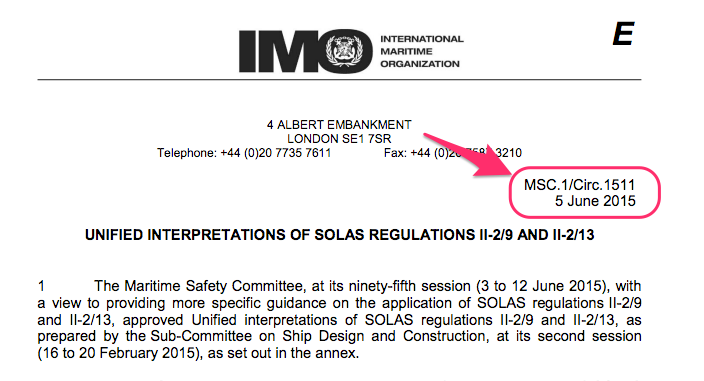
In this MSC ofcourse denotes that it is circular issued by Maritime safety committe of IMO.
The number 1 denotes the sub-category of the circular. ‘Circ.’ tells us that it is a circular and the number in the last is the circular number which is numbered in chronological order.
The six sub categories that MSC circulars are divided into are
- MSC.1 : Circulars related to general information disseminated by MSC on safety matters
- MSC.2 : Circulars related to MSC- Implementation of codes and recommendations adopted by the assembly
- MSC.3 : Circulars on Illegal immigrants
- MSC.4 : Circulars on piracy matters
- MSC.5 : Circulars related to resolution 950(23) which is “Maritime assisstance services
- MSC.6 : Other circulars related to safety
MEPC Circular
Again as obvious, MEPC circulars are related to information on matters concerning maritime pollution. MEPC circulars are divided into seven sub-categories. These categories are numbered from one to seven. Any circular issued by MEPC would look like this
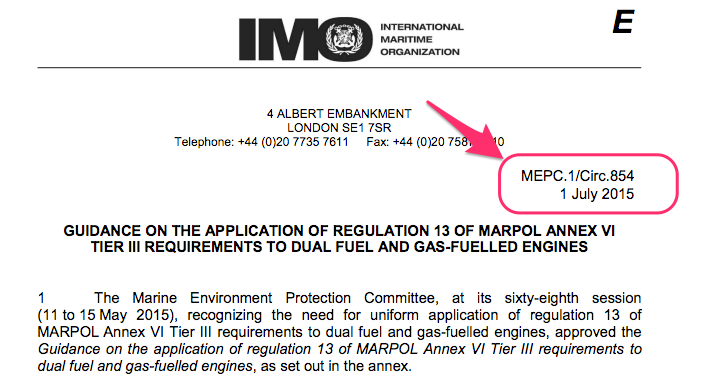
In this MEPC denotes that the circular is issued by Maritime environmenta protection committee.
The number next is the number of sub-category that the circular belongs to. The letters ‘Circ’ detones that it is a circular and finally the number is the circular number which is in chronological order.
The seven Sub-categories that MEPC circulars are divided into are
- MEPC.1 : Circular relating to general information disseminated by the MEPC on pollution matters
- MEPC.2 : Circular relating to Provisional categorization of liquid substances
- MEPC.3 : Circular relating to Facilities in ports for the reception of oily wastes from ships
- MEPC.4 : Circular relating to Facilities in ports for the reception of noxious liquid substances (NLS) residues from ships carrying chemicals in bulk
- MEPC.5 : Circular relating to Pollution prevention equipment required by MARPOL
- MEPC.6 : Circular relating to List of national operational contact point or points responsible for the receipt, transmission and processing of urgent reports on incidents involving harmful substances including oil from ships to coastal states
- MEPC.7 : Circular relating to Maritime Environment Protection Committee on pollution matters
We have only discussed the MSC and MEPC circulars. But there are more than 50 categories in which IMO circular are divided.
Each category has again different sub-categories like we have for MSC and MEPC circulars.
Conclusion
Finally to conclude in short, IMO conventions are set of rules which when adopted by a country’s legal system, becomes law for that country.
There is a growing need to amend these conventions to keep pace with the fast moving world and technology. The conventions are amended by the IMO resolutions which are passed by the committees.
The committees also communicates the interpretation, guidance and clarifications for the conventions by the various time to time circulars.
A practical guide of bill of lading for Seafarers
If you ask me to name one document that is most important in shipping trade, I would name it as Bill of Lading. Banks do not issue funds, if the bill of lading is not clean. Carrier do not release the cargo if they do not receive bill of lading. And carrier cannot escape from claim of liability for cargo damage against clean bill of lading. The commercial aspect of shipping trade revolves around bill of lading. It is thus important for Masters to be aware of all the situations they can be subjected to and how they should deal with such situations.

I am covering these in 3 sections
- Issuing letter of authorisations to agents for signing bill of ladings
- Master signing bill of ladings, And
- Dealing with illegal requests
Lets dive in.
1. Issuing Letter of Authorisation to agents for signing bill of ladings
It is usual nowadays for the agents to sign bill of lading on Master’s behalf. There are few reasons why agent’s are asked to sign bill of ladings on master’s behalf. These can be
1) Bill of lading quantity not ready before vessel’s departure. This is particularly the case where EDP (Early departure procedure) is excercised. One such example is loading of crude oil in the port of Rastanura where EDP is common and vessel has to sail minutes after completion of cargo. This is also common where terminal takes more time for calculating shore figure loaded on board.
2) Terms and conditions for the bill of lading not yet finalised. This can happen if the format of the bill of lading is not yet agreed between the ship owners and the shipper (or shipper’s charterers). While they may still be communicating on the format of the bill of ladings, owners can instruct the agent to sign bill of lading on Master’s behalf.
3) The break-up of quantities not yet finalised. Sometimes the break up quantities for a commingled cargo is not finalised. In such case charterers may request owners to have the bill of ladings signed later by agent on behalf of master.
Whatever the reason, Master must receive explicit instructions from the owners about who will sign the bill of lading. If the agent has to sign bill of ladings on master’s behalf, he would need master’s authorisation to sign the bill of ladings. In such case, some agents may bring their own format of “Letter of authorisation” or they can ask master to draft one. In both the cases, Master must ensure that the letter of authorisation has all the element to safegaurd the interests of the vessel and the owners. The checks to be considered before issuing such authorisation can be
1) The LOA should highlight the fact that “bill of lading should be signed in strict accordance with the mate’s receipt”. And while we put this in LOA, it is prudent to double check for correctness of details in Mate’s receipt.
2) LOA should also instruct the agent to send the draft copy of the B/L to the owners for their approval before signing it.
3) LOA should instruct the agent to sign the bill of lading in strict compliance with the terms of the relevant charter party.
4) LOA should give as much detail to the cargo as possible. Each bill of lading to be signed by agent would require a different LOA. If the break up quantities are not finalised by the charterers, Master may require to issue a common LOA for each grade and later issue LOA with split quanities.
Master should be more cautious with the letter of authorisations if the agent signing the bill of lading is not appointed by the owners.
2. Master Signing bill of ladings
If Master has to sign the bill of lading, there are few things he should be aware of and conduct himself in a certain way.
1. Signing incomplete bill of ladings: In ports where EDP (early departure proceudres) is involved, shipper may present a blank or incomplete bill of lading for master to sign. No matter what, these should never be signed.
2. Format of bill of lading: The first thing for the Master to check is if the correct form for the bill of ladings is used. There are different kind of forms in use in shipping industry. These could range from the standard form from different shipping agencies, P&I club or shipping bodies. Or these could be a form that is formated by the ship owner to suit their requirement. Master must clarify with the ship owners as to which form is in use. One way for Masters to do this to ask the owners to send him the draft copy of the final bill of lading that he will be signing. Draft copy would have all the details of final bill of ladings inserted in it except the cargo quantities. Once the Master has the draft bill of lading, he can just compare same with final bill of lading before signing.
3. Date of Loading: Date of loading might look a small thing but wrong date on bill of lading can have major implications. Date of loading should be the actual date on which cargo was loaded on board. If the loading took more than one day, the date of completion of cargo should be inserted. If previous or post date is inserted into the bill of lading, shipowner might be at risk of claims from cargo interests. That is because the value of the cargo varies each day. Cargo buyer may have to pay more or less amount to seller depending upon the change in cargo price for that day. Whatever the change, someone (Buyer or seller of the cargo) will be at loss and they would pass this loss to the carrier. Even P&I clubs do not entertain these claims and these would finally be out of pocket expenses for the owners.
4. Correct Cargo quantity: Correct cargo quantity is most important information in the bill of lading. This is the information that is in direct control of master and his crew. If the vessel has received lesser quantity than the bill of lading quantity, Master should refrain from signing the bill of lading, even if terminal is ready to sign letter of descripency or letter of protest for difference in quantities. Master should follow the guidance provided in SMS manuals of the company or the charter party for the instructions to deal with such situations. Usually, charter party instruct the Masters to sign bill of ladings if difference in quantities is less than 0.3%. If the difference is more than 0.3%, master should refrain from signing the bill of lading and call P&I club after consulting the ship owners.
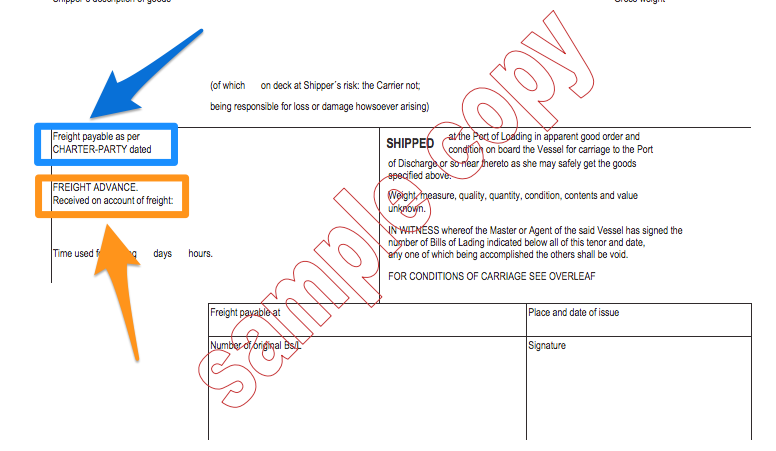
5. Freight Prepaid: There are usually one of these two statements regarding freight that would be bill of ladings. “Freight Prepaid” or “Freight payable as per terms and conditions of relevant charter party”. Clause “freight prepaid” implies that carrier has already received the freight. Master must never sign bill of ladings with the clause “freight prepaid” without express permission from the shipowners. This is because of obvious reason that if the freight is not paid yet, you do not want to sign a legal document that states otherwise.
3. Dealing with Illegal requests
A Master in his career can come across number of different kind of pressures to sign a bill of lading that he is not suppose to sign. I personally have come across to some of these. Let us see what these requests can be
1) Request to sign bill of lading with ship shore quantity difference.
Terminal may request master to sign bill of lading showing more loaded quantity than ship’s figure. The terminal may ask the master to issue letter of protest for discrepancies in quantities and sign the bill of ladings. The master may find himself under pressure for delays and terminal manager may on board with a letter of protest stating all delays will be on ship’s account. Another one, terminal demanding the vessel to leave berth within three hours of completion of cargo. Whatever the case, Master must not come under pressure to sign bill of lading which he thinks he should not sign. Generally, Master can sign bill of lading if the ship shore quantity difference is lesser than 0.3%. If the difference is more than 0.3%, master should request for P&I attendance and must never sign bill of lading unless matter has been sorted out.
2) Request to sign blank or incomplete bill of ladings
In one sentence, the request must be denied. We have discussed earlier in this blog , the possible reasons for this request. In most cases the reason for this request is insufficient data due to EDP. Master should inform the owners and charterers if any such bill of lading is presented to him for signing.
3) Request to issue clean bill of lading
Shipper may request the master to issue clean bill of lading with a logic that clean bill of lading is required for letter of credit from the bank. Though true, but that is a problem shipper has to deal with and master must only sign the bill of lading which describes the actual condition of the cargo. Shipper may propose to indemnify master and owners of any consequences because of it. Master must resist from any of such pressures as there are huge risks involved in this. It does not matter if any indemnity letter was issued to master. If master issues a clean bill of lading despite inaccuracies, it will be assumed that cargo was loaded in apparent good condition. Owners would have little to defend for any cargo claims arising because of inaccurate bill of lading if clean bill of lading was issued by the master.
4) Request to retain an original bill of lading on board
Shipper may request to keep one or more than one original bill of lading on board and carry same to discharge port. Shippers does this to avoid the possibility of original bill of lading not arriving at discharge port before vessel’s arrival. This is particularly the case with short voyage where it is impossible for shipper to provide the original bill of lading at discharge port. Master usually signs three original bill of ladings and few of the non-negotiable copies of bill of ladings. The number of original bill of ladings signed by master is mentioned on each bill of ladings, usually on the bottom of front cover. None of these original bill of ladings can be carried on board to discharge port.
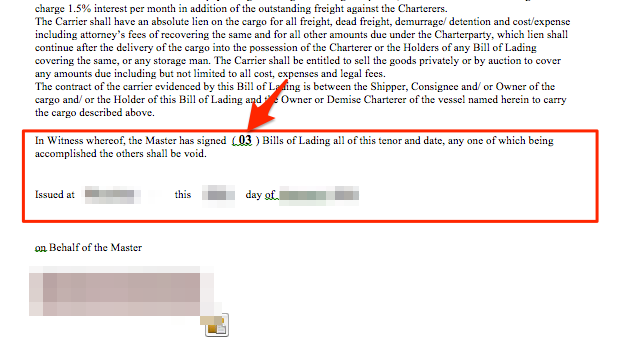
If requested by shipper, Master must deny any such request as their are risks involved with this. The main risk involved is the change of ownership of the cargo while the vessel is enroute. If there has been change of title of the cargo, this would reflect on the two bill of ladings but not on the bill of lading carried by th master onboard. So the bill of lading carried by the master may not be showing correct details to whom the cargo belongs. The ship owner will have absolutely no defense in wrongful delivery of the cargo in this case.
5) Request to discharge cargo at different destination to that in bill of lading
If a request is made to proceed to a port different than that mentioned in bill of lading, master must inform the ship owners. Apart from that he must proceed only when ship owners have safeguarded their interest. There are two risks involved in such a request. first, one of the original being presented at port of discharge stated in bill of lading. Second, claim for deviation to another port. Ship owners has the arrangements to deal with such requests, such as they can ask the shipper to re-issue the bill of lading after destroying the previous one. Whatever the arrangements,
6) Request to discharge the cargo without production of original bill of lading
The practice of discharging the cargo against a LOI (Letter of indemnity) is so common specially in tanker trade that this can trick masters. Masters must ensure that direct request from charterers/shipper to discharge the cargo against such LOI should not be considered. Master must receive such instructions from the ship owners. If vessel is on time charter, charterer would receive the LOI from shipper or sub charterer and instruct master to discharge the cargo. These instructions might look something like this
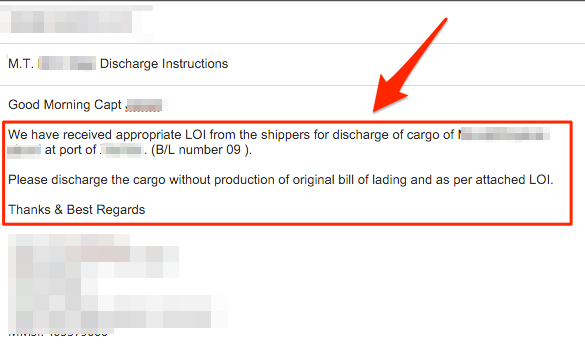
In these cases, sometimes owners need LOI in their own format. Also such LOI from shipper or sub-charterer is indemnifying the charterers but not the owners. Owners are not under any contractual obligations with sub-charterers and such LOI might not be enough to protect owner’s interest. So in this case owners might need a separate LOI in their format from the charterers (time) of the vessel.
Incoterms: Guide of everything you want to know about
Incoterms is the short form for International Commercial terms. These terms relates to the sales contract and are used worldwide. INCOTERMS were first introduced in 1936 by International chamber of Commerce (ICC). These Incoterms were revised several times, latest being Incoterms 2010.
Why do we need INCOTERMS ?
A cargo may move several days before it arrives at its destination. Even though shipping is safer these days, many cargoes still do not reach their destination or reach in bad shape. And when that happens, one should know who had the title of the goods lost. For that reason, It is important for buyer and seller to pre-define the responsibilities and obligations for transport of the goods. INCOTERMS are all the possible ways of distributing responsibilities and obligations between two parties.
These responsibilities and obligations include
- Point of delivery: Incoterms defines the point of delivery of the goods by seller to buyer. The meaning of delivery here is”transfer of risk and responsibility”. So the INCOTERMS defines the point of change of hands (passing of risk) from seller to buyer.
- Transportation Costs: Incoterms defines which party pays for the transportation cost. There may be more than one means of transportation and INCOTERMS defines who pays for which leg of the transportation. In case of sea transport, it also means which party will act as shipper of the cargo.
- Export and import formalities: Incoterms outlines which party arranges for export and import formalities.
- Insurance costs: Incoterms outlines who bears the insurance costs.
There are few important points that requires highlighting before we move any further.
- Arranging for the main transport does not mean the risk is with the arranging party. Seller may arrange for the main transportation even when the consignment is already delivered (that is risk has passed to buyer). In this case the risk has passed to the buyer and seller is just acting as the shipper without any risk to him.
- Arranging for the insurance does not mean that risk is with the party arranging the insurance. In few of the INCOTERMS, seller arranges for insurance to cover buyer’s risk. In these cases, seller is only required to cover minimum risk as defined in the minimum risk clause in respective incoterm. Buyer must take more insurance to cover any extra risk that he wishes to insure against.
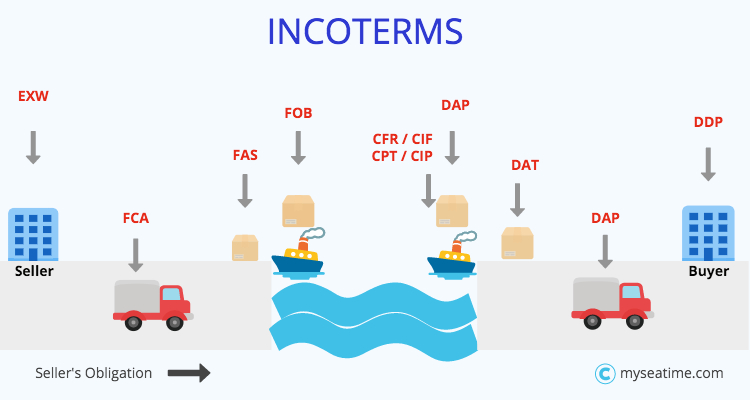
There are total 11 INCOTERMS defined by the ICC . The 11 INCOTERMS are based upon the consideration of least responsibility of the seller to least responsibility of the buyer. For example INCOTERM EXW (ex-work) considers least responsibilty for the seller. Same way INCOTERM DDP (Delievered duty paid) considers least responsibility for the buyer. We can say that all other nine INCOTERMS lies between these two extremes.
One last thing before we take the incoterms head on. Lets differentiate and group together each Incoterm. First on the basis of mode of transport that they are used and second based upon the point of delivery.
Incoterms Based upon the Mode of transport.

The first group includes seven incoterms which can be used in any mode of transport. These can be used even when there is no sea transport used. Incoterms EXW, FCA, CPT, CIP, DAT, DAP and DDP belongs to this group. The second group includes four incoterms which are used in sea or inland waterways only. This is because in these incoterms the point of delivery and the destination place are both sea ports. Incoterms FAS, FOB, CFR and CIF belongs to this second group.
Incoterms groups based upon point of delivery
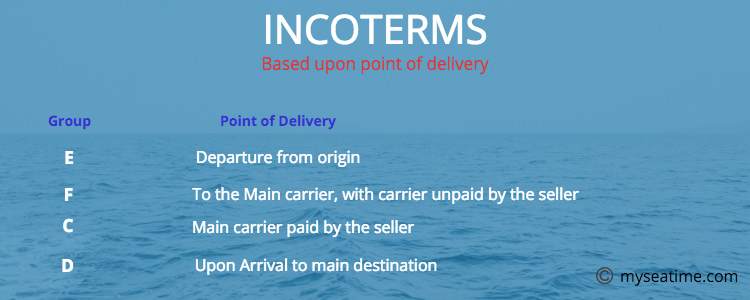
Incoterms can also be grouped together in 4 categories based upon the point of delivery. In group “E” (Ex-works), the delivery point is seller’s premises. In group “F” (FOB, FAS & FCA), the delivery point is before or upto the main carrier, with main carried unpaid by seller. In group “C” (CFR, CIF, CPT & CIP), the delivery point is upto and beyond the main carrier with carrier paid by seller. And finally in group “D” (DAP, DAT & DDP), the delivery point is the final destination.
Now that we are clear on some of the important points, lets jump into each of the incoterm.
1. EXW (Ex-Works):
Mode of transport: Multimodal
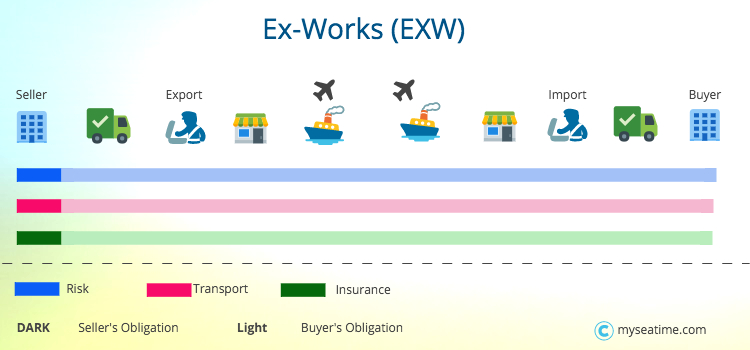
With Ex-works the seller has the least responsibility. Seller has the responsibility to deliver the goods to the buyer at seller’s premises, depot or any other agreed places. From there on, all responsibility and risks are with the buyer. It means,
- The delivery point is seller’s premises
- buyer pays for the export from seller’s premises and import into the destination.
- buyer arranges for all modes of transport .
- Buyer pays for the insurance
Ex-works is often used while making quoting initial prices for sale contracts. In practice, this incoterm can have practical difficulties specially in cross border assignments. These difficulties may include buyer’s inability to arrange for export formalities.
2. Delivered duty paid (DDP):
Mode of transport: Multimodal
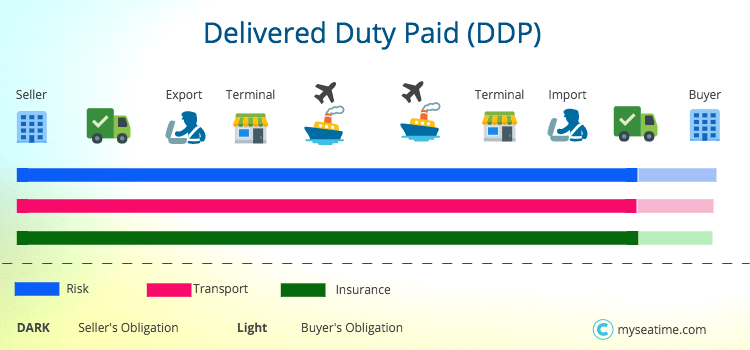
Delivered duty paid is just the opposite of Ex-works. Seller has the most responsibility. Seller has the responsibility to deliver the goods at buyer’s premises, depot or any other place as agreed. It means that from seller’s premises to buyer’s premises or any other agreed place
- The delivery point is buyer’s premises or other place agreed.
- Seller handles the cargo and pays for export as well as import dues and
- Seller arranges the transport of the cargo. Which also means that in case of sea transport, seller will be the shipper of the goods.
- Seller pays for the insurance.
As in Ex-works, DDP can also have practical difficulties in cross border assignments. In DDP, seller is responsible to clear the import formalities but the seller may not have the local knowledge & expertise to clear import formalities.
3. Free Carrier (FCA):
Mode of transport: Multimodal

Free carrier means the delivery point is carrier or other person nominated by the buyer at the seller’s premises or other agreed place. If the agreed place is seller’s premises, delivery takes place when the goods load on the truck. If the agreed place is not seller’s premises then the delivery takes place when truck arrives at this place and is ready for unloading. In Free carrier (FCA),
- The delivery point is seller’s premises or any other place agreed.
- buyer pays for the export from seller’s premises and import into the destination.
- buyer arranges for all modes of transport
In FCA incoterm, the agreed place has implications on the loading of the carrier. If the agreed place is seller’s premises then seller handles the loading. If the agreed place is other than seller’s premises, then seller has delivered the goods once the carrier arrives at the agreed place.
“FCA seller’s premises” might look similar to Ex-works but there is one main difference. In FCA, seller has the obligation to load the goods on the carrier.
4. Free Onboard (FOB):
Mode of transport: Sea
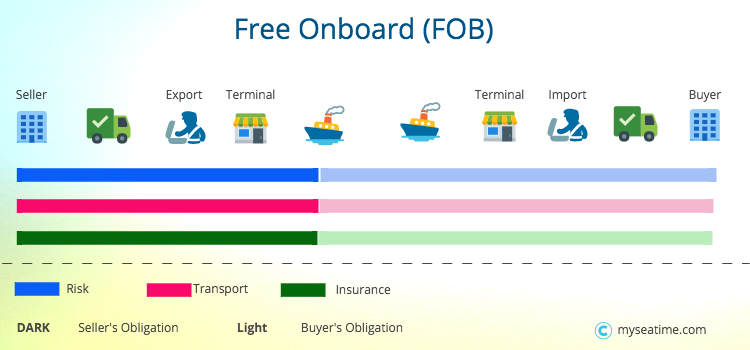
Free onboard means the seller delivers the shipment to the carrier nominated by the buyer. There is only a slight difference between FCA and FOB. One difference is the mode of transport. While FCA is applicable for multimodal transport, FOB is used only for sea transport. In FOB, the seller passes the risk to the buyer when shipment crosses ship’s rail. In FCA, the seller has the obligation to load the shipment on to the carrier arranged by buyer which is prior to the main carrier.
5. Cost and Freight (CFR)
Mode of transport: Sea
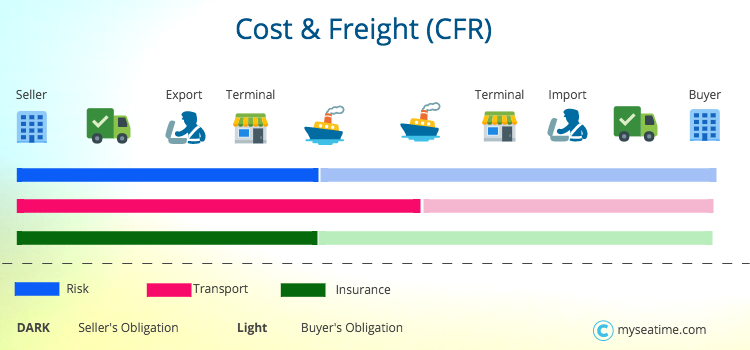
By cost and freight, it means while seller bears cost and freight of shipment to the destination but the risk is with the buyer. And that is also the main difference between CFR and FOB incoterms. In FOB, seller delivers the shipment and passes the risk to buyer when shipment crosses ship’s rail. But, in CFR, he also pays for the costs and freight until the shipment reaches to the destination. This was exactly the point discussed earlier. Arranging for the transport does not mean that the risk is with the party arranging the transport. In this case, seller arranges the main transport (Seller is the shipper), but he has already delivered the shipment or passed the risk to the buyer upon shipment crossing th ship’s rail.
6. Cost , Insurance and Freight (CIF)
Mode of transport: Sea
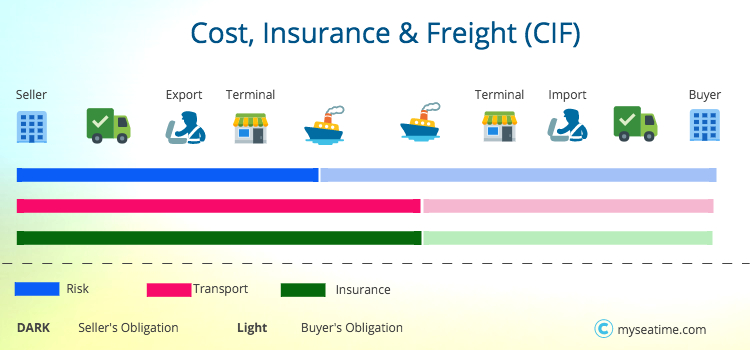
There is only one but obvious difference between CFR and CIF and that is addition of Insurance. Seller passes the risk to the buyer when the shipment is loaded on the carrier. But the seller also arranges for the main carrier (Seller is the shipper). Apart from that seller also pays for the insurance for covering the buyer’s risk during carriage of the shipment. As seller would be paying to cover the buyer’s risk, he would offcourse wish to have least insurance just to cover his obligations. Buyer must take this into account and take extra insurance if he wish to.
7. Free Alongside Ship (FAS)
Mode of transport: Sea
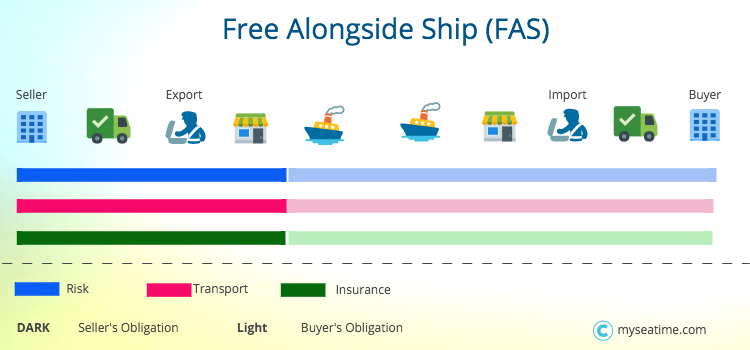
As simple as it sounds. The seller delivers the shipment to buyer when the goods are alongside ship. Risk passes from seller to buyer when the good are brought alongside the ship. Buyer arranges for the main carrier (Buyer is the shipper). Buyer pays for the all the insurance after this point.
8. Carriage paid to (CPT)
Mode of transport: Multimodal
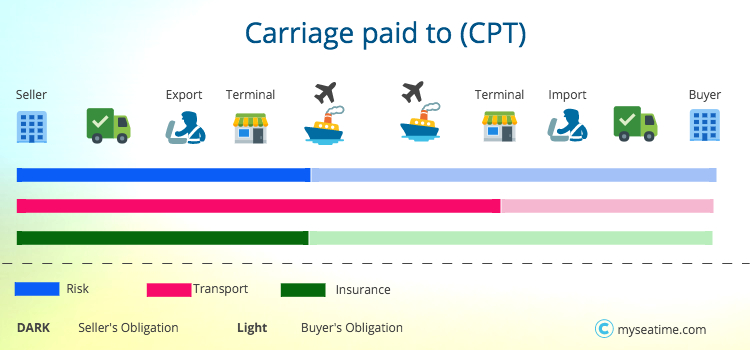
Seller pays for the main carriage to bring the shipment at agreed place. However the seller passes the risk to the buyer upon delivery to the main carrier. This is the point that we highlighted earlier. “Arranging for the main transport does not mean the risk is with the arranging party”. Here even when the seller arranges for the main carrier, risk has already passed to the buyer.
Buyer also arranges for the insurance from the point of delivery.
9. Carriage and insurance paid (CIP)
Mode of transport: Multimodal
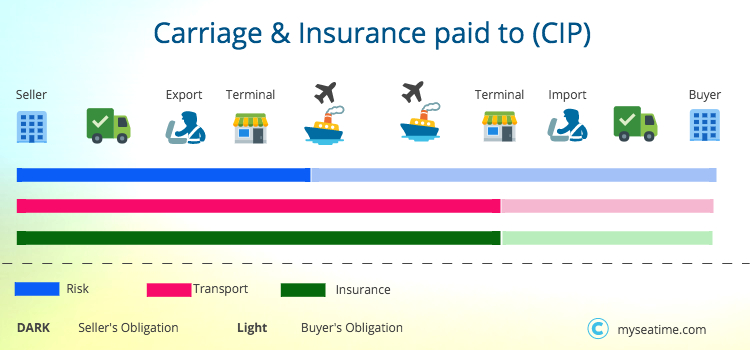
In CIP, Seller delivers the goods and passes the risk to the buyer upon delivery to the main carrier. Seller arranges and pays for the main carrier (Seller is the shipper) to bring the shipment at agreed place. Seller also arranges for insurance on behalf of buyer to cover buyer’s risk. The main difference between CPT and CIP is that the insurance is also paid by the seller. Again this point was highlighted earlier. “arranging for the insurance does not mean that risk is with the party arranging the insurance”. Here Seller pays for the insurance but the risk is not with him. Seller arranges for the insurance to cover buyer’s risk. CIP requires seller to arrange for insurance equals to 110% of the cargo value under minimum insurance claim. Buyer must insure himself against any additional risk he thinks need insuring against.
10. Delivered at place (DAP)
Mode of transport: Multimodal
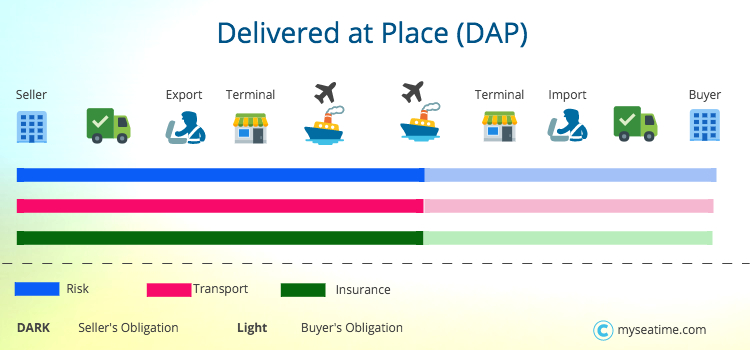
DAP means seller delievers when shipment arrives at final destination, ready for unloading from the arriving mode of transport. Seller bears all the costs and risks in bringing the goods to this place.
1) Seller handles export fees, carriage, insurance and destination port charges.
2) Buyer handles import fees and unloading of goods.
11. Delivered at terminal (DAT)
Mode of transport: Multimodal
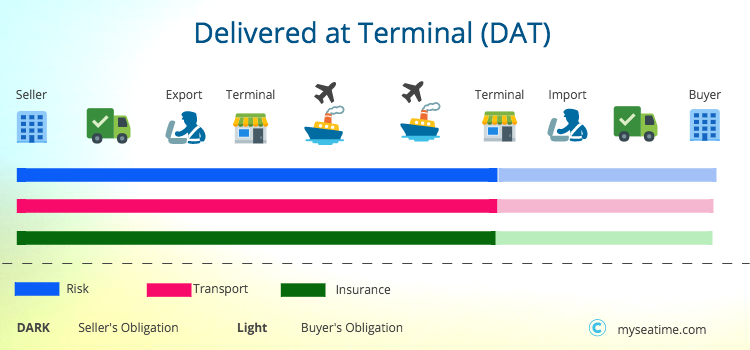
Seller delivers the shipment and passes the risk to the buyer when shipment is put at the disposal of buyer at the terminal of final destination. Seller handles export fees, carriage, insurance, destination port charges and unloading of the goods. The main difference between DAT and DAP is that in DAT, seller handles the final unloading of the goods.
Common Mistakes in using Incoterms
1) Failure to include the precise place alongwith the destination.
The use of Incoterms need to specify the precise place. For example FCA Durban does not specify the precise location as Durban is a broad area. Incoterm must mention the exact location in Durban. For example, FCA Durban berth no 42.
2) Use of DDP incoterm without considering if the seller has the knowledge and expertise or if local regulations allows him to clear import formalities in buyer’s country.
3) Use of EXW incoterm without considering if the buyer has the knowledge and expertise or if local regulations allows him to clear export formalities in seller’s country.
4) Using “sea or inland waterways” incoterms for containerized goods. These four incoterms which are used for sea and inland waterways are not meant for containerized goods. These are actually meant for bulk cargoes and non- containerized goods. Use of these incoterms for containerized goods can put exporters at undue risk as the goods may have to wait several days before despatch.
If you are still in doubt as to which Incoterm you should use where, here is a useful tool you should check. The tool was created by The Belgian foreign trade agency in collaboration with Always consult.
Are your emergency & GMDSS batteries in good shape ?

Emergency batteries as well as GMDSS batteries onboard serve an important function. During a black out, emergency generator need some power source to start automatically.
Emergency batteries acts as the source for thi required power to the emergency generator. If the emergency batteries are week, emergency generator may not start in auto mode.
We would then need to start the emergency generator manually from emergency generator room. This can take away vital time which may result in disastrous situations.
There are many ships where on load testing the emergency generator require black out of ESB.
If so, We should carry out this load test atleast every 3 months. The procedure to load test the emergency generator will be to disconnect ESB from main switchboard and then observing if emergency generator starts automatically.
If it doesn’t start, among other things we should also check the condition of batteries.
There are battery tests that the seafarer responsible for batteries must know. Regular testing of the emergency generator should also include tests to ensure if batteries can supply power to start emergency generator.
This goes for GMDSS batteries too. As per SOLAS GMDSS batteries should provide power to operate GMDSS for
- 1 hour in case GMDSS has the power from emergency generators
- 6 hours in case GMDSS does not have the power from emergency generators.
Now how do we test the GMDSS batteries to be sure that these won’t die down before the required time. Some of us confuse this test with the On load/Off load daily test of the batteries.
They argue that we need to switch off the AC power to GMDSS and operate the GMDSS for 1 hour (or 6 hours) . But this is not correct.
Yard provides the specifications of the required batteries during delivery of the vessel. If we have renewed the batteries with same specifications, we can be sure that the batteries would last for the required period.
Of course this would not be the case if the capacity of the batteries has reduced during the life of the batteries. To be sure that the capacity of the GMDSS batteries is OK, a capacity test is performed every year.
This is important test which ensures that in emergency your GMDSS batteries would last up to the required time.
Wishing you all fair winds following seas
Pilot Ladders: First sign of vessel’s safety standards ?
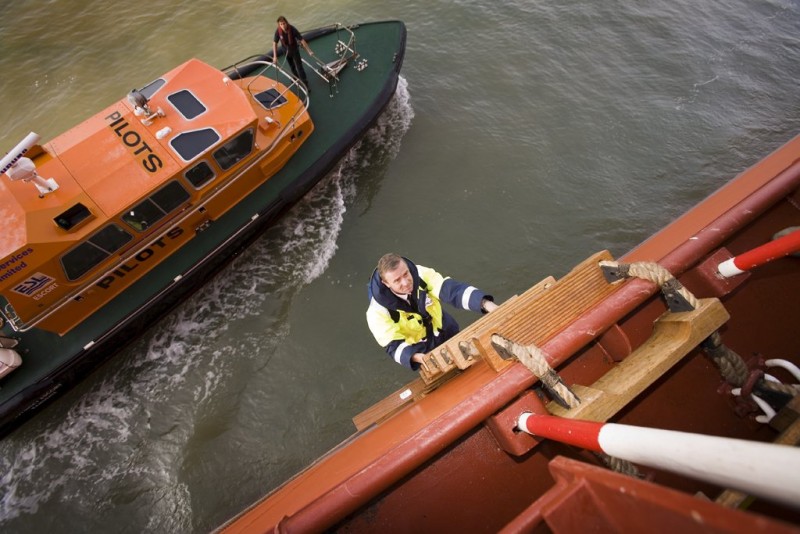
Shipping is changing drastically and not all changes are liked by shipowners, ship managers, and seafarers.
But if there was one change that is being welcomed by all is this…
Shipping industry now takes every personal injury or death very seriously.
For tanker operators, the oil Majors even require a death onboard any of their vessels to be reported to them.
We have to consider this change as a welcome change.
The KPI for Personal injuries and deaths need to be set to zero, an absolute zero.
But one area where we keep hearing about the loss of life or injuries for that related to embarking and disembarking of pilots.
We need to bring these to zero as well.
But that won’t happen just by thinking about it.
Pilot embarkation & disembarkation is a very routine but risky operation.
We keep hearing the tragic news of the death of pilots while embarking and disembarking from the ships.
All of these accidents are avoidable.
So what we, seafarers can do to avoid these accidents?
Well, we can ensure that the boarding arrangements are adequate and safe for pilot embarkation and disembarkation.
Let us discuss how it is done.
Pilot ladder requirement
The principle requirement for the pilot ladders is governed by Regulation 23, chapter V of the SOLAS.
There are few other references that talk about the construction of pilot ladders.
But if we need to bring the accidents due to pilot ladders to zero, we need to address three things.
- We need to ensure that pilot ladders onboard are made of the required material and as per the guidelines
- We need to make sure that the pilot ladders are maintained properly
- We need to make sure that the pilot ladders are used or rigged correctly
Let us understand each of these points in more detail.
Requirements for the construction
The first requirement is that the pilot ladder need to be certified by the manufacturer.
This means that the pilot ladder now no more can be made by the ship staff.
These need to be supplied and the manufacturer need to certify these to be complying with the SOLAS.
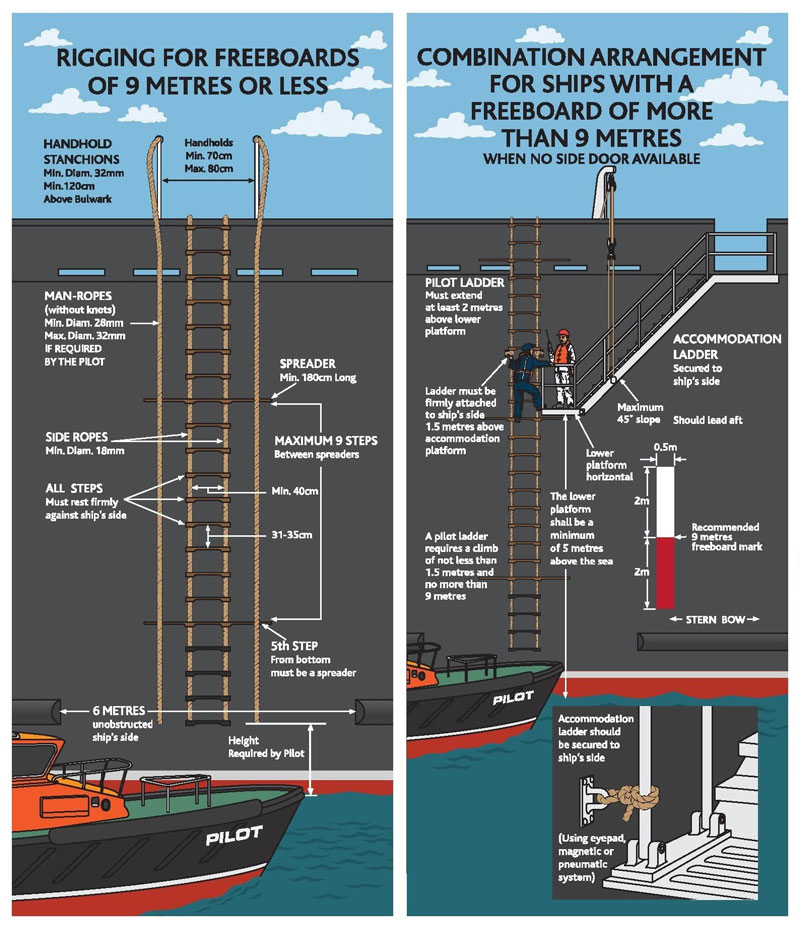
Then there are requirements for
- The step of the pilot ladder
- Location of the Spreader
- Ropes used in the making of the pilot ladder
- Side ropes
- The distance between each step
All these requirements are clearly defined in the IMPAHQ poster that all the vessels are required to have on the bridge.
Requirements for the maintenance of Pilot ladders
As per SOLAS ch V/Reg 23, all pilot ladders used for pilot transfer shall be clearly identified with a tag or other permanent marking.
The marking is required for the identification of the pilot ladder.
The marking could be by attaching a piece of canvas and stenciling the number on it.
But the best way of marking is by use of a scafftag.
Other SOLAS requirement is that the appliances shall be kept clean, properly maintained and regularly inspected.
The inspection of pilot ladders needs to be done as per the PMS routine of the company.
But what do we mean by properly maintained and what can we do to ensure that pilot ladder is appropriate for the use?
1. Ropes
The first thing that needs to be checked is the condition of ropes.
Most of the pilot ladder incident that occurs is usually because of the parting of either the ladder rope or the side ropes.
Why do these rope part and what can be done to avoid this?
Use of Manila rope is one of the requirements for pilot ladders.
There is a reason for this requirement.
Manila rope has an absorbing quality which ensures that the rope is always non-slippery.
That makes it the first choice for the purposes like stage rigging and use in the making of pilot ladders.
But this quality is also a concern when it comes to absorbing seawater and sunlight which may harden it or rot it over a longer period of exposure.
This can sometimes trick a seaman.
A manila rope which might look in excellent condition but which has been exposed to sunlight, sea water or even chemicals might have lost its internal strength.
Negligence of the seafarers to inspect and discard any obvious damaged rope and pilot ladder is one thing.
But a bad rope with the excellent visual condition can also be the cause of pilot ladder ropes giving way.
The best way to avoid degrading of the pilot ladder rope is to minimize its exposure to seawater, sunlight, and chemicals by securing it nicely when not required.
However considering that the visual inspection of manila ropes used in the pilot ladder can sometimes give a false indication of its condition & strength, I am personally of the opinion that pilot ladder should be changed with a new one after a fixed interval of time, irrespective of its condition.
2. Steps
At an interval required as per the PMS of the ship, the pilot ladder should be opened up and laid on the deck.
The close inspection of each of the pilot ladder steps must be made to identify any steps that show the early signs of cracking.
Apart from that, each step must be secured firmly and should be straight and not inclined towards any side.
Requirements for use of pilot ladders
A good and well-maintained equipment is good as long as it is used correctly.
The pilot ladder needs to be rigged correctly for it to be considered safe.
And the first thing that needs to be considered is the location of the pilot ladder deployment area.
As per SOLAS, the area needs to be
- clear of possible discharges of the ship (for example scupper plus).
- within the parallel body length of the ship and as far as practicable, within the midship half length of the ship
- Each step must rest firmly against the ship’s side.
The second consideration is how the pilot ladder is secured to the ship.
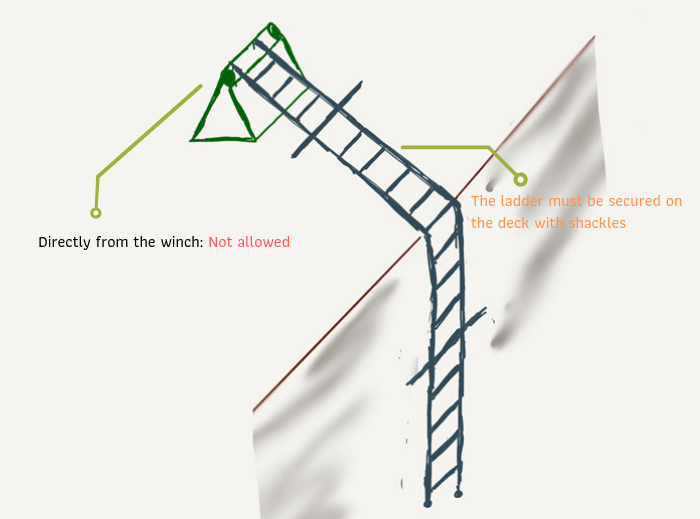
If the pilot ladder is stored on a winch, the pilot ladder must not be hanging from the winch. This must be secured on the deck with the shackles.
When the freeboard of the ship is more than 9 meters, we are required to use the combination arrangement for pilot embarking.
In this case, the pilot ladder and man-ropes need to be secured at a point about 1.5 meters above the bottom platform of the accommodation ladder.
This is usually achieved by attaching portable magnets the ship’s side and securing the pilot ladder to these magnets.
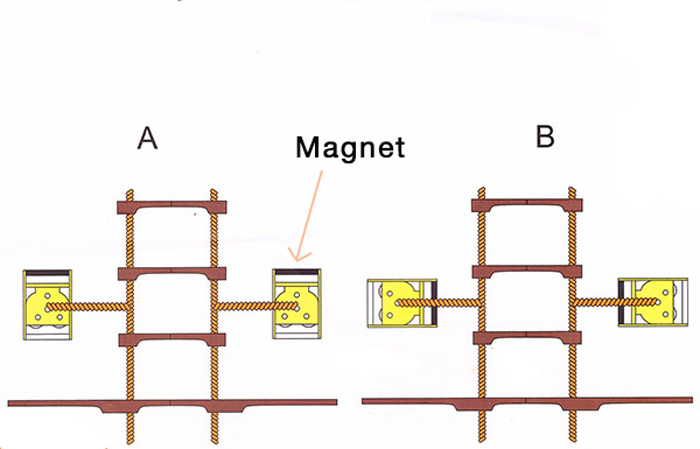
There are a few other points that we need to be aware of while securing the pilot ladder.
If the pilot ladder is secured at its ends (the thimble at the end of the pilot ladder rope), it can be secured with the appropriate shackles.
However if Pilot ladder needs to be secured at the intermediate length, it need to be secured with rolling hitch knot.
 Use of shackles for securing the ladder at intermediate length is a big no-no and dangerous.
The crew must check that the pilot ladder step is not resting on the fish plate. This can snap down once someone puts his weight on the pilot ladder.
In fact, any of the pilot ladder steps must not be resting on any of the ship’s structure.
The pilot would be lucky if he gets warning for inappropriate securing of the pilot ladder after climbing for a few steps.
There have been incidents where the pilot ladder step snapped down and the pilot fell from a considerable height.
Access to deck
Once the pilot boards the ship the area where he would keep his first few steps need to be clear.
IMO Resolution A. 1045(27) gives the dimension of this area that needs to be kept clear of any obstructions.
The dimensions of the are that need to be kept clear are
- 915mm in length measured longitudinally along ship’s length
- 915mm in width measured inward from the ship’s side
- 2200mm in height measured from the main deck
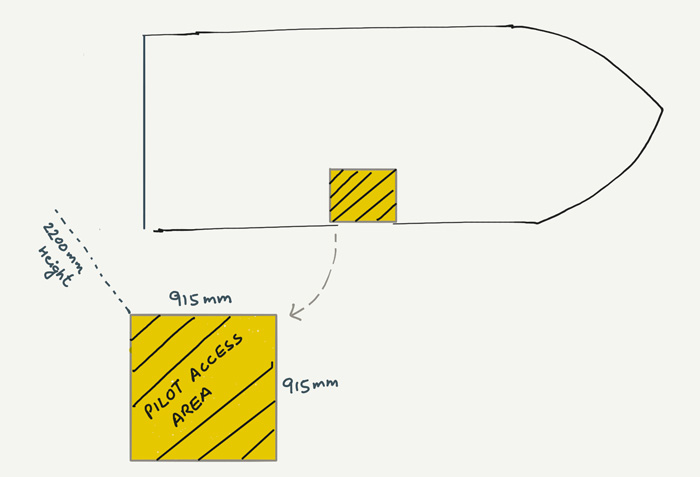
As a good practice this area is marked on the deck on each side of the ship.
Conclusion
In layman’s mind, the embarking and disembarking of pilot would be a routine and non-risky task.
But the number of accidents during this operation points otherwise.
All these incidents can be avoided by having a set of best practices related to use of pilot ladders.
Pilot ladders onboard should be of correct specification and ship staff should have certificates for the pilot ladders onboard.
Pilot ladders should be secured when not in use.
Exposure to sunlight and seawater should be minimised as far as possible. On longer voyages, the pilot ladder should be kept under shelter such as in deck store.
The condition of ladder ropes, steps as well as other fittings should be checked at least monthly and before use.
How does hedging in Crude Oil by an Oil and Gas Company take place ?
What is Hedging: As per the business directory, Hedging is a risk management strategy used in limiting or offsetting probability of loss from fluctuations in the prices of commodities, currencies, or securities. In effect, hedging is a transfer of risk without buying insurance policies. Hedging is done by the various risk derivatives. To understand this, it is important to first understand the basics of risk derivatives.
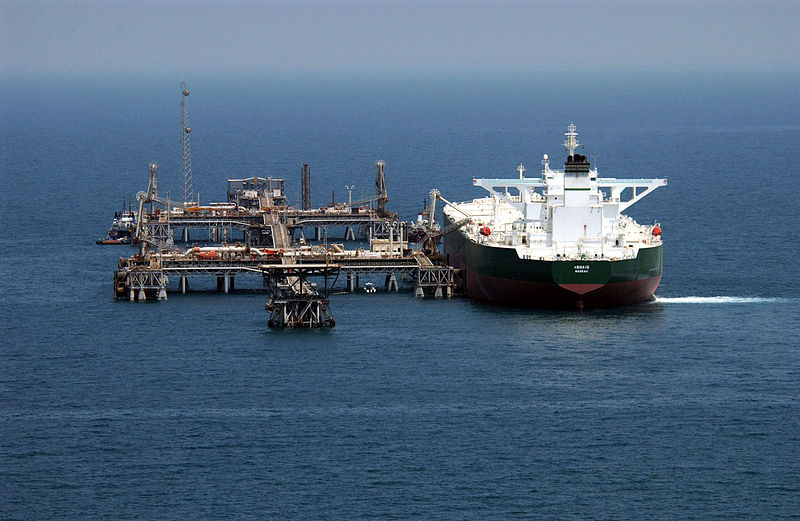
Broadly speaking there are two types of risk derivatives. Exchange traded and over the counter derivatives. As the name suggests, exchange traded derivatives are traded in the international exchanges (for example New York Mercantile exchange, NYMEX), where standard contracts, terms of which have been defined by the exchange are traded.
Over the counter (OTC) derivatives are traded through dealers and the contracts are tailor made. OTC derivatives come with the risk of other party not fulfilling his obligations.
In the trade exchange, future contracts and Options contract derivative are normally traded and Oil/gas companies choose these two hedging contracts.

To understand these hedging techniques, assume that I am oil/gas Production Company and I am producing 100000 barrels in a month. Today’s crude oil price is $80/barrel. I am afraid that by next month , when I will have inventory of around 100000 barrels, the crude oil price may fall to below $75/Barrel, and I might make a loss of $500000 compared with today’s crude oil price. Lets see how I can use hedging to reduce this loss.
1. Future and Forward contracts:
(The fundamental difference between future and forward contracts is that one is traded in exchanges while other is traded OTC, here I will discuss Future contracts).
“Future contracts between two parties A & B is a contract where party B has the obligation to deliver a commodity on agreed date and party A has the obligation to pay on same date the price, which is agreed today”.
So in my case I am party B and in a future contract with A today, I agree to deliver 100000 barrels of crude oil on 11th Dec 2014 and party A agrees to pay the listed price for Dec 2014 in the trade exchange (say NYMEX). Let us assume the listed price for Dec 2014 is $81/Barrel. It is important to note that I do not have to actually (physically) deliver the crude oil to party A.
Now in Dec 2014 when I have produced 100000 barrels of crude oil. Lets consider two scenarios
Scenario 1: Crude price drops to $75/barrels as expected by me.
In the Physical market
I sell 100000 barrels of crude oil @ $75/barrel to get $7500000 where as I had expected $8000000 so I incur loss of $500000 in the physical market.
In the Future contract
My obligation is to deliver 100000 barrels of crude oil which in dec 2014 will cost me $7500000 @ $75/barrel. But party A has the obligation to pay me @$81/barrel so total of $8100000. This way in the future contract I make profit of $600000.
Net profit I make is $600000 (Future contract) – $500000 (Physical market) = $100000
So I have hedged the crude oil price with future contract.
Scenario 2: Crude price increase to $82/barrels.
In the Physical market
I sell 100000 barrels of crude oil @ $82/barrel to get $8200000 where as I had expected $8000000 so I have profit of $200000 in the physical market.
In the Future contract
My obligation is to deliver 100000 barrels of crude oil which in Dec 2014 will cost me $8200000 @ $82/barrel. But party A has the obligation to pay me @$81/barrel so total of $8100000. This way in the future contract I make loss of $100000.
Net profit I make is $200000 (Physical market) – $100000 (Future contract) = $100000
So in both case of crude oil price reducing or increasing, I have made more money than I had expected in Nov 2014. With different number, it might also show some loss, even with future contract but the loss will be much lesser than what would have been incurred without hedging.
2. Hedging by OPTIONS Contract
There are two types of options contracts. Call & Put.
The relevant contract for me as Oil/gas production company will be PUT options.
“When I buy PUT options contract from another party (say party A), I have the option to sell my commodity (crude oil in this case) to party A at a particular price but I am not obliged to do so. It is upto me, if I want to exercise my option to sell my commodity to party A. My this right has an expiry date and I can use my option on any date before the expiry”.
Off course I will only exercise my option if the price of the crude oil has decreased and not if the price of crude oil has increased. However to buy this right (option contract) I have to pay a premium to party A.
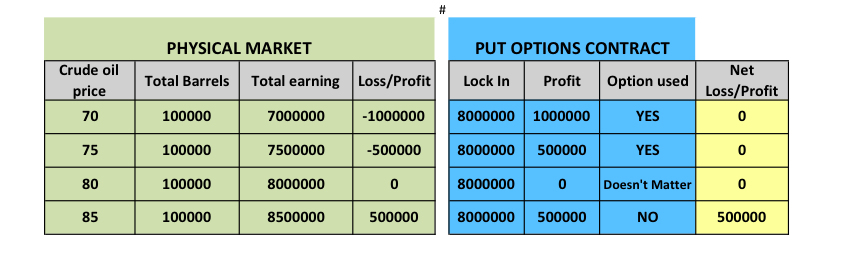
Let us assume that I buy “Put option contract” from party A at lock in price of $80/Barrel for crude oil. Table above shows, how after using “Hedging by Options contract”, I do not incur any loss even when the price of crude oil has fallen from $80 to $70.
Compliance with Loadicator Testing and its records
The requirement of loading instrument for bulk carriers is governed by SOLAS chapter XII, regulation 11. Even though there is no statutory requirement for loading computer onboard other ships, classification societies require all tankers of more than 100 meters to have type approved loading instrument. even otherwise so, Loadicator has rather been a necessity onboard ships. And once we have something onboard, it is duty of ship staff to ensure that it complies with its testing and record keeping procedures.
There are two parts of the question. First relates to the documents and certificates a ship is required to have onboard with respect to loadicators and second the testing requirement of the loadicator.
Documents required for Loadicator
There are three main documents ship should have for it to be actually complying with Loadicator requirements. These are
Class certificate for loadicator: This certificate is issued by the class and gives the details of the loadicator software as well as the hardware on which it is installed, including the details of the Make, model and serial number of the computer. Master and chief officer must ensure that the approved loading computer’s details matches with the details in this certificate. The certificate may even sometimes have the printer’s detail that is connected with the approved loadicator.
If you do not find this certificate onboard, you should check in the class survey status report if the loading computer is included in the list. If yes, the certificate can be asked from the class through your office. If No, then shipping office need to consult ship’s classification society for approval of loading computer.
Class approved Loadicator Manual: This is the user manual of the loadicator which is from the maker of the loadicator software. A class approved copy of the user manual should be onboard. If there was ever a class change associated with the ship, it is important to ensure that approval stamp of the current classification society is endorsed on the manual.
Class approved loadicator test conditions: To be very clear, these are not the conditions in the stability booklet of the ship. The stability conditions in the stability booklet are made by the yard and these are not the print outs from the loadicator software. These are also not the test conditions stamped by the class during annual class surveys. These are usually in the form of a booklet specifically titled “ test conditions for loadicator” with class stamp. These are usually provided during yard delivery of the vessel or after the loadicator is installed for the first time and approved by the class.
Once you have these three documents / certificates, you are OK with the certification part.
Testing requirements for the Loadicator
Testing by ship staff: The Loadicator is required to be tested periodically ( interval to be as per SMS of the vessel) by ship staff for its accuracy. The test procedure includes choosing a text condition from the approved test conditions, entering the exact same data in the loadicator and comparing the results with the approved test conditions. The important point to note is that the data need to be manually entered and not opened from a pre-saved file as it is not acceptable to classification society as well as OCIMF to simply retrieve a stored test condition and comparing it with approved test condition.
Annual testing of Loadicator in presence of Class : During annual class surveys, loadicator need to be tested for its accuracy in presence of a class surveyor. The procedure of testing is same as the quarterly testing but in here the class surveyor would ask for the print out of the test condition and he would stamp it and give it to the ship for ship’s records.
Why do we sometimes have two anchors of different cable lengths onboard ships ?
Ever wondered why do we sometimes have both the anchors of different lengths. It is not very uncommon to notice 10 shackles on one anchor while 11 shackles on other one. All the requirements concerning anchor onboard are formulated in the guidelines issued by International association of international classification (IACS). These requirements include requirements for anchor weight, diameter and steel grade for the stud link of the chain cable and the length of the anchor chain etc.
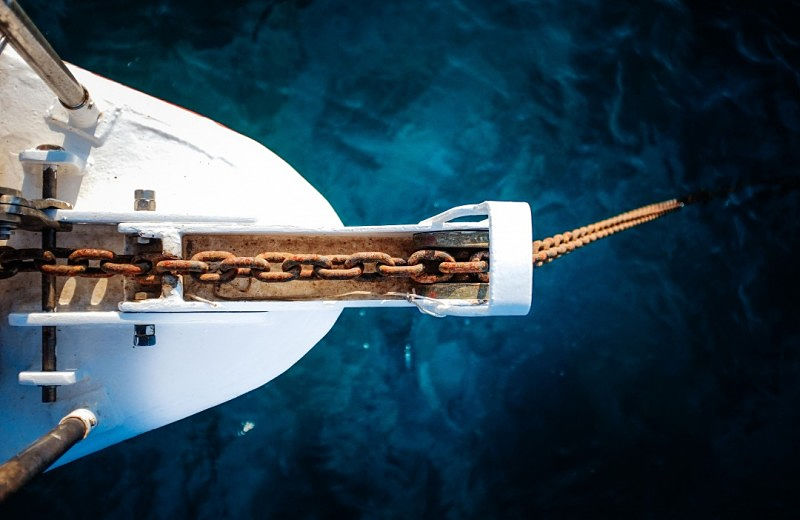
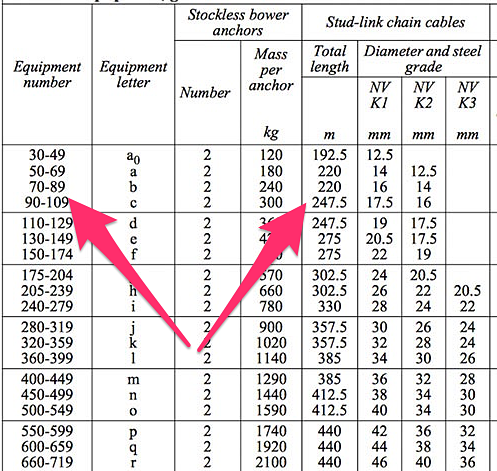
All these requirements are governed by something called “Equipment number”. If you would have seen the anchor certificate generally issued during yard delivery of the vessel, you would find the equipment number on that certificate.
Equipment number is calculated by formula
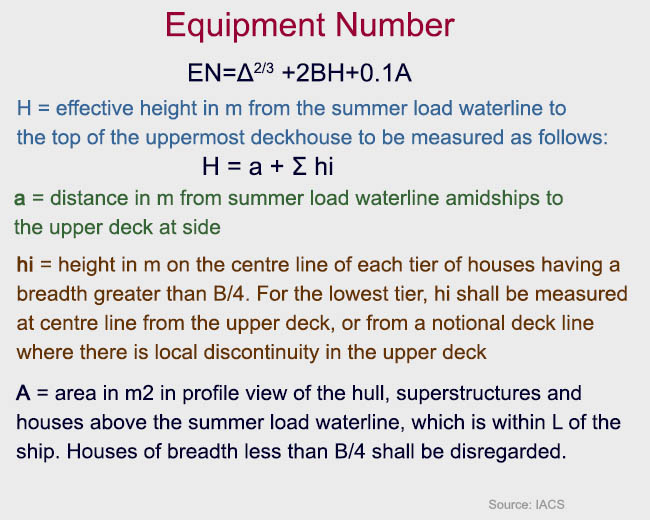
As per the equipment number, the total length of the anchor chain is given. So if say, for a particular equipment number, the minimum length of the cable required is 21 shackles, one side of the anchor is given 10 shackles and the other one 11 shackles. Below is the table that shows how equipment number corresponds to the particulars of the anchors onboard.
Did you find this information useful ? Let your views flow in the comments below. Meanwhile wishing you all fair winds and following seas.
Prevention of disputes on dry bulk Cargo quantities at Discharge Ports
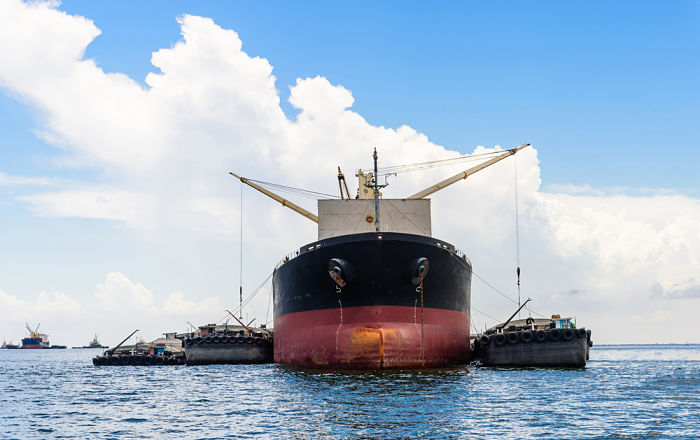
Cargo shortage disputes especially of agriculture products are frequent at discharge Ports. We come across with these cases very often especially when vessel has loaded cargo at load port by shore scale and cargo is discharged at multiple discharge Ports by draft surveys. Ship staff often unaware of discharge conditions at Indian Ports falls prey and this results in cargo shortage claims against vessel/owners.
We shall be able to avoid cargo disputes by following measures:
AT LOAD PORT
Accurate calculation of constant
First step on arrival load port has to be accurate calculation of vessel’s constant. For this accurate draft survey to be carried out.
Vessel must not go by previous constants records. We come across many cases where bunkers have been wrongly declared . Vessel declares constant from its previous record and which finally result in cargo disputes at discharge port.
Density of DW/Hydrometer
Vessel must use accurate & certified hydrometers and carry out exact draft survey calculations to determine cargo quantity loaded.
Shore Scale Loading
Agriculture products are usually loaded at ports like Australia, Canada, Argentina, Brazil by shore scale. Though in Australian ports the shore scales are very accurate but even then shore scale must be compared by vessel’s draft survey.
In case of shortage of cargo from shore scale, draft survey quantity to be mentioned on mates receipt.
In case Clean MR/Bill of lading is to be issued , owners must ask charterers to provide LOI for difference in shore scale and draft survey quantity.
Arranging P&I
P&I attendance must be arranged at load port to ascertain cargo quantity and hatch sealing. There opinion must be taken in case of ship/shore discrepancy of cargo.For example West of England P&I club shall allows for a cargo discrepancy of 0.3% .Different clubs have different regulations in this matter.
Remarks in cargo documents
To safeguard owner’s interests.SOF /MR/BL to be properly remarked at port of loading .LOP to be issued for fumigation.
Multi port discharge
In case of multiple port discharge vessels must issue a protest letter for multiple port discharge stating that vessel shall be responsible for total discharged quantity only. Vessel shall not be responsible for individual port quantities/any overlanding/short landing at any of disport.
Charterers must be asked to issue LOI to owners in this matter.
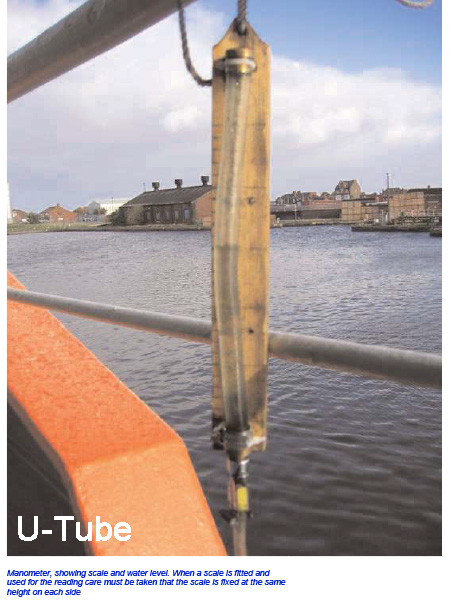
U tubes
U tubes must be used especially at load ports to check accurate drafts.
DURING SAILING
Record of cargo parameters to be carried out. Fumigation precautions to be taken. Ventilation to be carried out based on parameters to avoid cargo damage.
DISCHARGE PORTS
Port Captain Attendance
EDIN Maritime start attending vessels at first discharge port itself till her final discharge port and guide ship staff with our expertise and experience of Indian Ports. We continuously monitor her discharge operations at all discharge ports to ensure that she discharges her nominated quantity at every disport.
Anchorage discharge
Swell conditions- Vessels must fabricate and use wave dampers on board especially at anchorage port in-order to avoid errors in draft survey.
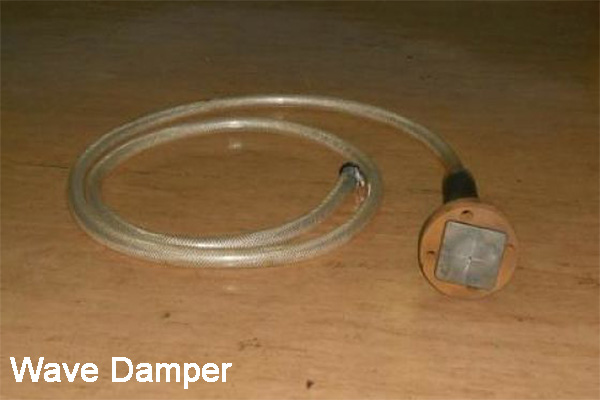
This will assist minimise errors in draft reading. Also vessel should put remarks regarding swell height in draft survey report.
P&I attendance
This to be arranged for draft survey/hatch unsealing.
Frequent draft surveys must be carried out while discharging & care need to be taken to avoid any over-discharging.
Ballast
Ballast must be properly handled at load/discharge ports. A discrepancy in ballast calculation result in cargo discrepancy.
Theft of cargo
Theft of cargo is common in many ports. Ship staff must be vigilant.
Photographic evidence of any cargo spillage must be taken and LOP issued stating that vessel shall not be responsible for any cargo short landing.
Remarks in cargo documents
To safeguard owner’s interests.SOF /MR/BL to be properly remarked at port of loading .
With the above stated precautions, we shall be able to avoid cargo disputes.
EDIN Maritime are experts in taking care of interests of concerned parties .
Why Captain’s cabin is always on starboard side ?
There are many questions in shipping industry which seem to be mysteries of the ancient shipping times with as many theories floating. And one of these question is “Why Captain’s cabin is always on Starboard side?” Here is what I have gathered during my sea career.
Captain’s cabin on the starboard side is a tradition that has been since many years but there has been some exceptions to it where captain’s cabin is on port side. Leaving aside the exceptions, in old days, the starboard side was considered superior to port side in every sense, be it flag etiquettes or two watch system in old days where more experienced staff used to keep watch on starboard side, the starboard side was considered superior to port side. Captain being overall incharge of the ship was considered superior to all the crew onboard and was given superior side of the ship.

In modern days however it is not superiority that is considered for captain cabin to starboard side. Starboard side is give way side in ROR (Rule of the road) and captain is expected to see the traffic on starboard side of his ship just to be aware of the traffic situation where it is his ship’s duty to take action. He can then also monitor if the officer on watch has taken the required action to avoid close quarter situation.
Do you have any other theory or do you agree with this explanation ? Do you have any other such question ? Leave a comment.
Meanwhile wishing you all fair winds and following seas.